AI Job Exposure: Why the Work Matters More Than the Job Title

Maverick Foo
Tuesday, 9th June 2026
Ask most people how exposed their job is to AI and they answer with their job title. The more useful answer sits one level down, in the work the role actually demands. A recent OECD paper gives us a precise way to see this, and the picture is more nuanced than safe versus gone.

What AI Job Exposure Really Measures

The OECD AI exposure measure asks a sharper question than whether AI will replace a given job. It asks how close today’s AI is to the capabilities each job actually demands, scored across nine capability domains: language, social interaction, problem solving, creativity, metacognition, knowledge and learning and memory, vision, manipulation, and robotic intelligence. The result is a Capability Gap. A bigger gap means AI is further from the demands of the work, so exposure is lower. A smaller gap means AI is closer, so exposure is higher. A score of zero means AI already meets the bar. One nuance matters here: the OECD notes that a gap greater than zero means meaningful gaps remain in parts of the role, which leaves room for human-AI collaboration and augmentation rather than wholesale replacement.

The Numbers Reshuffle a lot of Assumptions

Chief executives sit at a capability gap of 11.71. File clerks and data entry keyers sit at 0. Office and administrative support lands at just 0.8, the most exposed group of all.

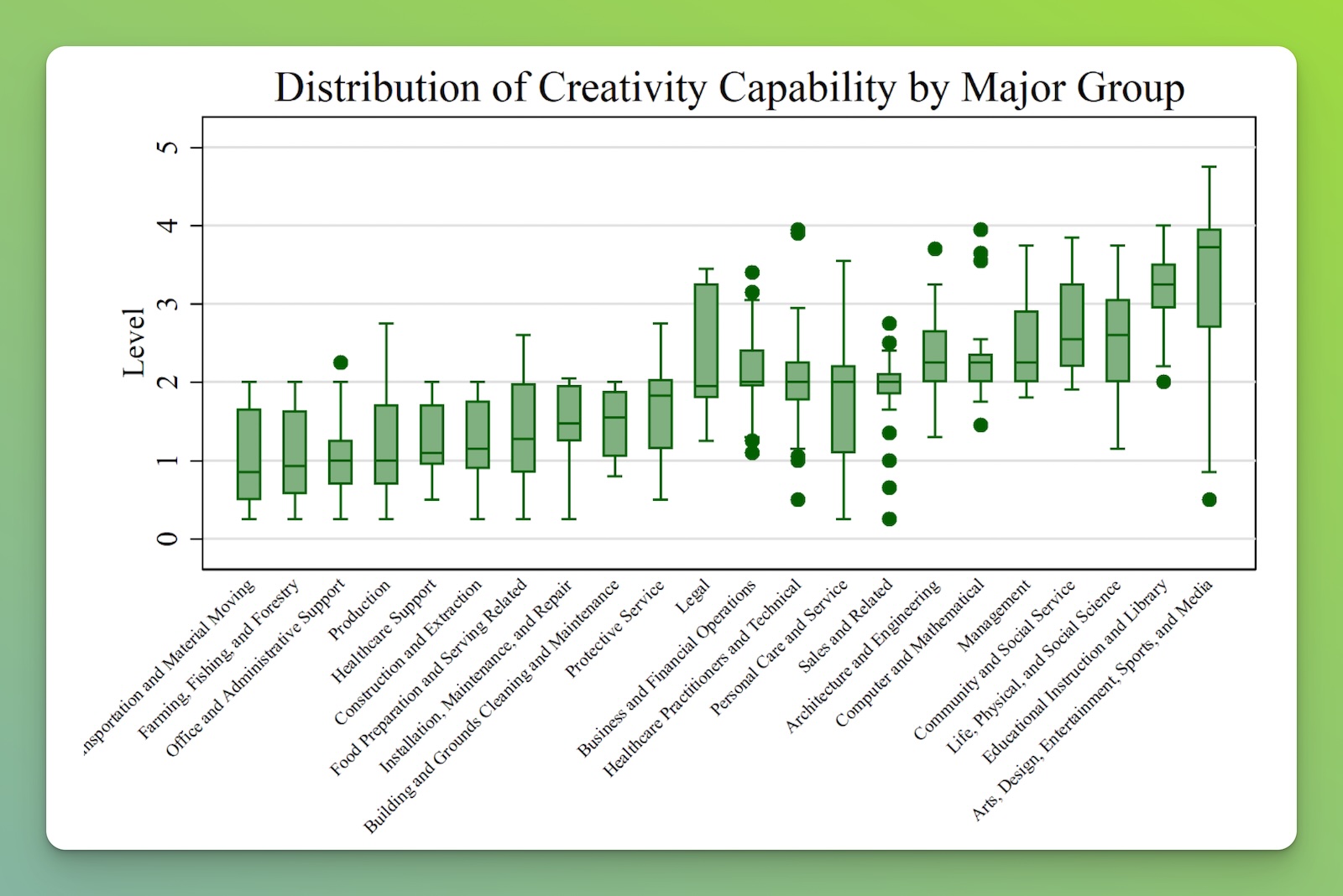
Across occupations, the most exposed groups are office and administrative support (0.8), production (2.0), food preparation (2.5) and sales (2.6). The least exposed are community and social services (6.4), legal (5.8), education (5.8), healthcare practitioners (5.7), protection services (5.6) and management (5.5).

Same workforce, wildly different exposure, driven by the work each role demands more than the label on the door.


Inside the Capabilities

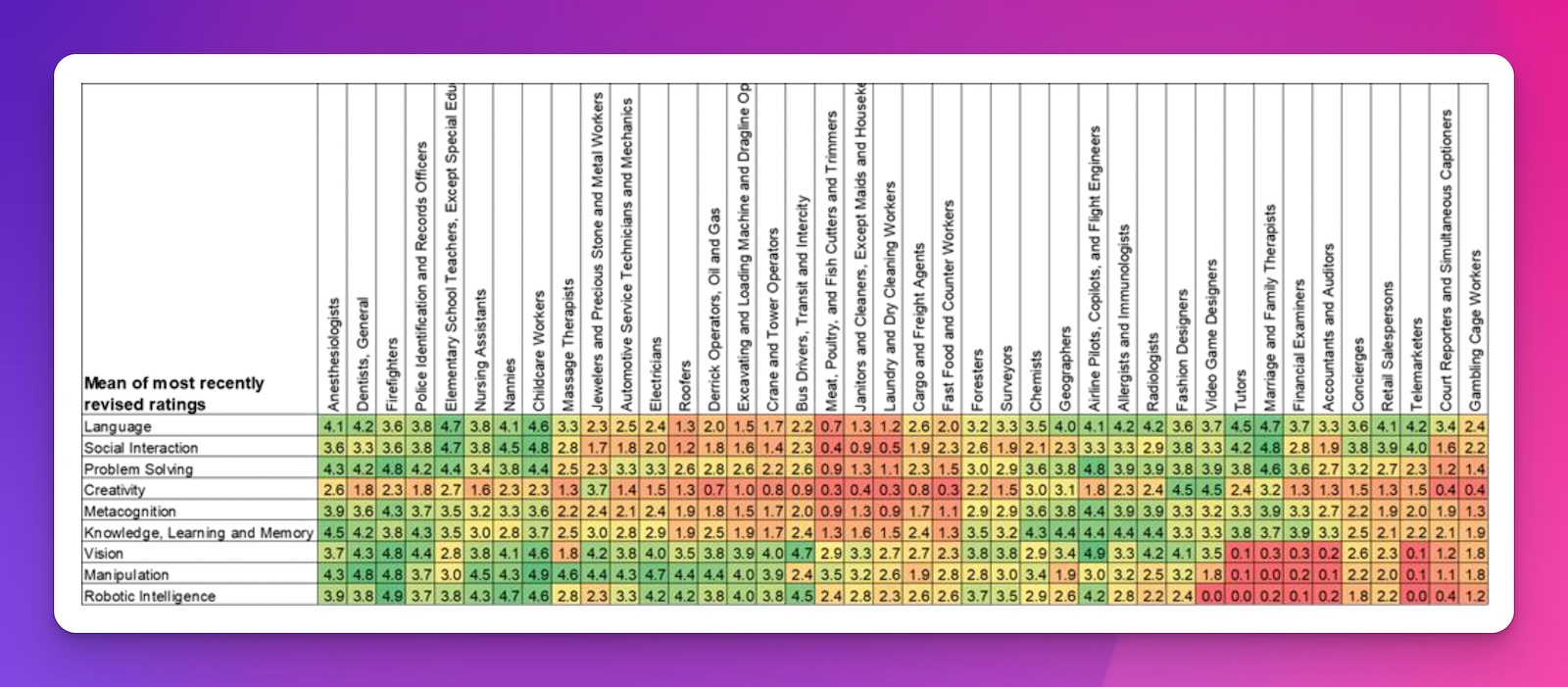
The detail gets sharper at the capability level. AI’s smallest gaps are in creativity (0.1), language (0.4) and knowledge, learning and memory (0.5). The routine cognitive work many of us were trained on is what AI is closest to matching.

Its largest gaps are in social interaction, complex problem solving and metacognition, all at 1.1. The human, judgment-heavy work is where AI is furthest behind.

Creativity is a useful surprise: it shows one of the smallest gaps, partly because exceptional creativity is rarely required across a whole occupation.

Why Job Titles Mislead

Occupations bundle a wide range of activities, and the capability demands within the same role can vary a lot from task to task.

That is why two people with identical titles can carry very different exposure. The

OECD frames its index as a job transformation signal rather than a replacement verdict. Highly exposed roles still contain sub-tasks that need a human, and lower-exposure roles still contain tasks AI can already do.

The paper’s tidy example is the bus driver, whose role today bundles driving, cleaning and handling luggage, tasks that may be unbundled as automation advances.


What This Means for the Work

This is what many leaders miss. They assess AI risk by title, then roll out one blanket training for everyone. The real exposure hides at the task level. Once you can see which kinds of work dominate a role, the strategy starts: you know what to hand to AI, what to protect, and where your people need to get sharper.

The opportunity is to redesign work for human-AI collaboration in the places where the gap is closing fastest.

Implications for Leaders and L&D

  • Map exposure at the task and capability level rather than the job title. Within-role variation is large, so blanket programs miss the real gaps.
  • Rebalance L&D toward the widest human gaps: social interaction, complex problem solving and metacognition. Routine language and knowledge tasks are where AI is closing fastest.
  • Treat a capability gap above zero as a transformation signal, an invitation to redesign workflows for human-AI collaboration.

Try This This Week

  • Pick one role on your team and list its tasks. Mark which lean on language and routine knowledge, where exposure is higher, and which lean on judgment and relationships, where exposure is lower.
  • Run a quick scenario. The OECD’s modelling suggests that if AI cognitive capability rose by one level, management’s gap could fall from 5.5 to around 2.2, so professional and managerial tiers deserve attention now.
  • Map one role against the six modes of work using our AI Momentum Framework, then decide which modes to hand to AI and which to keep with your people.

Ending Thought:

AI job exposure comes from the sum of the work a role demands, measured against what AI can do today, and it shifts as both keep changing. The OECD‘s capability-gap lens gives leaders something more useful than anxiety: a clear map of where AI is catching up, where humans still lead, and where work needs redesigning.

If you would like a clearer map of where AI fits across your team’s work, explore our AI Momentum Framework and see how Radiant Institute builds targeted training around it.

Maverick Foo

Maverick Foo

Lead Consultant, AI-Enabler, Sales & Marketing Strategist

Partnering with L&D & Training Professionals to Infuse AI into their People Development Initiatives 🏅Award-Winning Marketing Strategy Consultant & Trainer 🎙️2X TEDx Keynote Speaker ☕️ Cafe Hopper 🐕 Stray Lover 🐈

0 Comments

Submit a Comment

Your email address will not be published. Required fields are marked *

Share this
Send this to a friend