
The AI Partnership Phases
A practical AI adoption framework that helps organisations move from Clueless to Champion by building AI-Ready capability across workflows.
-
 Work Faster
-
 Think Sharper
-
 Learn Smarter
Most organisations do not have an AI problem.
They have an adoption gap: inconsistent usage, uneven quality, and avoidable risk.
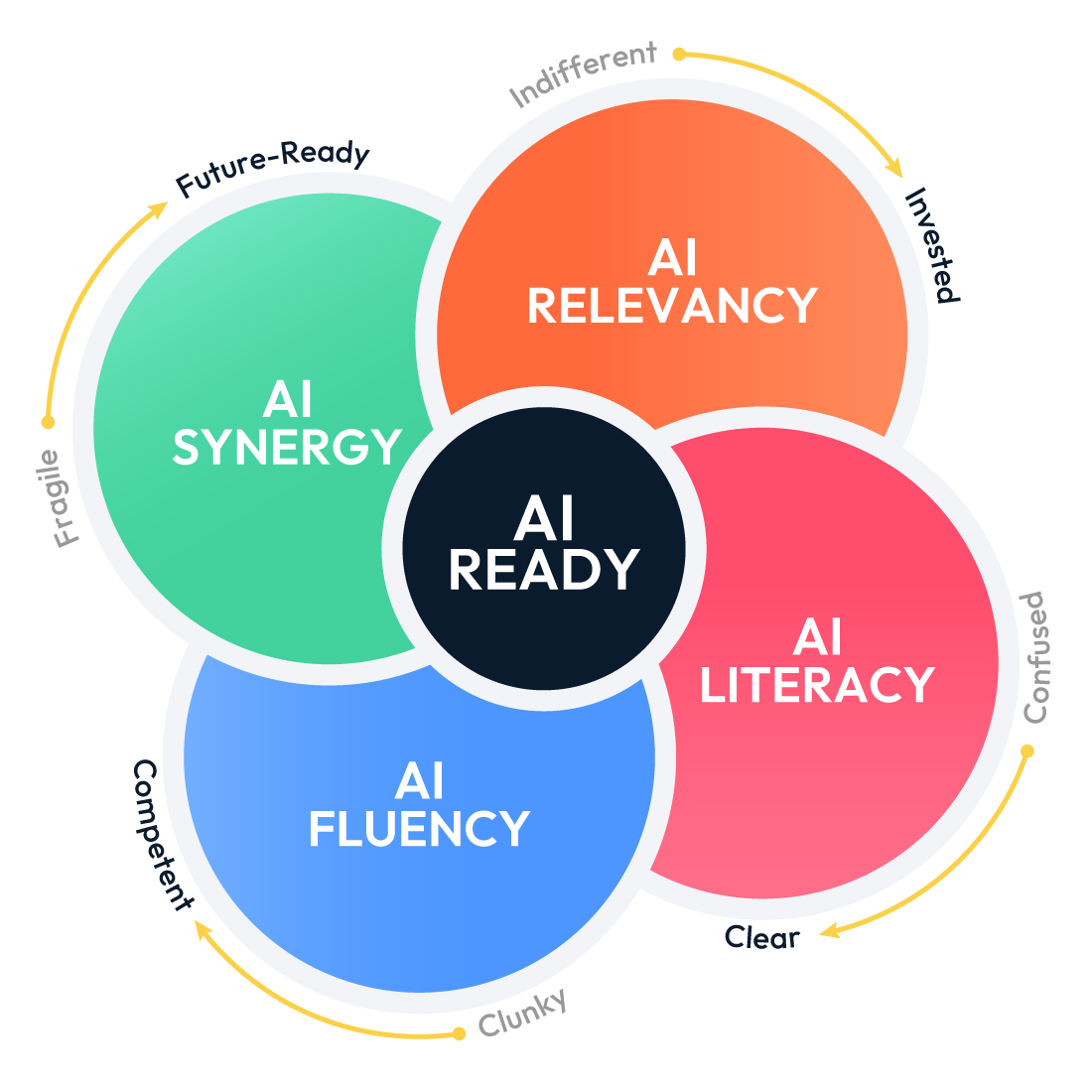
The AI Partnership Phases is a practical AI adoption framework that helps organisations move from Clueless to Champion by building AI-Ready capability across workflows.
It gives leaders and teams a shared map to build the Net-Effect that sticks after the initial excitement fades.
Why this AI Adoption Framework exists
AI adoption fails when it is treated as a tools or training problem.
It succeeds when it becomes a workflow and habit system.
Most organisations try to drive AI adoption using one of these levers – knowledge, access and hype.
Each creates activity, but not the Net-Effect.
The 3 myths that stall AI adoption
Myth 1: Knowledge will fix it.
“If people understand AI, they will adopt it.”
What happens: people get smarter, but behaviour stays the same. Literacy without workflow practice becomes awareness without output.
Myth 2: Access will fix it.
“If we buy Copilot, Gemini,ChatGPT or any licenses, adoption will happen.”
What happens: usage spikes, then plateaus. Tools increase options, but do not create standards, habits, or trust.
Myth 3: Hype will fix it.
“AI is a trend, so a talk and some excitement will move behaviour.”
What happens: short-term energy, long-term drop. Motivation fades when day-to-day friction and risk anxiety return.
What actually works
AI adoption is a workflow and behaviour-change problem. That is why the AI Partnership Phases exist.
AI Adoption vs. AI Enablement
Enablement is what makes adoption safe, consistent, and scalable.
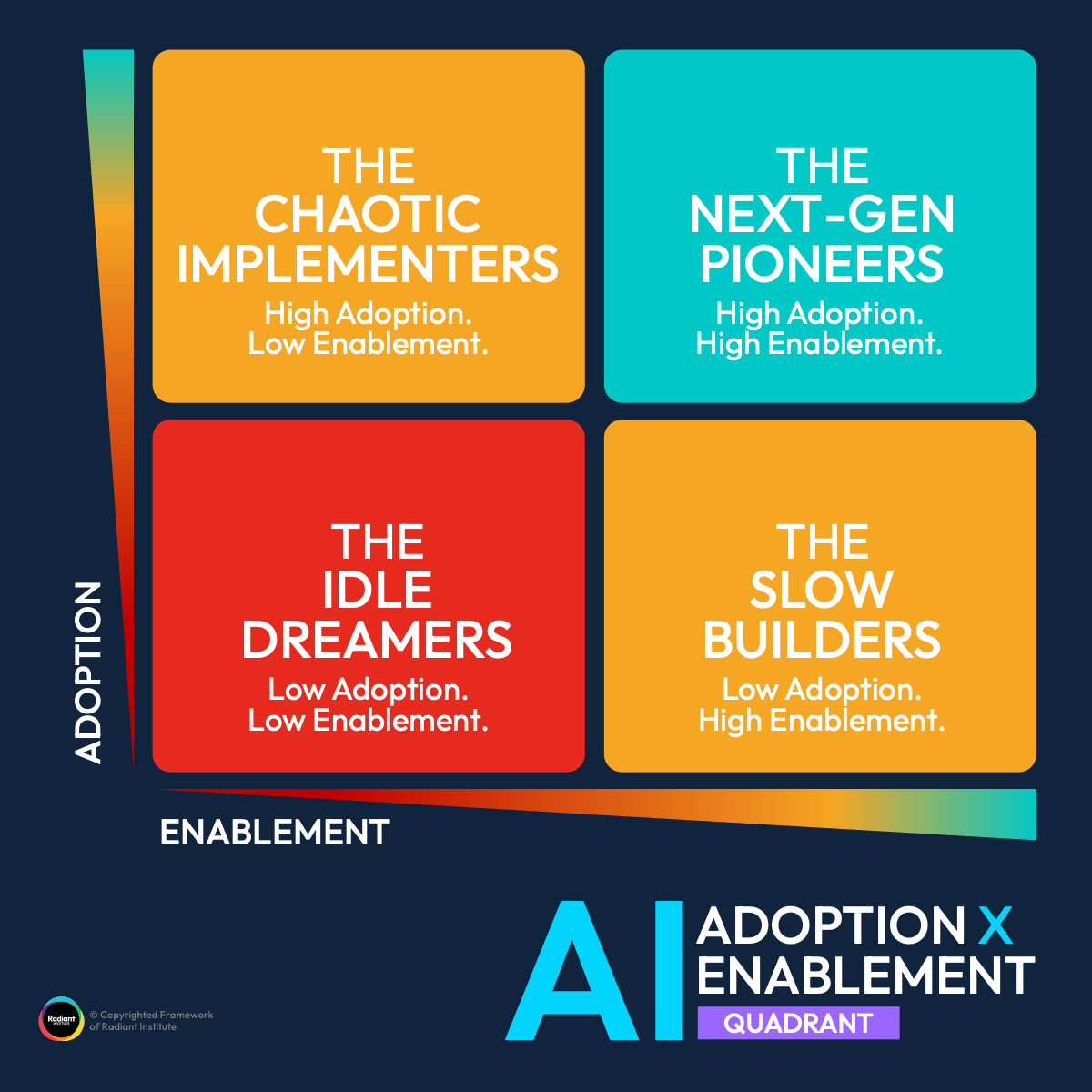
AI adoption is the visible behaviour: people actually using AI.
AI enablement is the invisible system: shared language, safe habits, workflow standards, and reinforcement.
You can get high adoption with low enablement.
That is where teams become chaotic, inconsistent, and risky.
Our goal at Radiant Institute is to help you build a future-ready workforce, and that means High Adoption and High Enablement across your entire organization.
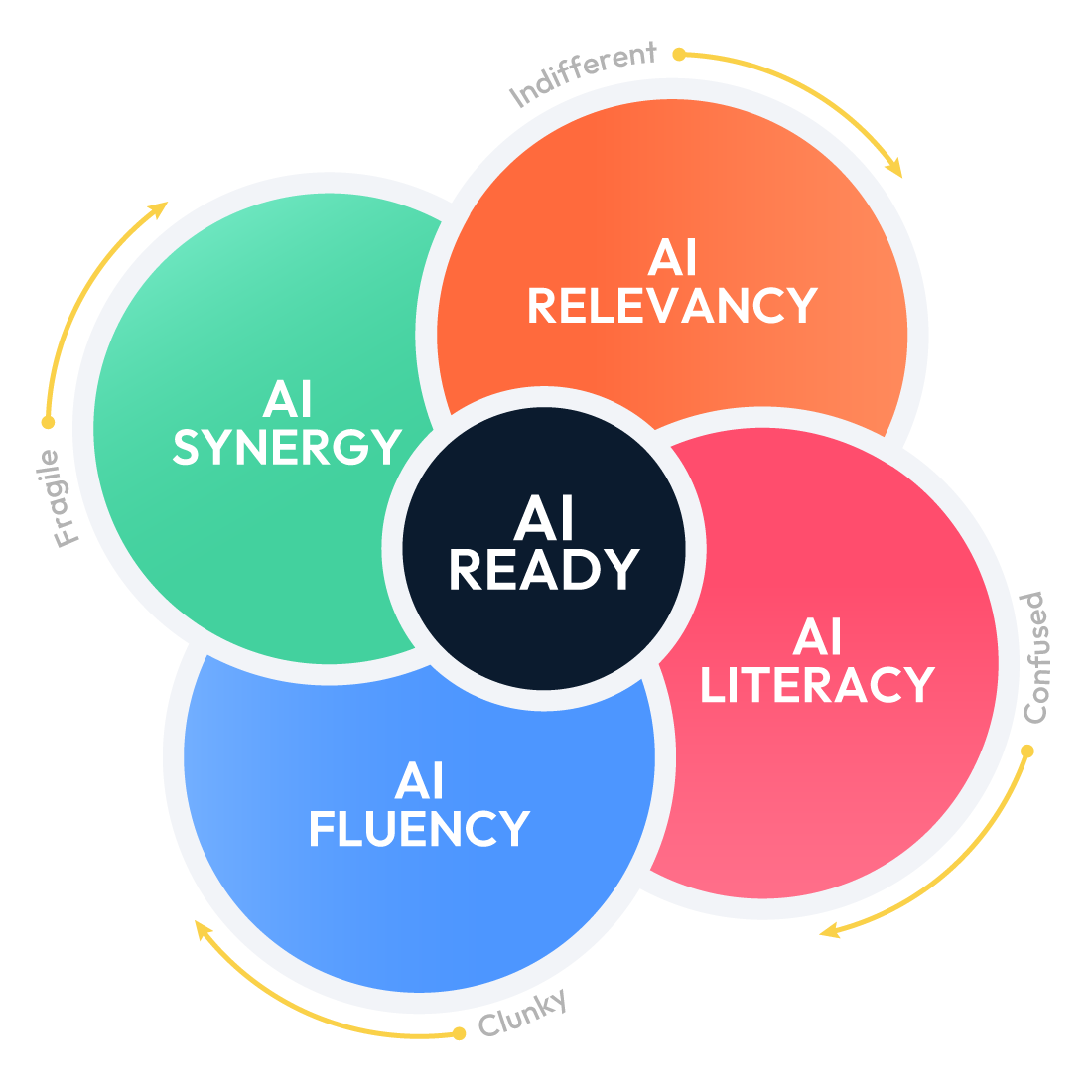
What the AI Partnership Phases are all about
A phased roadmap that turns AI from experimentation into workflow capability.
AI adoption happens in phases. If you skip phases, you create fragile adoption. If you build phases in sequence, you create durable capability.
These phases repeat as teams take on new workflows and new use cases over time.
Net-Effect: the durable shift that remains after the noise of old habits and resistance fades.
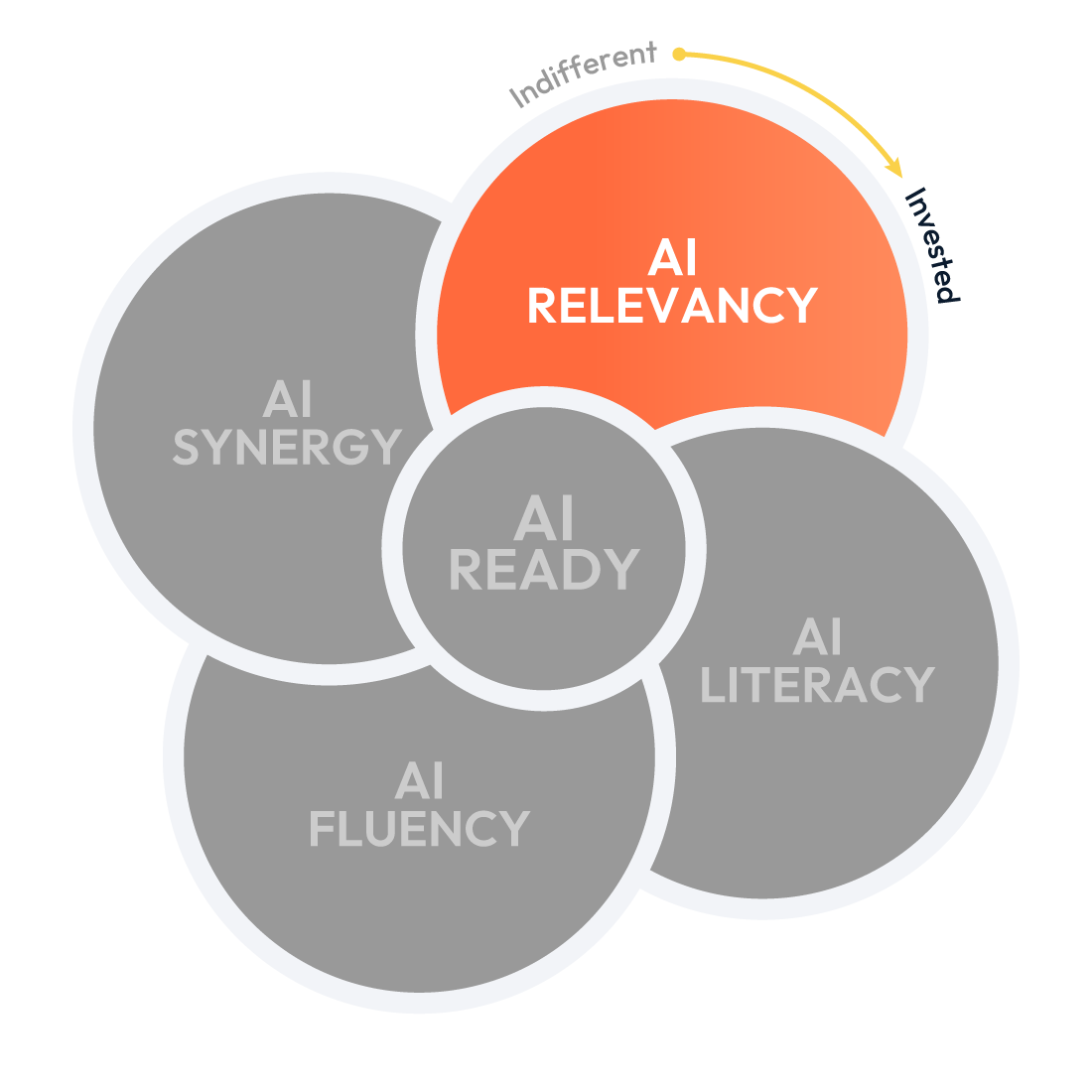
AI RELEVANCY
NET-EFFECT
From Indifferent to Invested.
CORE QUESTION
Why should we use AI here?
WHAT IT UNLOCKS
Buy-in and priority workflows.
AI LITERACY
NET-EFFECT
From Confused to Clear.
CORE QUESTION
What is AI and what are the rules?
WHAT IT UNLOCKS
Shared understanding and safer usage.
AI FLUENCY
NET-EFFECT
From Clunky to Competent.
CORE QUESTION
How do I use AI in my workflow?
WHAT IT UNLOCKS
Productivity and quality gains.
AI SYNERGY
NET-EFFECT
From Fragile to Future-Ready.
CORE QUESTION
How do we make human + AI outperform at scale?
WHAT IT UNLOCKS
Repeatable partnership and compounding ROI.
PHASE 1
AI Relevancy
From Indifferent to Invested.
What it is
The ability to explain, in plain business language, why AI matters for this role or team, why now, what outcomes it should improve, and the boundaries for safe use.
It turns “AI is important” into “AI is important for us, for these workflows, for these outcomes.”
Core question
Why should we use AI here?
What it unlocks
Buy-in and priority workflows, without random experimentation.
What success looks like
- People can name 2 to 3 workflows where AI helps
- People can define “better” in measurable terms within 30 days
- People can state boundaries confidently
Common misconceptions
- “Relevancy is just motivation.”
Relevancy is motivation plus specificity: workflows, outcomes, boundaries, measurement. - “If leaders say AI is strategic, people will follow.”
People follow when it maps to day-to-day work.
PHASE 2
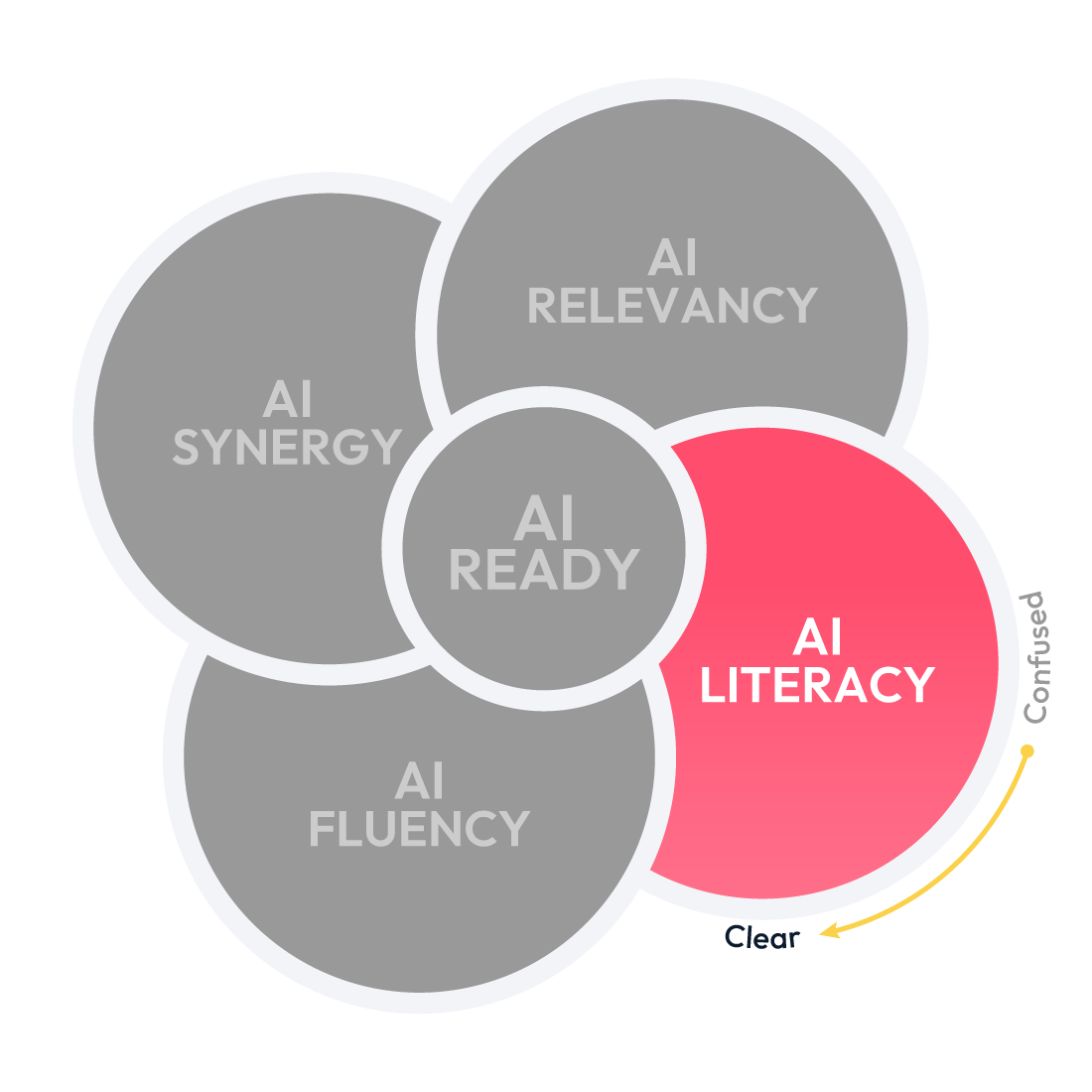
AI Literacy
From Confused to Clear.
What it is
Baseline understanding of AI concepts, capabilities, limitations, and safe-use rules that reduces black-box fear and prevents obvious misuse.
Literacy is necessary, but it does not guarantee value creation.
Core question
What is AI and what are the rules?
What it unlocks
Shared understanding and safer usage, so teams stop over-trusting or rejecting AI.
What success looks like
-
People can explain AI in plain language
-
People understand key limits (hallucinations, bias, sensitivity to prompts)
-
People know what data is safe and what is not
-
People know what to do when AI output looks wrong
Common misconceptions
-
“If they are literate, they are ready.”
Literacy creates understanding, not workflow competence. Fluency does that. -
“Literacy is a one-time event.”
Literacy needs refreshes as tools, policies, and risks evolve.
PHASE 3
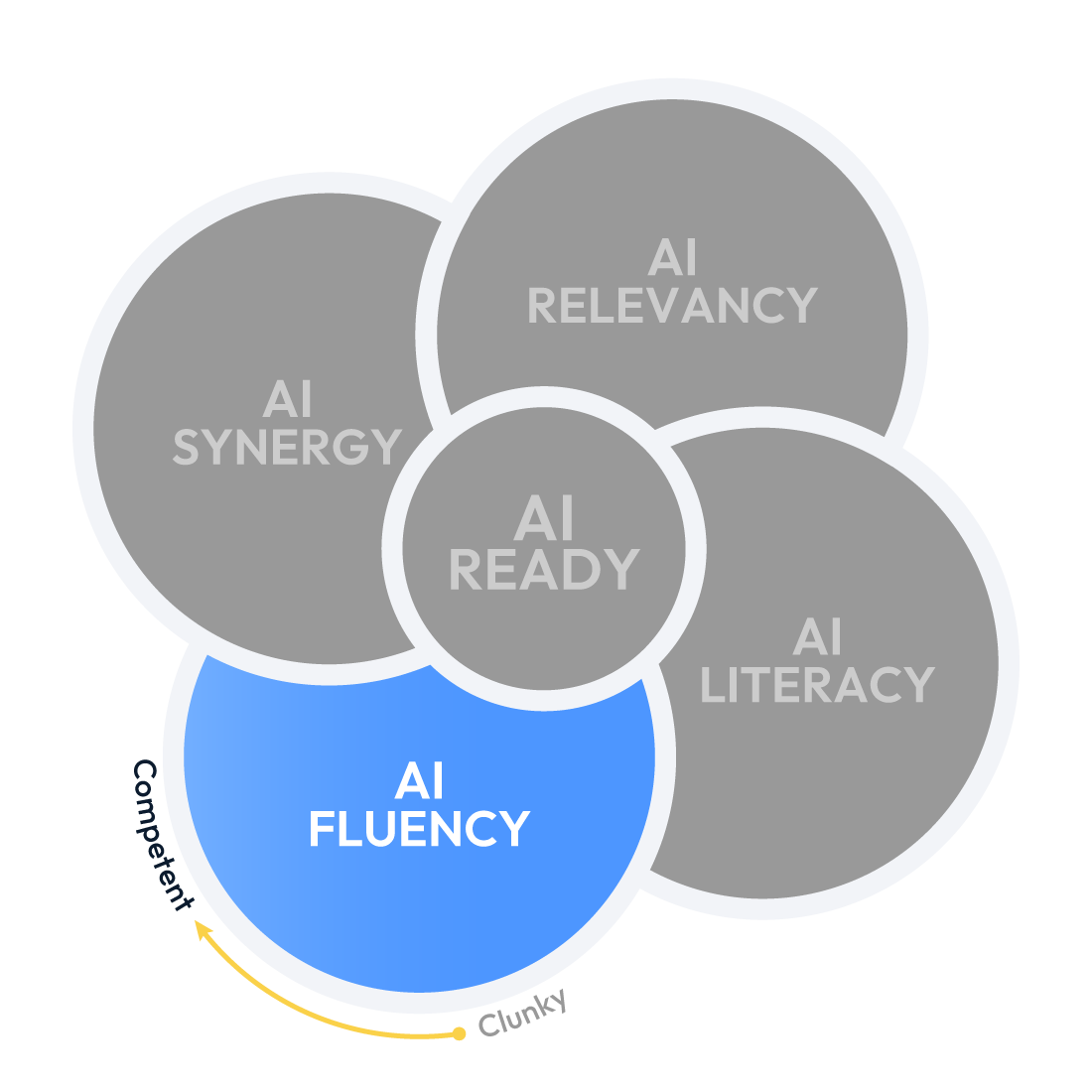
AI Fluency
From Clunky to Competent.
What it is
Applied competence to use AI inside real workflows to produce usable deliverables, with strong prompting habits, verification discipline, and human judgment integration.
This is where tangible productivity and quality gains show up.
Core question
How do I use AI in my workflow?
What it unlocks
Productivity and quality gains you can see in day-to-day work.
What success looks like
-
People can produce real deliverables faster with acceptable quality
-
People demonstrate verification as a habit
-
Outputs become less variable across individuals
Common misconceptions
-
“Fluency is prompt engineering.”
Fluency includes verification, judgment, and workflow integration. -
“If people use AI often enough, fluency will happen.”
Repetition without standards creates bad habits. Fluency needs structure.
PHASE 4
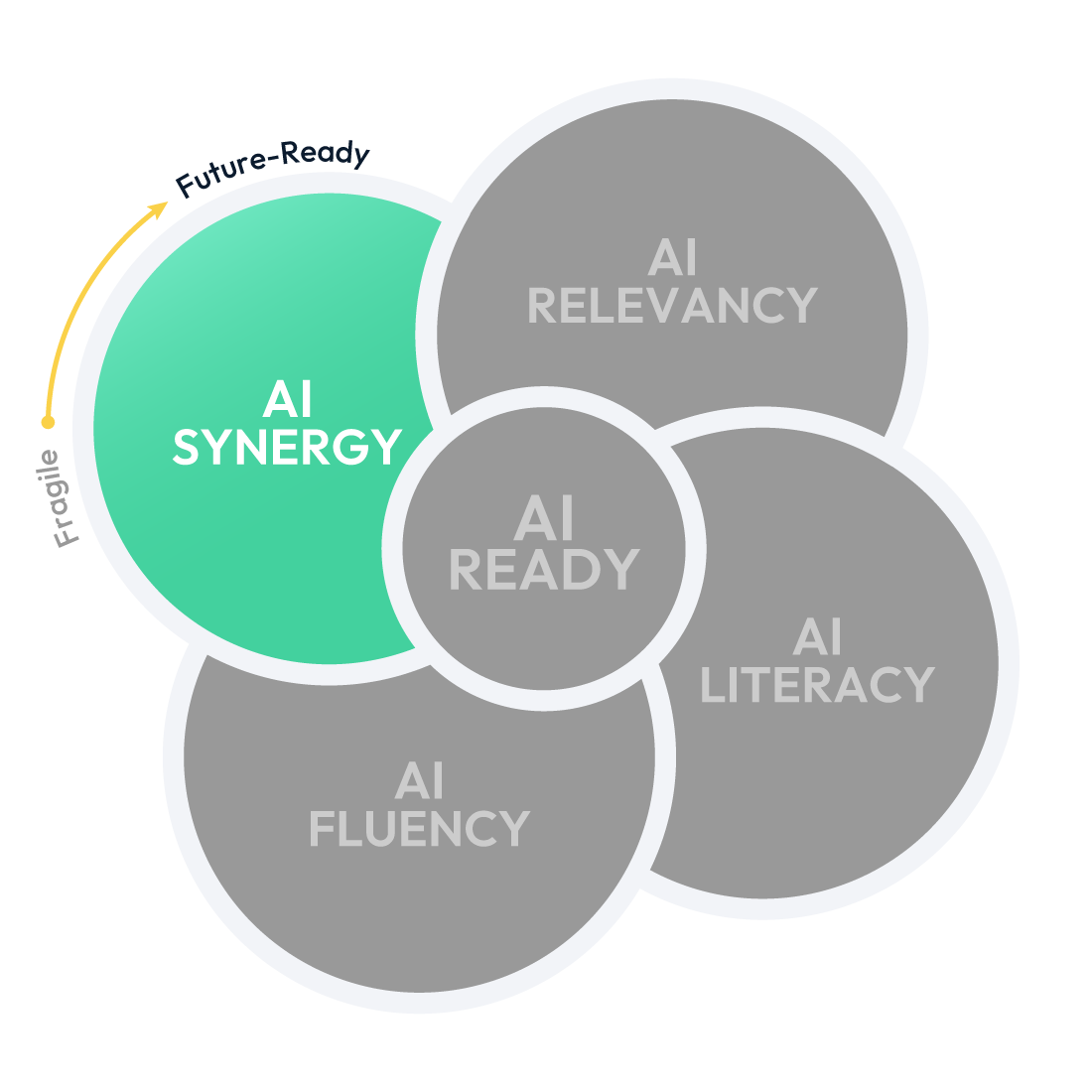
AI Synergy
From Fragile to Future-Ready
What it is
The capability to design and sustain a repeatable human + AI partnership where the combined outcome is better than either alone, and the system survives change (tools, policies, priorities).
Fluency is “I can use it.” Synergy is “we outperform.”
Core question
How do we make human + AI outperform at scale?
What it unlocks
A repeatable, scalable partnership and compounding ROI.
What success looks like
- AI use is visible, safe, and normalised
- Teams reuse and improve shared patterns over time
- Performance holds even when tools change or champions leave
- Impact stays steady, not a short spike
Common misconceptions
- “Synergy is just advanced fluency.”
Synergy includes scaling mechanisms: standards, playbooks, measurement, resilience. - “Synergy comes from better tools.”
Tools help, but synergy is an operating system: roles, workflows, habits, and standards.
4 Different Ways to Use This Framework In Your Organization
Start with clarity, build competence, then turn wins into a team system.
RECOMENDATION 1
Diagnose where adoption is actually stuck
Guiding question: Where are we truly stuck right now: buy-in, clarity, competence, or scale?
Most organisations do not have one “AI maturity level.” They have different phases across different workflows. One team may be competent in drafting content, but clunky in analysis. One department may be clear on safe use, but still indifferent about where AI actually matters.
The AI Partnership Phases helps you identify the real bottleneck without guesswork:
-
Relevancy: Is adoption stalling because people do not see a clear reason to change?
-
Literacy: Is adoption risky or hesitant because rules and understanding are unclear?
-
Fluency: Is usage happening, but outputs are inconsistent and clunky?
-
Synergy: Are results fragile because it depends on a few champions, not a team system?
Once you name the bottleneck, the next move becomes obvious.
RECOMMENDATION 2
Build an enablement roadmap that does not collapse after training
Guiding question: How do we move from awareness to capability in a way that actually sticks?
Most AI programs fail because they skip phases. Teams jump from “intro training” straight into “use cases,” then wonder why quality is inconsistent, risks rise, and adoption fades after the workshop.
This framework gives you a practical sequencing logic:
-
Start with Relevancy to choose priority workflows and define what “better” means.
-
Build Literacy so safe use becomes normal, not guesswork.
-
Build Fluency through real deliverables, verification habits, and workflow practice.
-
Move to Synergy by turning individual wins into shared patterns, standards, and team assets.
The goal is not a temporary spike in usage. The goal is Net-Effect: durable workflow capability that remains after the noise fades.
RECOMMENDATION 3
Scale safely, without locking into one tool
Guiding question: How do we scale what works across teams, without turning AI into a tool-specific dependency?
Synergy is tool-flexible by design. The goal is not to build your organisation around one vendor or one feature set. The goal is to build shared habits, standards, and workflows that remain useful even when tools change.
This is also how you reduce shadow AI. When safe, approved pathways are clearer and easier than improvisation, people stop inventing their own workarounds. Adoption becomes visible, consistent, and governable, not fragmented and hard to control.
RECOMMENDATION 4
Measure what matters
Guiding question: Are we getting real Net-Effect, or just more activity?
If you only measure usage, you will reward noise. Logins and prompt volume do not tell you whether the work improved, whether quality held, or whether risks were managed properly.
A better measurement story is simple: what changed in time, quality, rework, and risk hygiene? When you can show those shifts, you can secure leadership support, prioritise the next workflows, and repeat the phases with confidence.
EXAMPLE 1
People managers (from clunky to competent)
A manager uses AI to draft feedback quickly, then checks accuracy, fairness, and tone before sending.
What changes:
-
Drafting becomes faster
-
Judgment stays human-led
-
Verification becomes a habit, not a reminder
EXAMPLE 2
Sales enablement (from individual hacks to team assets)
AI produces a call recap and next steps. The rep verifies and edits. The manager coaches using a simple standard. The best patterns become shared team assets.
What changes:
- Follow-ups become more consistent
- Coaching becomes easier and more repeatable
- The team improves together, not just the power users
Want to see this framework in action?
Radiant Institute programs use the AI Partnership Phases to build a shared adoption roadmap across leaders and teams, so AI becomes safer, more practical, and measurably useful in real workflows.
Discover our programs built on this framework
Frequently Asked Questions
Short answers to common AI enablement questions
What is an AI adoption framework?
An AI adoption framework is a structured way to move from experimentation to repeatable, safe, measurable AI use in daily work. It focuses on workflows and habits, not just tools and awareness.
What is AI literacy?
AI literacy is baseline understanding of AI concepts, capabilities, limits, and safe-use rules. It reduces fear and prevents obvious misuse, but it does not automatically create workflow competence.
What is AI fluency?
AI fluency is applied competence. People can use AI inside real workflows to produce deliverables with verification discipline and human judgment.
AI literacy vs AI fluency. What is the difference?
AI literacy is “I understand it and I know the rules.”
AI fluency is “I can produce useful work with it, consistently, with verification habits.”
What does an AI-ready workforce mean?
An AI-ready workforce uses AI in a way that is valuable, safe, and repeatable in day-to-day work. Success is measured impact, not usage volume.