AI Working Modes: Four Ways to Work With AI (and How to Know Which One a Task Needs)

Maverick Foo
Tuesday, 2nd June 2026
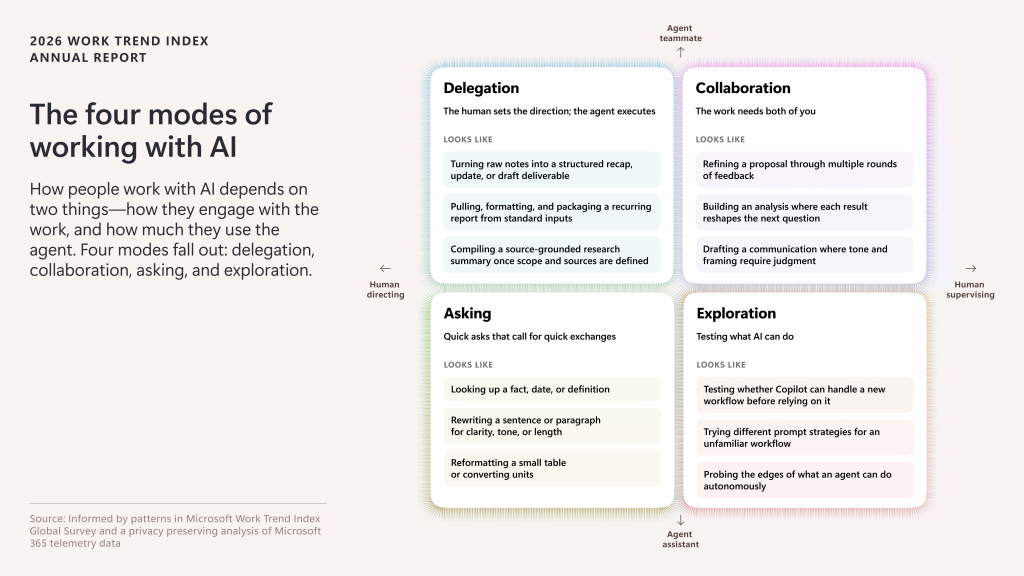
Most people use AI in one mode. The strongest users switch modes on purpose. That single habit is becoming one of the clearest dividers between people who get real value from AI and people who stay stuck at surface level.

Microsoft’s Work Trend Index 2026 studied how people actually work with AI and found four clear modes. Once you can name them, you can choose between them, and that is where the advantage starts.

The Four AI Working Modes

Think of these as four settings on the same tool. You are not picking one forever. You are matching the mode to the task in front of you.

Delegation

You set the direction, the agent does the work.

“Draft a performance review template for my team leads, aligned to our competency framework.”

In practice, this is where you hand over a defined output: a first draft policy, a meeting agenda, a structured summary of a long report. You stay responsible for the brief and the final check.


Collaboration

You build it together, back and forth.

“Let’s work through this team restructuring together. Propose an approach, then refine it role by role.”

This is the mode for thinking problems through. You are not outsourcing the answer. You are using the exchange to sharpen your own.


Asking

Quick question, quick answer.

“In one line, what is the difference between upskilling and reskilling?”

This is the fastest mode and the easiest to overuse. It is ideal for a definition or a quick check, and a poor fit when the task actually needed real thinking.


Exploration

You test what the tool can really do.

“Show me 5 ways I could use you to spot skill gaps across my team.”

This is the mode most people skip. It is how you discover workflows you did not know were possible, and it usually pays off long after the session ends.


The Skill Most People Miss

Here is the part most people miss.

Your edge is not which mode you use. It is knowing which one the task calls for.

Most of us get stuck in one. We treat a tool that can think with us like a search box. Or we delegate work that needed real collaboration, then wonder why the result feels generic.

The real skill is staying agile enough to move between all four. Read the task, then shift. Quick question now, deep collaboration next, full delegation after. The more fluently you move, the more value you pull from the same tool.

So the question is no longer what AI can do for you. It is which mode this task calls for. Decide the mode before you prompt, and everything that comes after gets better.


What Sets the Strongest Users Apart

Microsoft‘s research points to a group it calls Frontier Professionals, the people getting the most out of AI. They work differently in a few specific ways.

  • They pause before they prompt.
  • They stop to decide what AI should do versus what a human should do (53% versus 33%).
  • They also protect their own thinking, doing some work without AI on purpose to keep their skills sharp (43% versus 30%)
  • Rather than accepting whatever lands, most treat AI output as a starting point to refine, not a finished answer (86%).

None of that requires a new tool. It requires a more intentional way of using the one you already have.

Implications for Leaders and L&D

  • Mode switching is a teachable skill, not a personality trait. Most teams have never been shown the four modes, so they default to one.
  • Capability is uneven and usually invisible. Your best AI users have habits trapped in their own heads, and those habits rarely spread on their own.
  • The goal is not more AI usage. It is better judgment about when each mode fits, which is what shared language and training create.

Try This This Week

  • Before your next AI task, name the mode first. Decide whether it is Delegation, Collaboration, Asking or Exploration, then write your opening prompt to match.
  • Take one task you would normally rush through in Asking mode and run it as Collaboration instead. Notice the difference in the quality of your own thinking.
  • Check whether this skill is spreading or stuck. The Team AI Effectiveness Scorecard gives you a read on Scalability, one of The 7 Drivers of AI Effectiveness, so you can see whether good practice is shared across the team or locked inside a few people.

Ending thought:

Naming the four AI working modes is a small shift with a large payoff. It turns a vague sense that you should use AI more into a clear, repeatable decision you make before every task. Individuals can build this habit on their own. Teams need shared language, and that is harder to build alone.

If this is the gap you are seeing in your organisation, this is the work we do at Radiant Institute. We help leaders and L&D teams turn scattered AI use into a shared, confident way of working. If that is useful, reach out and we can explore what it would look like for your team.

p.s. If you’d like to know which AI working mode are you defaulting to most of the time, try out this PERFECT Prompt in your favourite AI tool!


Based on our past interactions across Exploration, Asking, Collaboration and Delegation, which mode do I use most? Which am I underusing?

  • Asking: I engage lightly, the agent helps lightly. Quick question, quick answer.
  • Delegation: I engage lightly, the agent does the heavy lifting. I set direction, it runs.
  • Collaboration: we both engage fully, thinking together, back and forth.
  • Exploration: I engage heavily and probe, testing what the agent can really do.

Maverick Foo

Maverick Foo

Lead Consultant, AI-Enabler, Sales & Marketing Strategist

Partnering with L&D & Training Professionals to Infuse AI into their People Development Initiatives 🏅Award-Winning Marketing Strategy Consultant & Trainer 🎙️2X TEDx Keynote Speaker ☕️ Cafe Hopper 🐕 Stray Lover 🐈

0 Comments

Submit a Comment

Your email address will not be published. Required fields are marked *

Share this
Send this to a friend