Most AI training begins with a familiar sequence.
A company chooses a programme/trainer, nominates the participants and sends them into the session, and hopes the program improves AI adoption.
The people may enjoy the session. They may leave with better prompts, a list of “today’s best” AI tools (that they may never be able to use within the organization), and a certificate of completion.
But one question often arrives too late:
Which parts of their work should change because of this training?
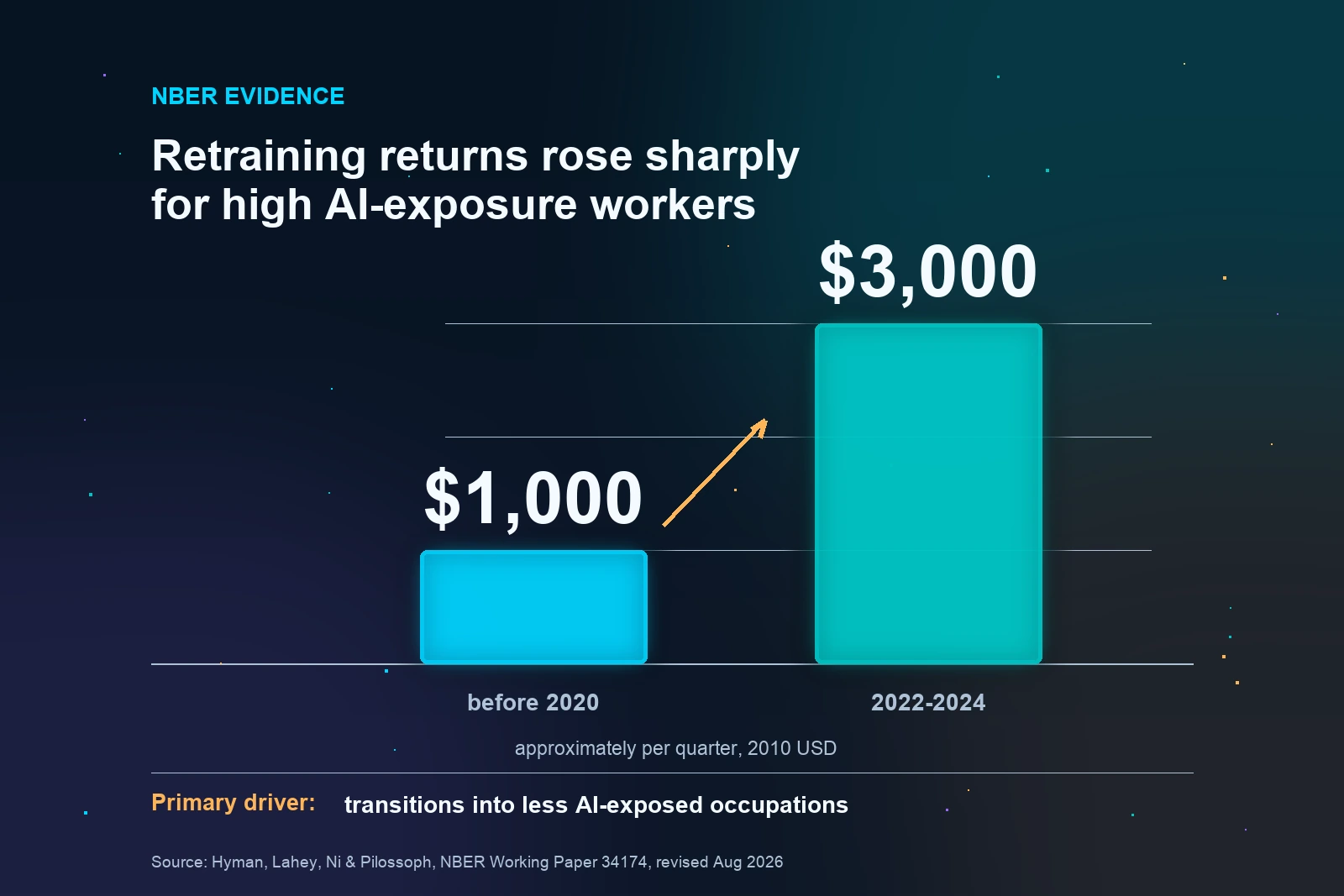
A new NBER working paper offers an important clue. The researchers examined 99,575 occupational-training spells from the United States and compared participants with similar workers who received only job-search assistance.
The finding that matters for L&D is that retraining did not produce one universal direction of movement.
- Workers starting in occupations with relatively low AI exposure often benefitted by moving into more AI-exposed work.
- Workers starting in highly exposed occupations followed a different pattern. During the 2022 to 2024 AI boom, many received stronger earnings returns by moving into less-exposed occupations.
- Others succeeded by developing skills that helped them work effectively alongside AI.
Starting position mattered. Direction mattered. The same prescription would not have served everyone equally.
Source: Hyman, Lahey, Ni and Pilossoph, NBER Working Paper 34174, revised August 2026.
That has a practical implication for workplace AI programmes:
Diagnose the work before training the worker.
Most Training Skips This Step
Here is where the standard AI training model breaks down. Most training providers and trainers sell curriculum, not solution.
A client buys a programme, and the facilitator delivers roughly the same content to every audience, because that is what the commercially rewarding model. There is little expectation, and often little budget, for the facilitator to customise to the tasks, friction points and constraints of the room in front of them. That means the sales execs, product designer, customer service manager, C-suite leader and HR intern all learn the same, rubber-stamped program.
But when training providers work with the client from the solution–angle, the question then becomes:
What’s the work-related outcome and performance impact of this training initiative?
Take a common example. A generic prompt engineering workshop might teach the same prompt example to a marketing team, a finance team and an operations team, regardless of whether their real bottleneck is drafting campaigns, reconciling variances or triaging support tickets. The curriculum stays fixed. The group photos changes.
A solution-led approach reverses that order: the content changes because the work changes, and the trainer’s brief becomes solving a named problem rather than completing a syllabus.
Radiant treats that gap as the opportunity. If direction matters as much as the NBER findings suggest, no standard curriculum can serve everyone in the room well. This is why an AI Training Needs Analysis comes before programme design rather than after it.
Diagnose first.
Personalize second.
Deliver third.
More AI Is Only One Possible Direction
AI training is often built around an unstated assumption:
Success means using more AI across more tasks.
The NBER evidence complicates that assumption. Greater AI exposure was valuable for some workers, while other workers improved their earnings by moving towards work where physical presence, clinical care, relationships or other human contributions carried more weight.
The paper calls one particular form of success AI Retrainability, or AIR. In plain terms, a worker counts as AI Retrainable when a move into a more AI-exposed occupation also comes with higher pay.
That measure is useful, but it does not capture every worthwhile transition. Someone who earns more after moving towards less-exposed work can have a successful outcome without qualifying as AIR success.
The distinction matters because organisations can make the same measurement mistake. They may count increased AI usage as progress even when the workflow, output or customer outcome has barely changed. It’s just repackaging an old problem with new, shiny, AI wrappings.
You see, the more useful question is whether AI created value in the flow of work, and whether the people involved moved towards the right combination of AI capability and human contribution.
Translating Occupation Routing Into Task Routing
“Great report! But you’re not seriously asking us to change employees around the organization, just because of the AI exposure level, right?”
In reality, most organisations cannot move employees between occupations every time technology changes.
They can, however, examine how tasks move within an existing role.
- A finance manager may use AI more heavily for variance commentary while retaining direct responsibility for signing off the numbers.
- A customer-service team may automate classification and drafting while preserving human involvement for emotionally charged or high-risk cases.
- A sales manager may use AI to draft outreach sequences and first-pass proposals, while keeping negotiation, relationship-building and final pricing calls firmly human-led.
- A learning professional may use AI to assemble materials while keeping facilitation, coaching and stakeholder judgment firmly human-led.
That’s where we adapt the Occupation Routing presented by the paper into Task Routing.
Instead of asking whether an entire job is exposed to AI, task routing asks:
- Which tasks have strong AI potential through speed, scale, synthesis, drafting or analysis? (A few of these same qualities show up again in the 7 Drivers of Coaching Effectiveness.)
- Which tasks depend heavily on context, trust, ethics, relationships, judgment or accountability?
- Which tasks could be redesigned around a different division of work?
- Which tasks should remain largely unchanged because AI adds little practical value?
These questions convert a labour-market finding into something a manager, HR partner or L&D team can use.
Four AI Transition Pathways
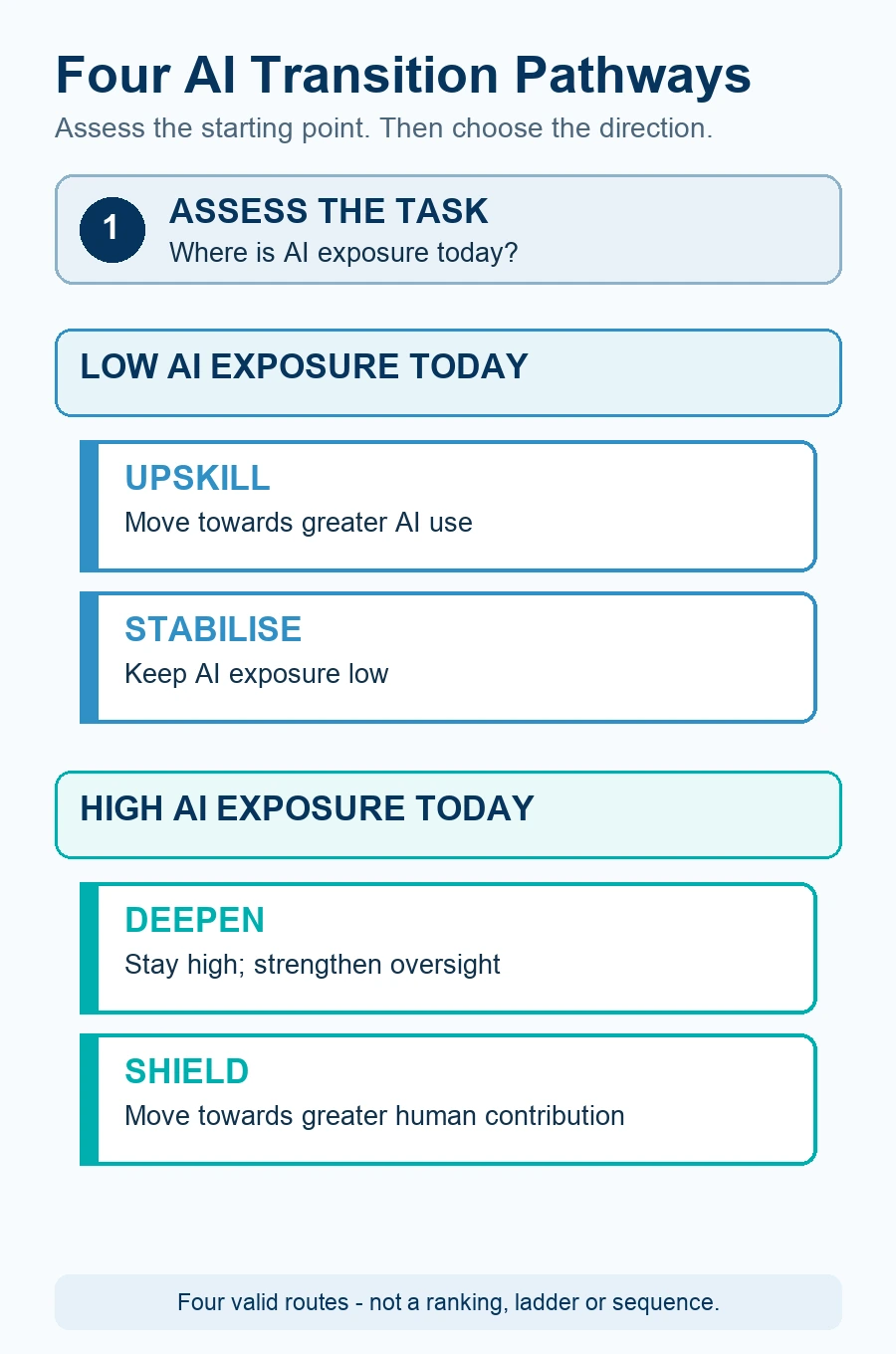
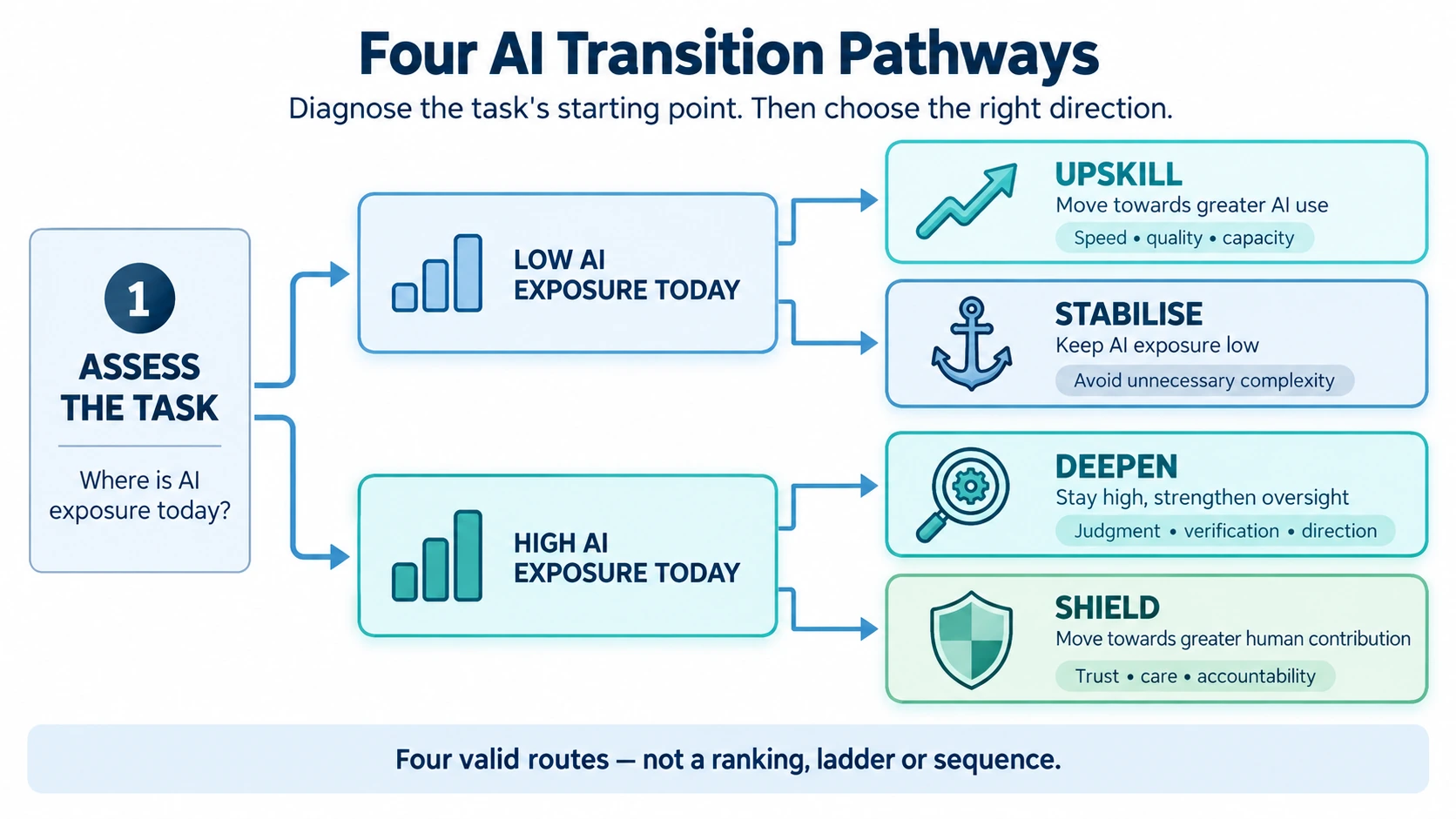
The NBER findings suggest four directions an organisation may consider.
| Movement | Pathway | Practical Meaning |
|---|---|---|
| Low → High AI exposure | Upskill | Introduce AI into tasks where it can increase speed, quality or capacity. |
| High → High AI exposure | Deepen | Build stronger judgment, verification, direction and supervisory skill. |
| High → Low AI exposure | Shield | Strengthen tasks where human presence, trust, care or accountability creates greater value. |
| Low → Low AI exposure | Stabilise | Protect effective work from unnecessary technology or complexity. |
Remember, this is a transition framework, not a ranking. High AI exposure is not automatically superior to low AI exposure. The right route depends on the task, the worker’s starting point, the surrounding workflow and the outcome the organisation needs.
Where the AI Training Needs Analysis Fits
The need for a proper TNA was the underlying motivation for Radiant Institute to develop the AI Opportunity Assessment. In its fourth iteration, we’ve incorporated the AI Momentum Framework and the 6 Modes of Knowledge Work. We’re continuously improving it to give L&D and leaders clearer insight for AI enablement.
Here’s how it works:
Before the programme begins, the analysis examines participants’ roles, recurring tasks, friction points, current AI use and business priorities. The information helps identify where AI could contribute, where human judgment must remain visible and where the real barrier sits outside training.
A useful assessment should examine at least six areas:
- The task. What is being produced, decided or communicated?
- The friction. Where do time, quality, consistency or handoffs break down?
- The AI potential. Which parts could benefit from drafting, synthesis, analysis, classification or automation?
- The Human Premium. Where do context, trust, ethics, relationships and accountability matter most?
- The constraints. What do policy, data access, systems and approved tools permit?
- The evidence. What observable change would show that the new approach created value?
The assessment then routes the opportunity towards an appropriate response. That response may involve upskilling, deeper AI supervision, workflow redesign, redeployment or a technology solution outside the training programme.
This protects organisations from treating every operational problem as a learning problem, and that AI is the immediate solution to all workplace challenges.
Why Self-Assessment Needs Calibration
There is one caution. Participants may not yet know enough about AI to assess the exposure of their own work accurately, and that miscalibration tends to show up in predictable ways.
- Someone labels a task as unsuitable for AI simply because they have never seen AI perform that kind of analysis.
- Someone assumes a task can be fully automated because the first draft looks convincing, while overlooking the judgment required downstream.
- Someone counts everyday tool use, such as asking Copilot, Gemini or ChatGPT to write an email, generate a chart or summarise a report, as meaningful use of AI. That’s a bit like creating a grocery list in spreadsheet software “using Excel.”
An AI Opportunity Assessment therefore needs guided task decomposition. Participants should see concrete examples of drafting, summarising, classifying, analysing, automating and agentic execution before rating their own work.
The facilitator’s role is to test the assumptions inside the response, rather than accept every self-rating as an objective description of the task.
Training Begins After the Diagnosis
Once the opportunities have been identified and routed, programme design becomes more precise.
The sequence becomes:
- Assess before. Identify starting capability, priority tasks, constraints and possible transition routes.
- Customise during. Build activities around the work participants genuinely need to change.
- Prove after. Ask participants to apply AI to a real task and show what changed.
This final step matters. Attendance and tool usage show activity. They do not demonstrate that the work improved.
A stronger evidence chain connects:
Capability → Application → Evolution
The outcome may appear as greater speed, stronger quality, better consistency, increased capacity, sounder judgment or reduced rework. The appropriate measure depends on the opportunity identified before the training.
An Old Teacher, the Same Lesson
For weeks, the teacher Anne Sullivan spelled the same word into her student’s hand. Over and over, letter by letter: w-a-t-e-r. Helen Keller could copy the sign back perfectly. She still did not understand that it meant anything at all.
Sullivan’s fellow teachers, well-meaning, assumed the fix was more repetition. Drill the sign harder. Say it again.
Sullivan tried something different. One morning at the water pump, she pressed one of Helen’s hands under the running water and spelled “water” into the other, at the exact same moment. Something clicked. Helen later described that moment as the one where the mist… was lifted.
Sullivan explained her method, years later, in a single sentence:
Language grows out of life, out of its needs and experiences.
That is not a linguistics tip. It is a diagnosis principle, phrased a century before anyone used the term “AI training needs analysis.”
The same idea runs through the NBER evidence explored earlier in this article. Repetition without direction rarely produces the outcome anyone wants. Workers who retrained gained the most only when the direction of their retraining matched their starting point. More effort pointed the wrong way barely moved the needle, however many training spells were logged.
Sullivan reached a version of that conclusion nearly 150 years earlier, with one student instead of a workforce. The lesson is not that training, or effort, should be reduced. It is that effort needs a direction before it can compound.
That is the case for diagnosis before prescription, whether the subject is a child learning language or an organisation deciding where AI belongs.
What This Means for Leaders and L&D
- Begin with the work. Choose the programme after identifying the priority tasks and transition routes.
- Expect different pathways. Some participants need greater AI fluency. Others need stronger judgment, redesigned responsibilities or clearer human ownership.
- Look beyond usage. More prompts and logins do not automatically indicate better work.
- Keep non-training responses available. Some friction points require process changes, system investment or role clarification.
- Define the evidence early. Decide what improvement should look like before participants enter the room.
Try This This Week
Choose one role in your organisation and list five tasks that recur every week.
For each task, ask:
- Would greater AI involvement improve the result?
- Does the task need deeper human judgment or accountability?
- Should the workflow itself change?
- What evidence would show that the change worked?
Then route each task towards Upskill, Deepen, Shield or Stabilise.
If every task ends up in Upskill, challenge the result. The NBER findings suggest that successful adaptation rarely moves everyone in one direction.
Closing Direction
The paper’s most useful lesson is that exposure does not determine destiny. The route taken after exposure matters.
For organisations, that route begins before the workshop. It begins by examining the work closely enough to decide where AI should contribute, where people should retain control and what needs to change around both.
An AI Training Needs Analysis, delivered through Radiant’s AI Opportunity Assessment, gives leaders and L&D a practical way to make that decision. It turns training from a standard intervention into a response designed around real work, real constraints and evidence the organisation can see.
Sullivan did not reach Helen Keller by drilling the same lesson harder. She reached her by finding the one connection that mattered, then building outward from it.
That is the same invitation behind an AI Training Needs Analysis. Not more training. Not less training. The right training, aimed at the tasks and people ready to move.
If your organisation is ready to find that connection rather than guess at it, start with Radiant’s Team AI Effectiveness Scorecard, a first look at where your own teams’ tasks might already be pointing.

Maverick Foo
Lead Consultant, AI-Enabler, Sales & Marketing Strategist
How to Choose a Corporate Training Provider That Actually Changes How Your Team Works
Aug 14, 2026
Most corporate training doesn’t change how people work. Here’s what separates a corporate training provider that builds lasting skills from one that just runs a workshop.

AI for Marketing: What It Actually Changes for a B2B Team
Aug 14, 2026
Discover how AI genuinely transforms B2B marketing teams, moving beyond content generation to accelerate research, map buyer journeys, and spot engagement patterns.

How to Choose a Corporate Training Provider in Malaysia
Aug 14, 2026
Looking for a corporate training provider in Malaysia? Discover how to choose programs that drive real workflow change, boost AI adoption, and qualify for HRD Corp claims.
REACH OUT TO US
Fill up your details below, and we will get back to you A.S.A.P.!


0 Comments