AI adoption numbers look healthy right now.
- 85% of organisations increased their AI investment in the past 12 months, and 91% plan to increase it again (Deloitte).
- 78% of enterprises report adopting AI in at least one business function (McKinsey).
- In APAC, 70% of frontline workers use AI regularly, compared with 51% globally (BCG).
- Organisations report 10.3x ROI on AI investments, with more than 5 to 10% of EBIT directly attributable to AI (McKinsey).
- AI users report real gains: 90% save time, 85% can focus better on priorities, 84% feel more creative, and 83% enjoy their work more (Microsoft and LinkedIn).
That is the promised potential of AI.
Now look at the present state. Same research houses. Sometimes the same reports.
- AI returns are “difficult to measure and slow to materialize”, and 38% of enterprises lack ROI frameworks. (Deloitte)
- Only 6% of organisations have scaled AI to a point where it creates significant value (McKinsey).
- 74% of companies report struggling to turn AI adoption into scaled business impact (BCG).
- Only 39% of organisations attribute any EBIT impact to AI, and most of those say it is less than 5% of EBIT (McKinsey).
- Nearly 60% of leaders are worried about how to measure AI productivity gains, saying their organisation lacks a clear plan or vision for AI implementation (Microsoft and LinkedIn).
Read those two lists again. McKinsey is the source for the 10.3x ROI and also for the 6% scaled value. BCG is the source for APAC’s world-leading frontline adoption and also for the 74% who cannot turn adoption into business impact. Microsoft and LinkedIn celebrate the time savings, then warn that most leaders cannot measure them. The optimism and the caution come from the same people.
Both sets of numbers are true. That is what makes AI confusing for leaders right now. The promise is real. The struggle is also real.
The gap between AI promise and AI performance is not only a technology gap. It is a human capability gap.
This is where the AI Hall of Mirrors comes in. AI reflects how people think, how teams make decisions, and how leaders set expectations. Some reflections are encouraging. Some are uncomfortable. All of them are useful.
Here are five adoption gaps the mirrors reveal, and what leaders can do about each one.
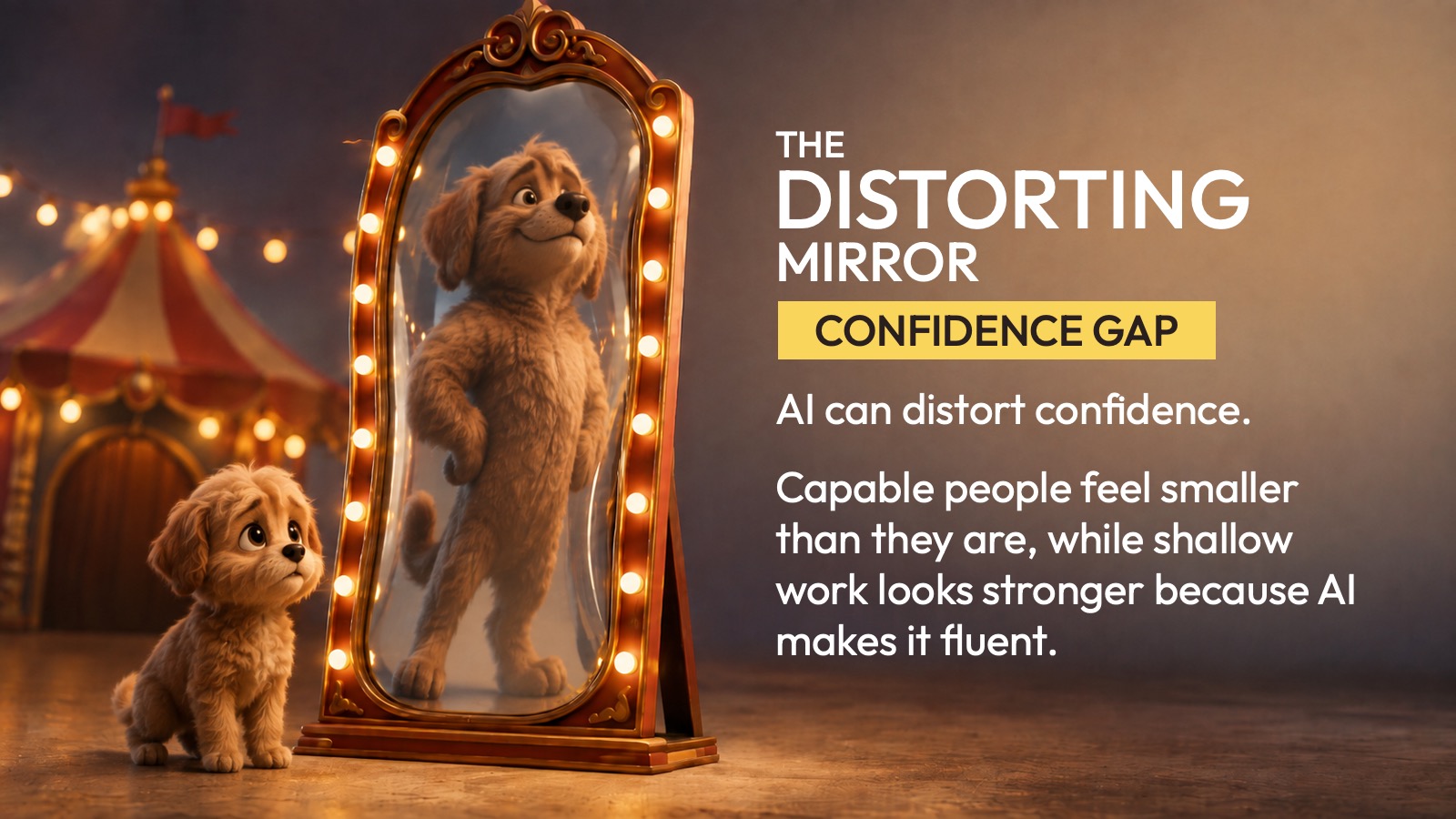
The Distorting Mirror: The Confidence Gap
A distorting mirror changes how people see themselves. AI can do the same at work.
On one side are people with real capability who feel smaller than they are. They say things like:
- “Everyone else gets this faster than me.”
- “If I need help from AI, maybe I’m not good enough.”
- “If I use AI wrongly, people will judge me.”
This is where capable people hesitate.
On the other side are people with shallow understanding who suddenly feel more capable than they are:
- “The answer looks polished, so it must be right.”
- “I can now do this even though I don’t really understand it.”
- “AI brilliant! I don’t need to check the work!”
This is where weak judgement hides behind fluent output.
The goal sits between the two extremes: Calibrated Confidence. People who are grounded enough to try, humble enough to check, and clear enough to keep improving.
AI performs better with grounded data. People perform better with grounded confidence.
Confidence is shaped by leadership behaviour more than personal attitude. Gallup’s 2026 research found that employees who strongly agree their manager supports their team’s use of AI are 98.7 times as likely to strongly agree that AI has transformed how work gets done.
Meanwhile, Mindbreeze’s 1H 2026 GenAI Confidence Index found that confidence in organisations’ ability to implement GenAI fell from 70% in 2H 2025 to 38% in 1H 2026, even as the tools themselves improved.
The confidence gap will not close with more tool access. It closes when leaders normalise not knowing, let people experiment without shame, and reward responsible attempts instead of polished outputs.
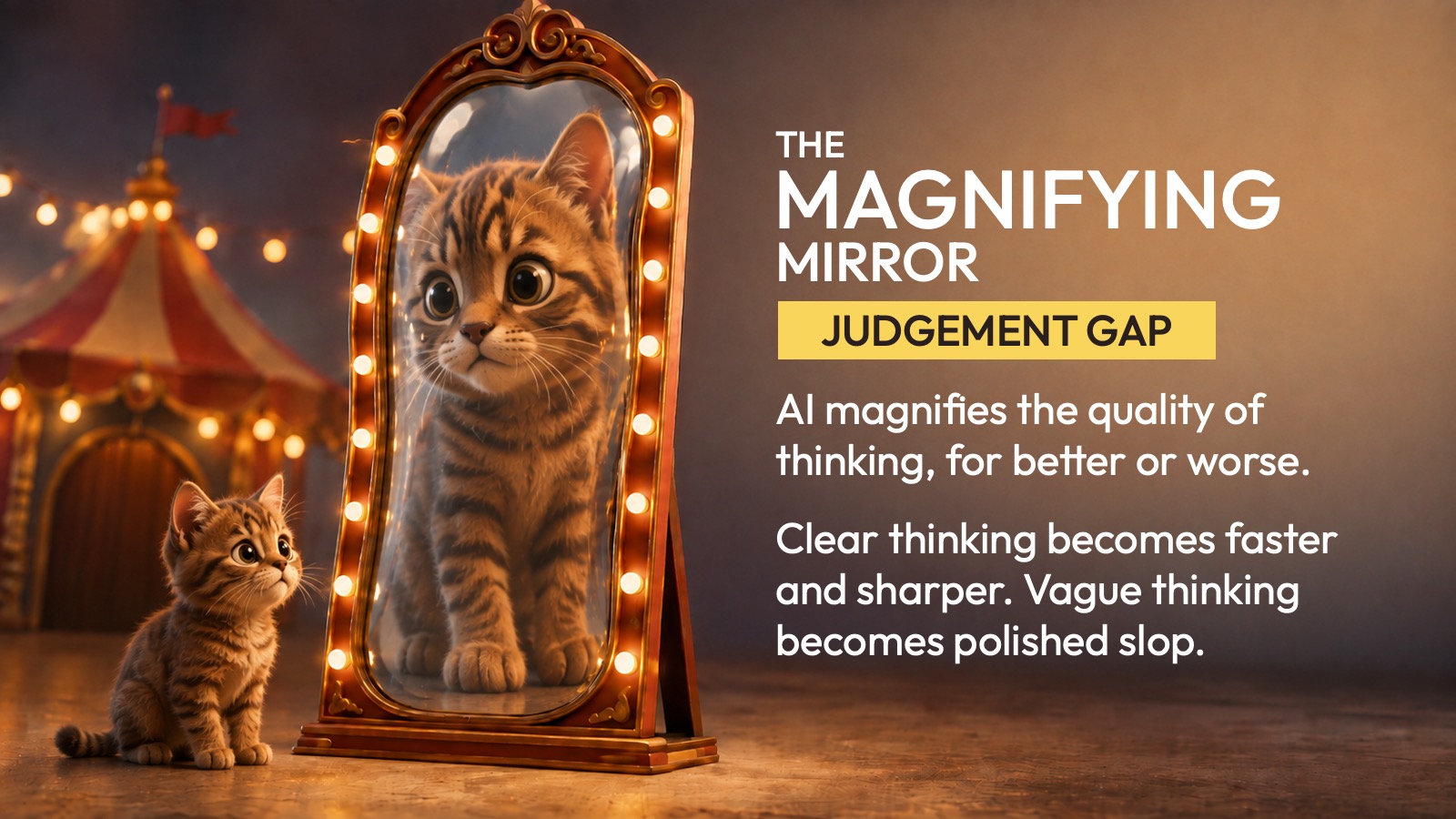
The Magnifying Mirror: The Judgement Gap
A magnifying mirror makes details easier to see. AI magnifies the quality of thinking people bring to the tool, and that include good and bad quality of thinking.
Clear instructions lead to useful first drafts. Vague instructions lead to polished vagueness. Strong assumptions get tested and improved. Weak assumptions get scaled.
BCG’s 2026 research describes the risk directly:
“The downward trend starts with overreliance on AI outputs without stress testing or challenge, a factor cited by almost 90% of surveyed leaders.”
One way to see your own habits is to map them on two axes: how much you use AI (AI leverage) and how well you evaluate what it gives you (human judgement). That gives four archetypes:
- Doer: low AI leverage, low human judgement. Not using AI much yet, and has not built the habits to evaluate AI-assisted work.
- Delegator: high AI leverage, low human judgement. Uses AI often, but accepts outputs too quickly or outsources too much thinking.
- Artisan: low AI leverage, high human judgement. Strong standards and craft, but may be relying too much on manual effort.
- Orchestrator: high AI leverage, high human judgement. Uses AI actively while staying in charge of direction, quality, and consequence.
The Orchestrator is where AI adoption becomes AI effectiveness.
If you want a quick read on where you sit, paste this prompt into the AI tool you use most:
Based on all that you know about me, give me a short “AI Judgement Mirror.” Keep the whole answer under 150 words.
1. Bold my archetype on the first line: Doer, Delegator, Artisan, Orchestrator.
2. Score me 1 to 5 on each of these three judgement habits, one line each, with brief evidence from my prompts:
– Challenge the Output: I push back on and pressure-test your answers.
– Allow for Uncertainty: I treat your output as a draft to refine, not a final answer.
– Own the Decision: I make the final judgement instead of accepting your answer too quickly.
3. Use those scores to place me in one quadrant and justify it in one sentence. Challenge the Output and Allow for Uncertainty set my Human Judgement. My ability to direct AI across a task sets my AI Leverage.
4. Name my weakest judgement habit.
5. Give me one sample prompt I could use tomorrow at work to strengthen that habit.
If you cannot see enough of our history, ask me to paste my last five prompts first, then run the mirror.
AI can generate the answer. Judgement tells us whether the answer is good enough to use.
For leaders and L&D, the response is to train evaluation, not just generation: source-checking, assumption-testing, challenge prompts, peer review, and knowing when to slow down.
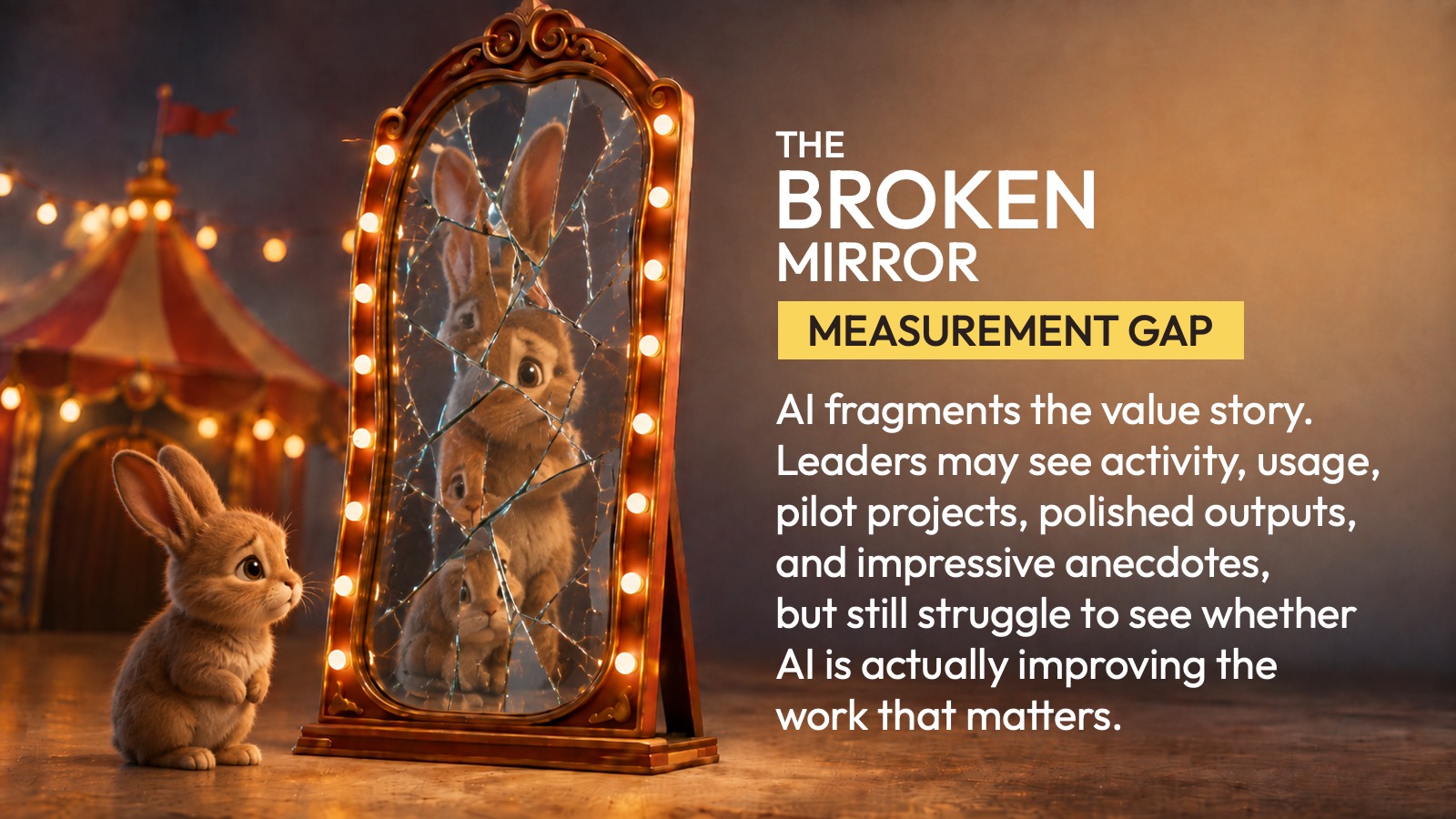
The Broken Mirror: The Accountability and Measurement Gap
A broken mirror shows fragments. AI can fragment both accountability and the value story.
One person prompts the tool. Another edits the output. A manager approves it. The platform generated the first version. When something goes wrong, everyone can point to a different piece of the process. “The AI said so” is not an ownership structure.
The same fragmentation shows up in measurement. The opening numbers already hinted at it: 38% of enterprises lack ROI frameworks, and nearly 60% of leaders say they have no clear plan for measuring AI productivity gains. Accountability sharpens the picture further. KPMG’s Q2 2026 Global AI Pulse found that organisations with clearly defined accountability for AI outcomes report established ROI at more than three times the rate of those without it: 14% compared with 4%.
Part of the problem is the question leaders ask. “Are your people using AI?” is a surface question. It invites license counts, login rates, and prompt volume.
“How are your people using AI?” is a strategic question. It leads to workflows, quality, risk, and outcomes.
That question is the spine of the 7 Drivers of AI Effectiveness, the framework we use to measure whether AI is actually working inside a team. It tracks seven things: Velocity, whether work moves faster from first prompt to action-ready result. Quality, whether the output is clear and worth acting on. Capability, what people can now do with AI that they could not do before. Safety, whether trust, data, and credibility stay protected. Continuity, whether work keeps flowing when a tool changes or fails. Mentality, how naturally people bring AI into the task. And Scalability, whether good habits spread beyond a few individuals.
If you want a read on where your own team stands, the Team AI Effectiveness Scorecard is a free 7-minute diagnostic built on those drivers. It shows you which driver is holding the team back, so you know which gap to close first.
Measurement tells us what is changing. Accountability tells us who owns the change.
AI may draft, suggest, summarise, and accelerate. People still approve, decide, verify, and own the consequence.
The Fogged Mirror: The Norms and Safety Gap
A fogged mirror still reflects, but the image is unclear.
Many employees are working inside that fog. They know AI is encouraged, but they are unsure what data can be uploaded, which tools are approved, when AI use should be disclosed, or how much human review is expected.
The fog is not hypothetical. UpGuard’s State of Shadow AI 2025 report found that 81% of workers use unapproved AI tools at work, and 88% of security professionals do the same. When companies block AI tools, 45% of people find a way around the block.
Because of these uncertainties team members may react differently. Some respond by avoiding AI completely. Others move too casually. We have seen people upload a full name list with ID numbers into a public AI tool with a simple request: “Can you help me sort this by age?” The tool can do it. The question is whether the prompt was ever supposed to be submitted.
That is the fogged mirror. People are not always resisting AI because they are negative or lazy. Sometimes they simply cannot see what safe usage looks like.
A broad instruction like “use AI responsibly” does not help people make daily decisions. Leaders need to clear the fog with practical answers:
- What can we use AI for?
- What data should stay out?
- Which tools are approved?
- When is human review required?
- When should AI involvement be shared?
- Who do we ask when we are unsure?
Answering those questions once is not enough, so here are three moves that make the answers stick:
- Make the official path the easy path. Give people a strong, secure, approved AI tool that can actually help with real work. UpGuard’s data is blunt about why this matters: the top reason people use shadow AI is not that the unapproved tool is smarter. It is easier.
- Write guardrails in plain language, with examples. “Do not upload personal data” is a policy. “Names and IC numbers stay out of public AI tools” is a rule people can follow on a Tuesday afternoon.
- Redesign one key workflow around the official tools. When the approved way is also the fastest way, people stop looking elsewhere.
So instead of asking “How do we stop shadow AI?”, leaders need a better question: “How do we make the official way to use AI good enough that people do not feel the need to go elsewhere?”
Governance without enablement creates fear. Enablement without governance creates risk.
Clear norms give people the confidence to use AI well without guessing where the boundaries are.
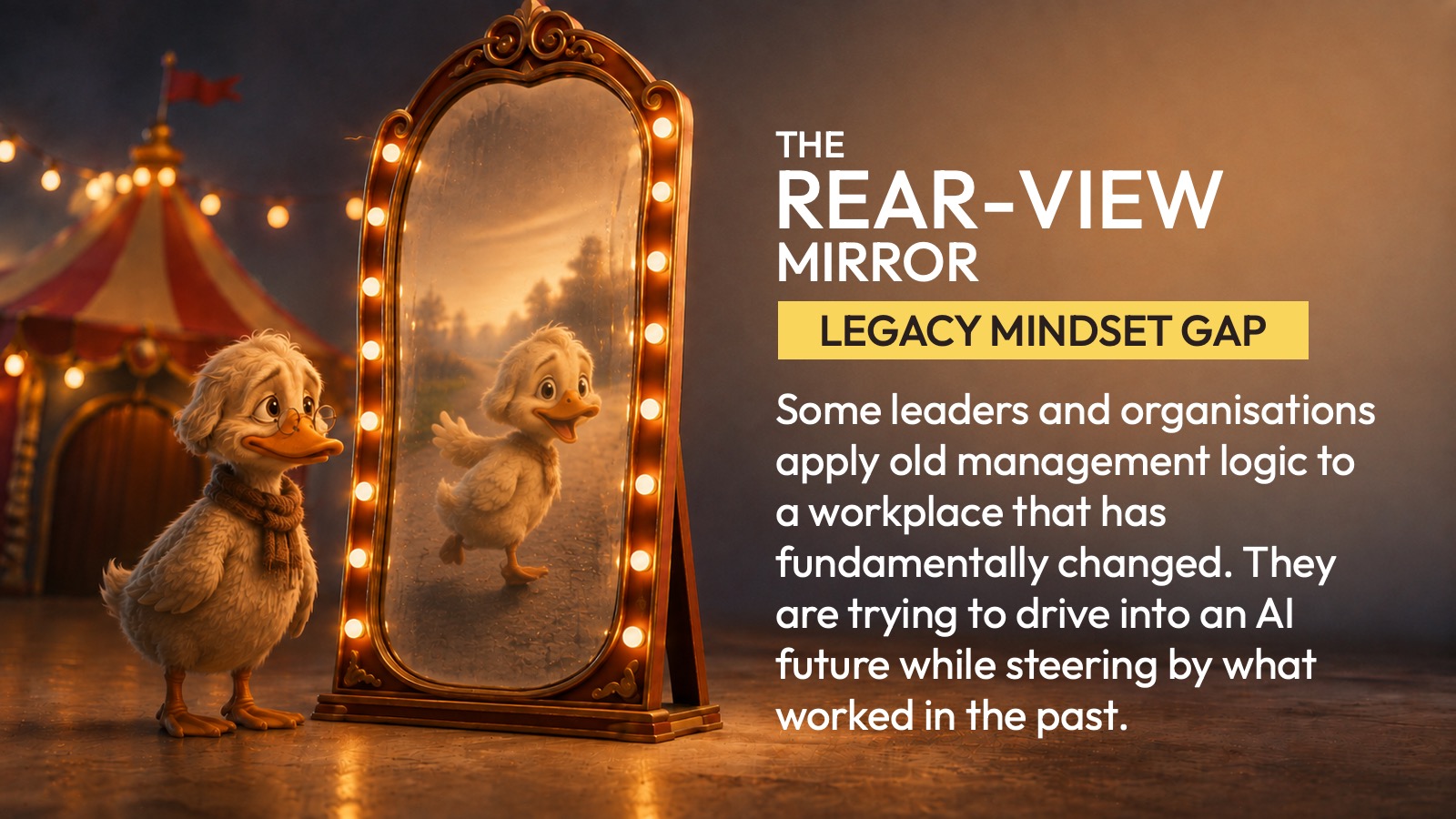
The Rear-View Mirror: The Legacy Thinking Gap
A rear-view mirror helps drivers understand what is behind them. It becomes dangerous when they treat it as the main guide for moving forward.
Some organisations are making AI decisions through old assumptions. They use yesterday’s job descriptions for today’s AI-supported work. They measure productivity by hours saved without asking whether the work itself should be redesigned. They celebrate adoption numbers while junior employees lose the repetitive tasks that once taught them the basics.
That last one is already showing up in the data. PwC’s 2026 Global AI Jobs Barometer, built on more than a billion job ads, found that the most AI-exposed entry-level jobs are now seven times more likely to require traditionally senior skills, and 49% of CEOs expect AI adoption to reduce junior hiring over the next three years. Senior professionals use AI to complete the routine work they once delegated to juniors. It looks efficient this quarter. But in parts of the world, some senior lawyers and doctors are already delaying retirement because there is no new talent ready to take over.
Sometimes when the practice ground disappears, the pipeline follows.
Take the AI notetaker as an example, because almost every team has one now. In most organisations, it joins the weekly status meeting, transcribes everything, and produces a clean summary with action items. Genuinely useful.
But name one meeting that got shorter. Or better… one that stopped happening. One decision that got made faster. For most teams, the honest answer is none. Same attendees. Same 60 minutes. Same weekly cadence. The notetaker made the meeting easier to remember. It did not make the meeting worth having.
A team that redesigns the workflow behaves differently. Status updates move to a digest sent before the meeting, so nobody reports live. The meeting exists only for decisions and disagreement. Attendance narrows to the people who hold decision rights. Decisions and owners go into the tracker as they are made. The recurring status meeting eventually disappears.
Same tool, very different experiences. In the first version, one person got faster. In the second, the organisation did. That is the rear-view mirror in miniature: the meeting was still running on a pre-AI design, and adding AI only changed the documentation.
That means leaders need better questions:
- Which tasks should remain human-led?
- Which workflows should be redesigned, rather than simply sped up?
- Which skills are being strengthened or weakened?
- How should roles and development paths change?
Past experience still matters. It should inform the next way of working, not trap the organisation inside the old one.
The Mirror Jung Turned on Himself
In 1913, Carl Jung’s professional world collapsed in public. His split with Freud was ugly: he lost his mentor, his movement, and for a while, his footing.
Instead of rushing to rebuild, Jung did something unusual. He spent years examining his own reactions to other people, especially the ones that irritated him. Out of that season came a line that fits this entire discussion:
“Everything that irritates us about others can lead us to an understanding of ourselves.”
That is worth holding onto in any conversation about AI at work. When we catch ourselves saying “they needed ChatGPT for that?” or “that is not real work anymore”, the irritation is information. Sometimes it protects a genuine standard. Sometimes it protects a version of ourselves that feels threatened by how fast the tools are moving.
The hall of mirrors works in both directions. AI shows us the work. Our reactions to other people’s AI use show us ourselves.
Implications for Leaders and L&D
AI adoption becomes more useful when leaders look beneath tool usage and work on the human gaps.
- Build grounded confidence so people can experiment without fear or false certainty.
- Train judgement so AI-assisted work is checked, challenged, and improved.
- Make accountability, safety, and measurement practical through clear ownership, everyday norms, and questions that go deeper than usage.
Technology teams can provide access and guardrails. Leaders and people teams shape the habits that turn access into AI effectiveness.
Try This This Week
- Name the mirror. Ask your team which one feels most familiar: confidence, judgement, accountability, safety, or legacy thinking.
- Change the adoption question. Replace “Are people using AI?” with “How are our people using AI, and which workflow has actually improved?”
- Start with a simple diagnostic. Use the Team AI Effectiveness Scorecard to identify which of the 7 Drivers of AI Effectiveness needs attention first.
Ending Thought:
AI adoption is often measured by access, activity, and usage. Those numbers have their place, but they only show the surface.
The deeper question is whether people can use AI with grounded confidence, sound judgement, clear accountability, practical safety, and updated ways of working.
That is the path from AI adoption to AI effectiveness.
The mirrors are already in front of us. The leaders who benefit most will be the ones willing to look carefully, name what they see, and help their people respond.
If your organisation is ready to move from AI usage to AI effectiveness, Radiant Institute can help your teams build the confidence, judgement, habits, and workflows to use AI well.

Maverick Foo
Lead Consultant, AI-Enabler, Sales & Marketing Strategist
The AI Specialist Myth: What’s Really Behind the AI Skills Gap
Aug 18, 2026
Understand the AI skills gap and what leaders and L&D can do about it, with practical steps to build AI literacy across your entire workforce this quarter.
AI Corporate Training in Malaysia: What a Good Program Actually Includes
Aug 14, 2026
Most AI corporate training in Malaysia is a one-off demo. Here’s what a program built to change daily workflows actually looks like, and what to check before you book one.
What an HRD Corp Registered Training Provider Should Actually Deliver
Aug 14, 2026
Registration ensures levy claimability, not quality. Learn how to evaluate an HRD Corp registered training provider for real workflow impact & ROI.
REACH OUT TO US
Fill up your details below, and we will get back to you A.S.A.P.!


0 Comments