AI Agents in the Workplace: What the WorkWorlds Study Reveals About the Evidence Gap

Maverick Foo
Tuesday, 3rd November 2026
Researchers affiliated with Harvard and Stanford recently put three leading AI agents to work inside a simulated company, and one result stood out to me.

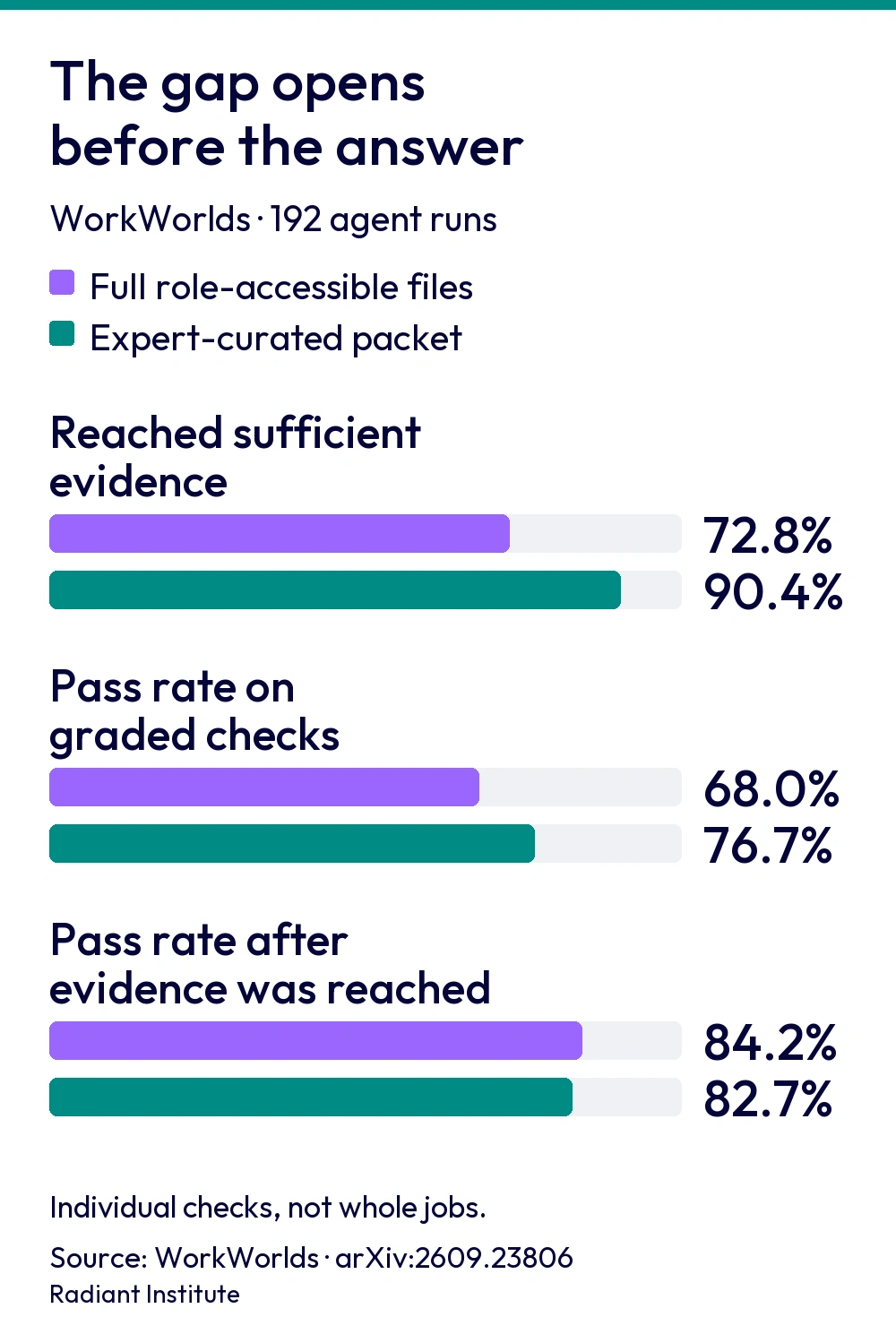
Once the agents had found enough evidence, they passed 84.2% of the checks when they could see every file their role allowed, and 82.7% when the files were hand-picked for them.

In other words, the AI handled the work well once it had the right material. The difference came earlier, and that matters to anyone bringing AI agents into the workplace.

With AI agents at work, the gap opens before the answer, at the moment of finding the evidence.

If you have read our piece on managing AI in the workplace, you will know every use of AI needs someone who owns the work. This piece looks at what that work runs on: the files, records, and messages the AI can actually find.

What the WorkWorlds Study Tested

The study is called WorkWorlds, by Yining Hua and Levi Lian, published in September 2026.

Most AI tests hand the agent a neat bundle of documents along with the task. The authors argue that this quietly removes a step every real employee faces.

As they put it, “the company’s databases, networks, and history exist long before a task arises”.

So they built PharmaCo, a fictional pharmaceutical company based on transformed, de-identified organizational material. It holds eight work assignments spread across six employee roles.

Each role comes with an employee projection, meaning everything that role is allowed to see at a given point in time. For two of the roles, that is 775 files, most of them on a shared drive.

The researchers then ran every task in two conditions:

  1. Full projection. The agent gets everything the role can see and has to find what matters.
  2. Curated packet. Domain experts pick the relevant sources in advance, a median of 9.

Across 192 runs, everything else stayed the same: the company, the task, the role, the agent, and the grader.

Where the AI Agents Slipped: Finding the Evidence

Here is what changed when the files were hand-picked:

  • Access to sufficient evidence rose from 72.8% to 90.4%, a gain of 17.6 percentage points
  • The pass rate on graded checks rose from 68.0% to 76.7%, a gain of 8.7 percentage points
  • File and record inspections fell from 28.6 to 15.2 per run
  • Tool calls fell from 34.1 to 23.2 per run

Each task was scored against a set of criteria, so these are pass rates on individual checks, not whole jobs completed.

All three agents did better with the curated packet, and so did seven of the eight tasks.

Yet once an agent had reached enough evidence, the two conditions looked almost identical. The researchers sum it up in one line:

What changed was how often the agent got there.

To me, that is good news about AI. The reasoning held up, and the slip happened during the search.

One fair caveat: this is one simulated company with eight tasks, so treat it as a strong signal rather than a universal rule.

WorkWorlds comparison: sufficient evidence reached, 72.8% with full files versus 90.4% with curated files; graded-check pass rate, 68.0% versus 76.7%; pass rate after evidence access, 84.2% versus 82.7%.

AI Agents in the Workplace Run on Your Information Environment

Inside your company, nobody hands AI a curated packet. It works from your shared drives, your inboxes, and three versions of the same deck.

Take a common request as an example. A manager asks, “Why did profitability fall last quarter?”

The folder holds sales reports and marketing results, but no cost data.

An agent that stops at the first plausible file will offer a confident cause. A strong answer says what the evidence supports, names what is missing, and asks for the cost figures before drawing a conclusion.

That is the skill this study points to. At Radiant Institute, we call it Find, Filter, Frame. It starts as a human skill. Once your people can do it well, they build it into how their AI agents work.

Here is how each move looks for the profitability question, first for you and then for your agent:

  1. Find. Locate the evidence the task needs, across every place it lives.
    • You: Before asking the question, you list where the answer could live: the sales report, the marketing results, and the finance team’s cost sheet.
    • Your agent: You add that list to the agent’s instructions, so it checks all three places before it answers.
  2. Filter. Separate what matters from what only looks relevant, including outdated versions and unrelated files.
    • You: You notice the folder holds two sales reports, and the older one came out before the regional figures were corrected.
    • Your agent: You tell the agent to use the latest version of each file and to name the files it relied on.
  3. Frame. State what the evidence supports, what it cannot support, and what is still missing.
    • You: You tell your manager that sales fell in two regions, and that the cost data is still needed before naming a cause.
    • Your agent: You ask the agent to end every answer with two short lists: what the evidence supports, and what it still needs.

WorkWorlds measured AI agents, so Find, Filter, Frame is our way of applying the finding. The pattern will feel familiar to anyone who has watched a capable colleague lose a morning hunting for the latest version of a file. The more clearly your people can spell out these three moves, the easier it becomes to write them into the instructions, checklists, and review steps their agents follow.

Our earlier pieces on the Anthropic State of AI Agents report and Prompting 2.0 looked at agents as workflow executors. This study adds the step before that: an agent has to find what the workflow runs on.

A Wealth of Information

Herbert Simon grew up in Milwaukee. As an undergraduate, a field study for a term paper sparked his interest in how organizations actually make decisions.

That curiosity shaped his whole career. In 1978, it earned him the Nobel Prize in Economics for his research into decision-making inside organizations.

Long before shared drives existed, he gave a talk titled Designing Organizations for an Information-Rich World, later published in 1971. In it, he made a point that reads like a summary of the WorkWorlds results:

A wealth of information creates a poverty of attention.

Simon argued that information consumes the attention of whoever receives it. The scarce resource becomes the attention needed to sort through it all.

AI agents face the same problem. More files meant almost twice as many inspections before the agent reached what mattered.

Organizations that design their information well give both people and AI more attention to spend on the actual work.

Implications for Leaders and L&D

  • Test AI in real conditions. A pilot run on a tidy sample folder measures something different from daily work. WorkWorlds shows that how you prepare the information changes the results you see.
  • Treat the information environment as part of AI readiness. Where files live, which version is current, and who can see what all shape how well AI performs.
  • Build evidence skills alongside prompting. Anyone in charge of talent development can add evidence discovery to AI training, so people learn to judge what the AI found as well as what it wrote.

Try This This Week

  • Pick one recurring task your team uses AI for. List every file it needs, where each one lives, and which version is current.
  • Before accepting an AI answer on a real question, ask it which sources it used and what information it did not have.
  • Use the AI Momentum Framework to look at Sensemaking, the mode where information turns into understanding, and spot where your team loses time finding evidence.

Closing Thoughts

WorkWorlds shows that AI agents handle workplace tasks well once they find the right evidence, and that most of the measured gap opens before they get there. For AI agents in the workplace, the information environment is part of the work. If your teams need help building the habits to Find, Filter, and Frame evidence with AI, reach out to Radiant Institute about AI enablement training.

Maverick Foo

Maverick Foo

Lead Consultant, AI-Enabler, Sales & Marketing Strategist

Partnering with L&D & Training Professionals to Infuse AI into their People Development Initiatives 🏅Award-Winning Marketing Strategy Consultant & Trainer 🎙️2X TEDx Keynote Speaker ☕️ Cafe Hopper 🐕 Stray Lover 🐈

0 Comments

Share this
Send this to a friend