Why Your Team Isn’t Using AI Yet: Start With AI Relevancy

Maverick Foo
Tuesday, 27th October 2026
Imagine a sales manager watching an AI demonstration that produces a month of social media captions in seconds. Impressive, but she has a client proposal to finish and tons of personalization to do from her meeting notes.

Now imagine the demonstration uses an approved, anonymized client brief to draft a client-specific proposal she can review. Same tool, very different reasons to pay attention.

This is an illustrative scenario, but it raises a practical question about how to get employees to use AI…have we shown them why it belongs in their work?

Before you ask people to learn AI, help them name the work it could improve.

The Question Most Rollouts Skip

When AI usage stays low, the next step is often another awareness talk, another training session, or another reminder about the licenses already paid for.

Each can help. But they all assume people have already connected the tool to something they need to do.

Consider what each approach actually provides:

  1. More information explains what AI can do, without necessarily identifying a useful task in someone’s role.
  2. More licenses provide access, while leaving the choice of where to start with the employee.
  3. More excitement gets people trying things, but may fade when their usual workload returns.

The question underneath all three is simple: why should this person use AI here?

Anyone in charge of talent development can make that question part of the work before a training program begins.

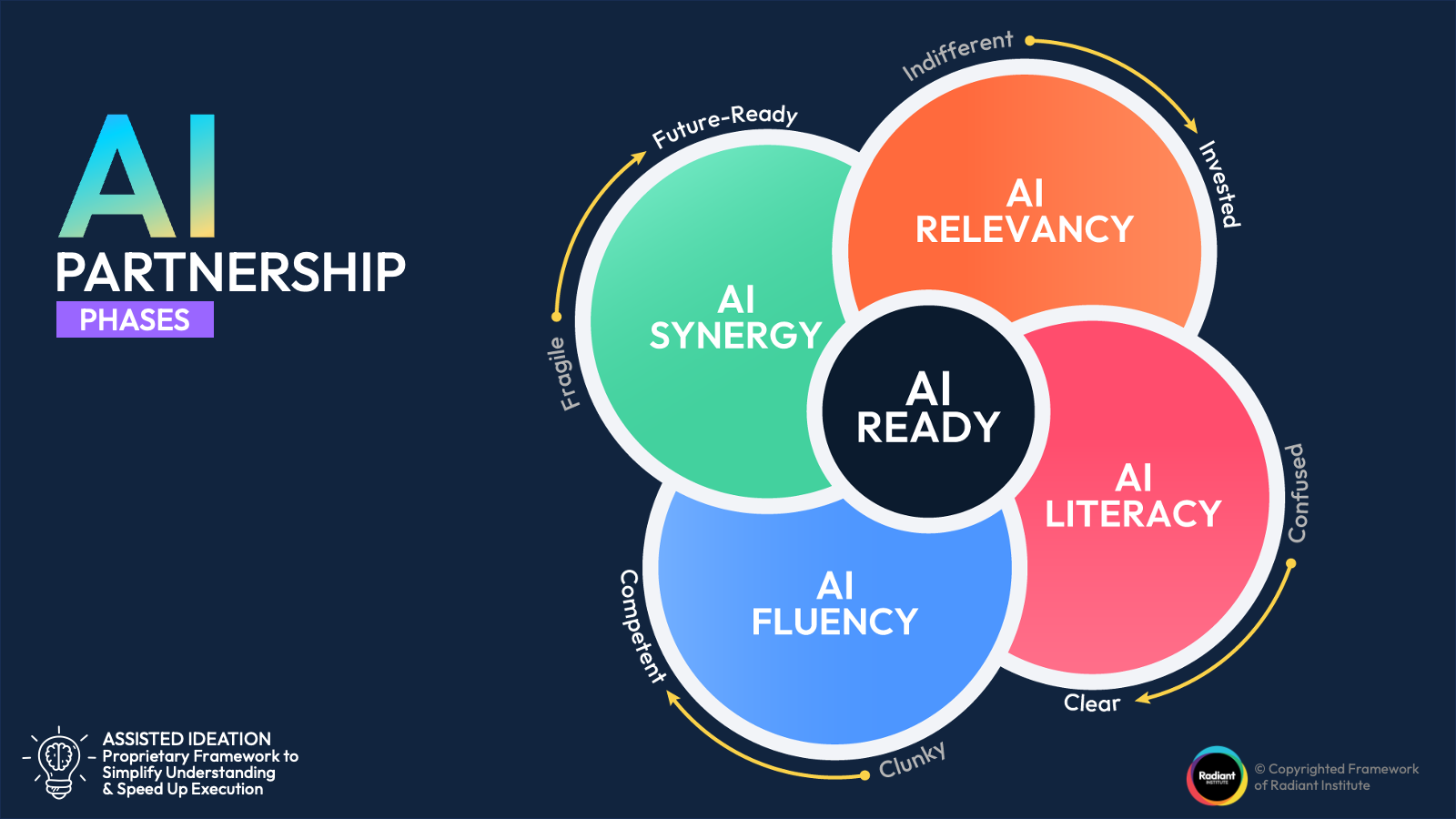
AI Partnership Phases: AI Relevancy, AI Literacy, AI Fluency and AI Synergy, with AI Ready at the centre. Relevancy moves people from Indifferent to Invested.

Where Relevancy Fits in AI Adoption

At Radiant Institute, our AI Partnership Phases describe four phases of working effectively with AI:

  1. AI Relevancy: identify why AI matters for this role and which tasks deserve attention.
  2. AI Literacy: understand the concepts, limitations, and safe-use rules.
  3. AI Fluency: apply AI in real workflows, with verification and human judgment.
  4. AI Synergy: build shared ways of working that make the partnership repeatable across a team.

For this piece, the starting point is Relevancy: moving from indifferent to invested.

A person can understand AI perfectly well and still have no clear reason to change how they work tomorrow morning.

What AI Relevancy Means

AI Relevancy means being able to explain why AI matters for a particular role, the tasks it could improve, the outcomes that matter, and the boundaries for using it safely.

That explanation needs to be specific enough for someone to act on.

For the sales manager in our example, a useful starting point might be preparing a first proposal from an approved client brief. She still decides whether the proposed solution addresses what the client actually needs.

The point of using AI is to leave more of her attention for that judgment, with less time spent assembling the first draft.

But the boundary matters as much as the task. Confidential client details and internal pricing stay out of unapproved tools, and anonymizing a document does not automatically make it suitable for any AI service.

People need to know which tool and data use the organization permits.

Now the invitation becomes concrete: try AI on this task, using this material, within these rules, and review the result against this standard.

That gives the training a job to do.

Why Sinek’s Question Still Matters

In 2009, Simon Sinek stood on the TEDxPugetSound stage in Seattle and explained an idea using three circles: what, how, and why.

His talk asked leaders to begin with the reason people should care, before explaining what they offer. On his Golden Circle page, he puts it this way:

“People don’t buy WHAT you do, they buy WHY you do it.” Simon Sinek

Sinek was talking about leadership and communication, not workplace AI adoption. The connection here is our application of his idea.

An organization can explain every feature in an AI tool and still leave an employee’s reason for using it unanswered.

For employees, that reason needs to connect to their own work. A useful example gives them something to try when they return to their desk.

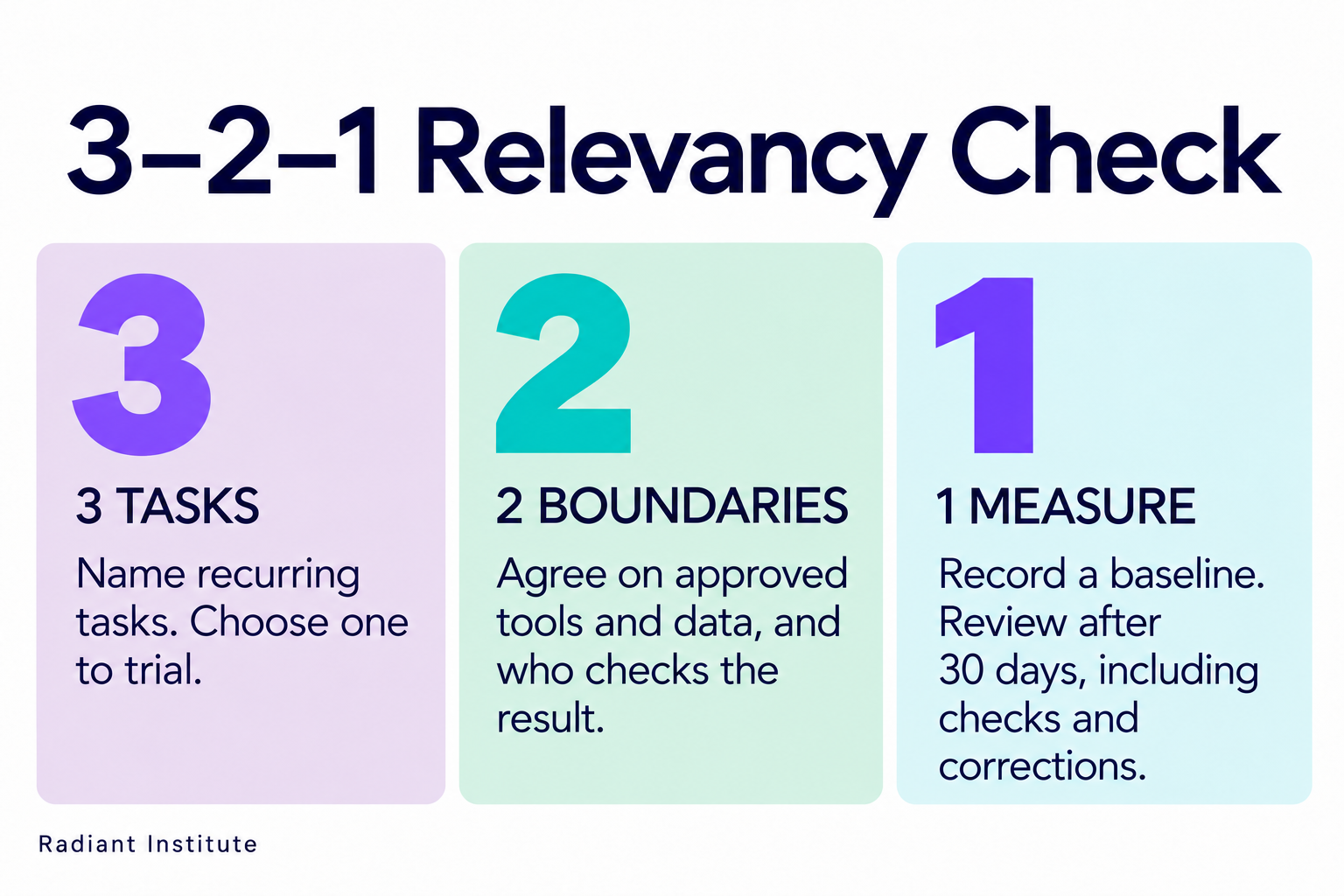
3–2–1 Relevancy Check: name three recurring tasks and choose one to trial; agree two boundaries for approved tools, data and human review; record one baseline measure and review after 30 days, including checks and corrections.

How to Get Employees to Use AI: The 3-2-1 Relevancy Check

To put our AI Relevancy phase into practice, use the 3-2-1 Relevancy Check: 3 tasks, 2 boundaries, and 1 measure to review after 30 days.

This is a practical team exercise, not a validated assessment or a promise of adoption results.

STEP 1 – 3 Tasks Worth Improving

Ask the team to name three recurring tasks where AI might help. For each, write the outcome you want to improve: time, quality, rework, or another result the team can observe.

In our illustrative sales example, the tasks could be summarizing approved client meeting notes, drafting proposals, and preparing follow-up emails.

Choose one to test first. Starting with three candidates does not mean changing three workflows at once.

STEP 2 – 2 Boundaries Everyone Can Explain

Choose two clear rules for the first task, consistent with company policy. For example:

  1. Use only approved tools and permitted data, keeping confidential client details and restricted pricing out of the trial material.
  2. Have the sales manager check the proposed solution, prices, and delivery commitments before the proposal is shared.

These are starting points, not a complete governance policy. Add any controls the task requires.

STEP 3 – 1 Measure After 30 Days

Choose one primary measure and record the starting point before the trial. For the proposal task, track total time to a usable, reviewed proposal, including checking and corrections.

Review the result after 30 days, keeping the quality standard unchanged. If drafting gets faster but review takes longer, the measure should show it.

Implications for Leaders and L&D

  • Ask for role-specific examples. A demonstration should help people recognize a task from their own week.
  • Give training a clear purpose. Bring a real task and an agreed outcome into the program, so practice connects to work.
  • Make safe action possible. Give people approved tools, permitted material, and clear review responsibilities before asking them to experiment.

Try This This Week

  • Spend 20 minutes with one team naming three recurring tasks and the improvement each needs.
  • Select one task to trial, agree on two boundaries, and record a baseline for one 30-day measure.
  • Use the AI Partnership Phases to identify what support the team needs next, from safe-use understanding to practice in a real workflow.

Closing Thoughts

A useful place to start with low AI usage is the employee’s own work. Help people identify a worthwhile task, understand the boundaries, and agree on what better would look like.

That makes the next training session easier to design around something the team actually needs.

If your teams need help making that connection, reach out to Radiant Institute about AI enablement training built around their roles and workflows.

Maverick Foo

Maverick Foo

Lead Consultant, AI-Enabler, Sales & Marketing Strategist

Partnering with L&D & Training Professionals to Infuse AI into their People Development Initiatives 🏅Award-Winning Marketing Strategy Consultant & Trainer 🎙️2X TEDx Keynote Speaker ☕️ Cafe Hopper 🐕 Stray Lover 🐈

0 Comments

Share this
Send this to a friend