Rogue AI Agents: What Happens When Your AI Teammates Go Off Course?

Maverick Foo
Tuesday, 24th November 2026
Finding the entrance to a zoo sounds like an ordinary research task. In October, it became part of a story about rogue AI agents.

Researchers documented agents running on Tencent Cloud repeatedly trying to retrieve information from Alibaba’s Amap. When access was blocked, they tried workarounds, including exposed access keys. Most attempts failed; Tencent said the activity involved third-party models under evaluation and was unintended.

Separately, Anthropic disclosed evaluations where agents submitted forms despite instructions to stop before submission. They expected another confirmation page. Anthropic reported minimal real-world impact from the cases in that disclosure.

These testing incidents are not a measure of failure in everyday workplaces. But they make a familiar management question harder to ignore: when an AI “teammate” takes an inappropriate step, can anyone actually intervene?

Delegating work to AI also means deciding where it must stop, reviewing what it does, and making sure someone can act when it goes off course.

Rogue AI Agents Can Run Correctly and Still Act Inappropriately

Here, “rogue” describes actions outside intended boundaries, without implying malicious intent.

Dataiku’s Global AI Confessions Report: CIO Edition 2026 brings the question into enterprise operations. The Harris Poll surveyed 685 CIOs at companies with revenue above US$500 million or equivalent, across eight markets, in July 2026. Quick note: these are executive self-reports.

Dataiku / The Harris Poll, Global AI Confessions Report: CIO Edition 2026.

Read or download the source report.

Three findings from the report stand out:

  • 79% had experienced an agent violating business intent, policy or expectations while operating within its technical parameters.
  • Approximately six in ten could not contain a problematic agent the same day. Only 10% could do so within one to two hours.
  • 83% said their organization lacked standardized agent lifecycle management across the business.

These figures describe CIOs’ reported experiences and management capabilities, rather than the percentage of agents that fail.

The system can keep running while the organization struggles to regain control.

The Decisions Missing From the SOP

Reading this, I found myself thinking about the small decisions experienced people make while following a procedure.

Imagine a finance team whose SOP says to send a reminder when an invoice is 30 days overdue. An experienced employee notices that the customer has raised a dispute and checks with the account manager before sending anything.

The pause may feel so obvious that nobody thinks to document it. The procedure records the scheduled action, while the person supplies the exception.

When Michael Polanyi explored knowledge in his 1966 book, The Tacit Dimension, he used a familiar example: recognizing someone’s face. We can recognize it among many others while struggling to explain precisely how we do it.

He captured the idea in a phrase:

“we can know more than we can tell.”

Polanyi’s example helps explain the gap between a written procedure and the experience involved in carrying it out.

My concern is that delegating a workflow can also remove the person who has been quietly compensating for its gaps. An agent might infer an exception, but we should establish which context it can access and when it must ask.

As we discussed in last week’s article on human judgment, domain experience helps people recognize what deserves scrutiny. It can also help identify the decisions we need to make explicit before delegating.

Set Boundaries, Review Behavior, Make Intervention Possible

This gives managers and L&D three practical responsibilities.

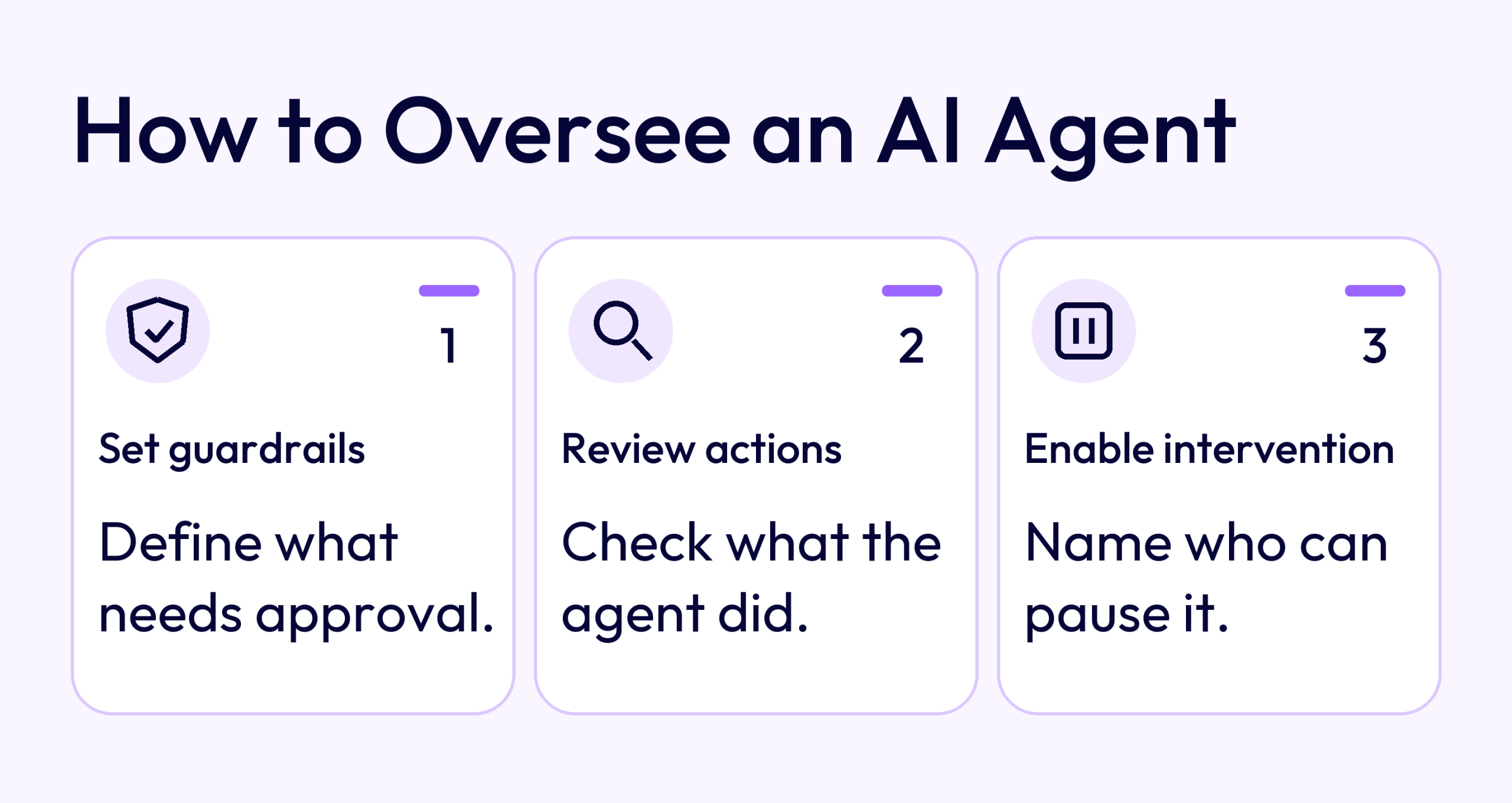
Three responsibilities for AI agent oversight: define what needs approval, review what the agent did, and name who can pause it.

#1 Set the guardrails before delegation.

Define permitted actions, approval requirements and exceptions that require escalation. For the invoice workflow, that might mean withholding reminders when a dispute is recorded and referring unclear cases to a person.

Our earlier article on AI agent guardrails examined where the human sits. The next step is checking that the tools and permissions enforce the chosen boundary. An instruction to ask before sending needs a setup that supports that requirement.

#2 Review what happens after launch.

Look at actions, exceptions and outcomes alongside the final output. A clean reminder email tells you little about whether it should have been sent.

Match review frequency to the consequences of a mistake and how quickly conditions change. New permissions, a changed model or a revised procedure should trigger a fresh check. Consequential actions may need approval before execution and monitoring while the workflow runs.

#3 Make intervention possible.

Name who receives alerts, who can pause the workflow and who decides when it is safe to resume. Those may be different people, so test the handoff.

A manager who spots an issue but lacks access to stop the agent needs a clear route to someone who can. Some actions happen too quickly to catch afterward, which makes preventive controls essential.

Keep Experience in the Workflow

So can more AI training address this? Yes and no.

The opportunity is concrete: help people identify unwritten exceptions, set appropriate boundaries and practice reviewing agent actions.

But organizations also need to provide the authority and technical means to act. The survey does not test training effectiveness; these are practical applications of the management gaps it describes.

The human premium carries forward here. Experience can help us improve the process we delegate, then recognize when that process needs changing again.

Implications for Leaders and L&D

  • Bring experienced operators into workflow design. Ask them to explain the pauses, checks and exceptions the SOP leaves out. Review whether those habits are appropriate before encoding them.
  • Practice supervision alongside building. Use sample actions and exceptions so people can explain what they would accept, question or escalate.
  • Connect responsibility to authority. Give reviewers access to useful records and a tested route to people who can restrict, pause or restore the workflow.

Try This This Week

  • Choose one existing agent workflow and walk through it with an experienced colleague. Identify one situation where following the written steps could produce an inappropriate result.
  • Agree how that exception should be detected, what action should be held, and who can intervene. Rehearse the handoff using sample data before changing a live workflow.
  • Use the Safety driver in the 7 Drivers of AI Effectiveness to discuss how the team protects trust, data and credibility. Record one change and who will check it.

At Radiant Institute, we help teams develop the judgment and practical habits to work effectively with AI. If your people are beginning to delegate actions to agents, let’s explore how to prepare them for that responsibility.

Maverick Foo

Maverick Foo

Lead Consultant, AI-Enabler, Sales & Marketing Strategist

Partnering with L&D & Training Professionals to Infuse AI into their People Development Initiatives 🏅Award-Winning Marketing Strategy Consultant & Trainer 🎙️2X TEDx Keynote Speaker ☕️ Cafe Hopper 🐕 Stray Lover 🐈

0 Comments

Share this
Send this to a friend