Managing AI in the Workplace: What KPMG’s AI Pulse Reveals About Ownership

Maverick Foo
Tuesday, 20th October 2026
KPMG surveyed 2,131 senior leaders across 20 countries for its Q3 2026 Global AI Pulse, and one finding stood out to me. 34% of organizations now report significant employee adoption of AI agents, up from 25% in Q1.

Part of the work in many teams is now done by AI, which raises a practical question about managing AI in the workplace…who is actually managing it?

The report gives a clear answer at the top of the organization. Inside the team, the answer is much less clear, and that gap matters to anyone in charge of talent development.

AI gets managed at two levels. A leader owns the system, and a manager owns the work.

The Top Level: Someone Owns the System

The good news is that ownership at the top is taking shape. KPMG found that 53% of organizations place accountability for AI-informed decisions at C-suite level or above:

  • 35% with a named executive, such as a chief operating officer, chief AI officer, or chief information officer
  • 18% with the CEO or executive committee

The report also tracks what it calls an "AI harness layer," meaning the tools, controls, and processes that sit between AI models and the people who use them. 55% of organizations now run a formal one. Among organizations already reporting established returns, that figure rises to 86%, compared with 31% of those still experimenting. The survey shows the two travel together. It does not prove one causes the other, but the pattern is hard to ignore.

KPMG sums up the stakes in one line: a control layer without a named owner "is a policy rather than a management system." In plain terms, controls only work when someone answers for them.

The Gap in the Middle

Here is what the report covers far less:

What happens inside the team, day to day.

It tells us who owns AI at the executive level. It says much less about who decides which tasks a team hands to an AI agent, who checks the output, and who answers for it when the output is wrong.

Yet the team level is where things are moving fastest. Three numbers from the survey show it:

  • 34% of organizations report significant employee adoption of AI agents, up 9 points since Q1
  • Among organizations already reporting returns, adoption reaches 48% and resistance of any kind falls to 3%
  • At the proof-of-concept stage, those same figures are 15% and 26%

To me, that reads as an enablement gap. Ownership has been named at the top, and the work has already started moving underneath it.

The layer in between is the manager, and that is the part the data says least about.

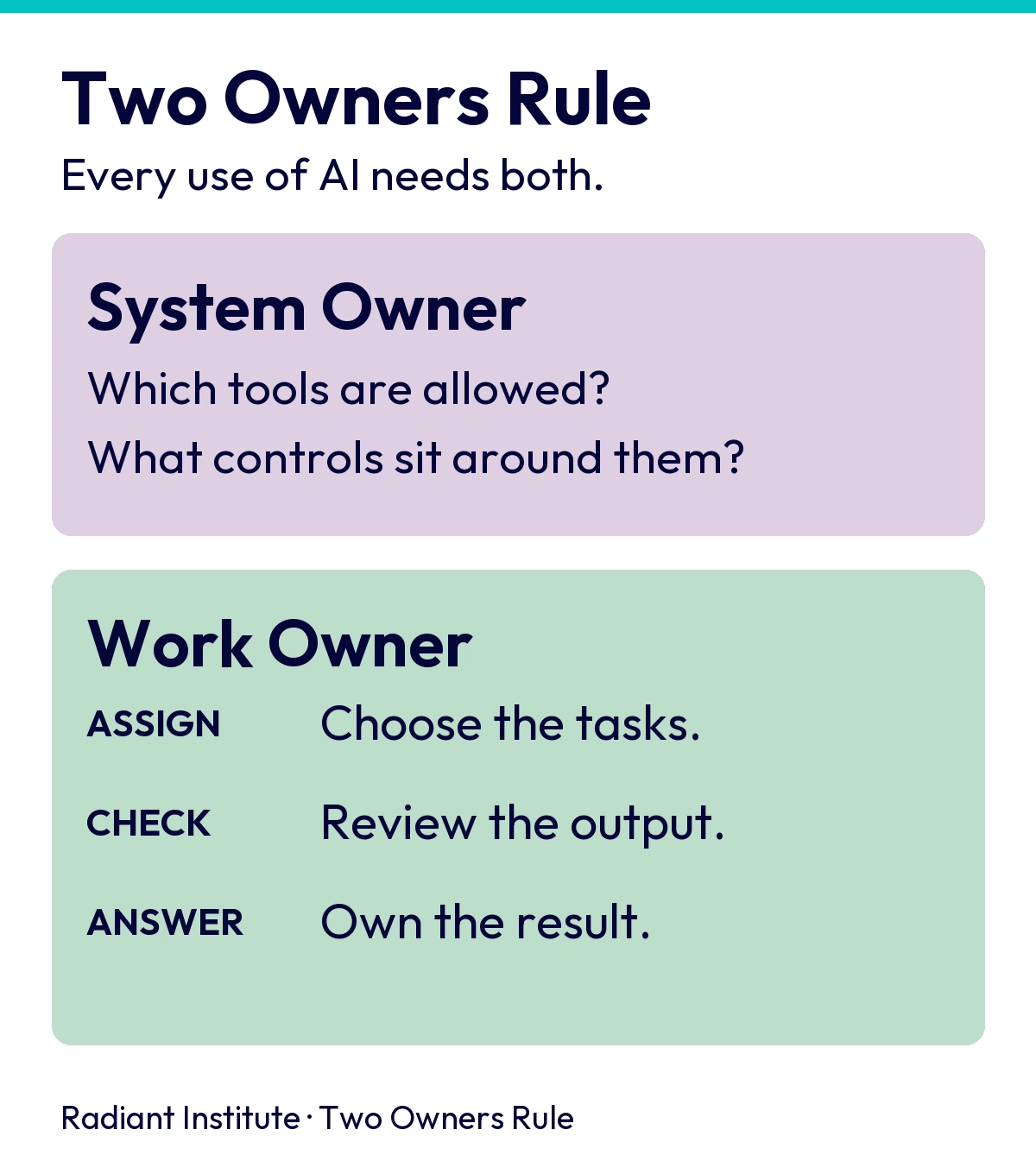
Two Owners Rule: System Owner controls allowed tools and safeguards; Work Owner assigns tasks, checks output and answers for results.

What Managing AI in the Workplace Looks Like at the Team Level

At the team level, the manager's job now includes AI.

That can sound abstract, so take a monthly sales report as an example. A team member uses an AI agent to pull the numbers from the CRM and draft the commentary. The System Owner has already decided the agent may access CRM data. But nobody has decided who checks the commentary before it goes to the regional head, so the answer defaults to whoever happens to notice.

That is where the manager comes in. At the team level, managing AI comes down to three moves:

  1. Assigning. Decide which tasks AI does, which stay human, and which are shared.
  2. Checking. Decide what gets reviewed before it leaves the team, and by whom.
  3. Answering. Own the result when AI gets it wrong, the same way you would for a team member.

At Radiant Institute, we call this the "Two Owners Rule": every use of AI needs a System Owner and a Work Owner. The System Owner decides which tools are allowed and what controls sit around them. The Work Owner decides how the tool is used on the job and answers for the result. If you have read our piece on managers as AI conduits, this will sound familiar.

KPMG's own data points the same way. Priya Emmanuel, Global Head of aIQ at KPMG International, describes what the organizations seeing a return did: "guardrails in place, workforce ready, data cleaned up. That is a sequence, not a secret."

Guardrails come from the System Owner. A ready workforce depends on the Work Owner.

A Bad System Will Beat a Good Person

In 1950, an American statistician named W. Edwards Deming was invited to Japan to teach quality methods to the engineers and executives rebuilding the country's industries after the war.

Japanese companies built his ideas into daily work, and Japan's top quality award still carries his name.

Back home, most American managers had never heard of him until 1980, when an NBC documentary called If Japan Can… Why Can't We? introduced him to a national audience. He was 79.

Deming spent the rest of his career making one argument to managers: most results come from the system people work in, far more than from individual effort. He put it bluntly in a 1993 seminar:

"A bad system will beat a good person every time."

AI makes his point sharper. A capable employee with a capable AI agent can still produce a poor result when nobody owns the system or the work. Good people need a good system around them, and with AI in the team, that system needs two owners.

Implications for Leaders and L&D

  • Ownership at the top needs a partner in the team. A named executive can own the AI system, but every team using AI also needs someone who owns the work.
  • Managers need new skills. Assigning, checking, and answering for AI output are management skills, and many manager development programs were designed before AI agents were part of the team.
  • The priorities are already shifting. KPMG found that human-AI collaboration and responsible AI each gained 4 points as top priorities, to 32% and 30%, while productivity fell 5 points to 37%. Anyone in charge of talent development can use that shift to make the case for manager training.

Try This This Week

  • List every AI tool or agent your team uses, then write two names next to each one: who owns the system and who owns the work.
  • Pick one AI-assisted output that leaves your team this week and decide in advance who checks it before it goes out.
  • Use the AI Enablement Framework to define the human role for each AI task, so everyone knows where they stand alongside the tool.

Closing Thoughts

KPMG's latest AI Pulse shows ownership taking shape at the top, with more than half of organizations now placing accountability for AI-informed decisions with the C-suite. The next step sits inside the team, where AI agents already do part of the work. Managing AI in the workplace needs both levels: a leader who owns the system and a manager who owns the work. If your managers need support building that second level, reach out to Radiant Institute about AI enablement training for your teams.

Maverick Foo

Maverick Foo

Lead Consultant, AI-Enabler, Sales & Marketing Strategist

Partnering with L&D & Training Professionals to Infuse AI into their People Development Initiatives 🏅Award-Winning Marketing Strategy Consultant & Trainer 🎙️2X TEDx Keynote Speaker ☕️ Cafe Hopper 🐕 Stray Lover 🐈

0 Comments

Share this
Send this to a friend