AI and Middle Management: The Adoption Bottleneck No One Budgets For

Maverick Foo
Tuesday, 16th June 2026
AI is reshaping every layer of the organisation. But there is one layer where the outcome is quietly decided, and most rollout plans walk straight past it.

That layer is middle management.

We have spent the last two years treating AI adoption as a technology problem: the tools, the models, the rollout plans. Gallup’s 2026 State of the Global Workplace report keeps pointing somewhere else, at the person one layer above the team.


The Real Constraint is Human Readiness

The investment is real, and the returns are lagging. Gallup cites an MIT study finding that despite roughly 40 billion dollars in enterprise investment, 95 percent of organisations have seen zero measurable impact on profits, alongside an NBER survey in which 89 percent of executives report no effect on labour productivity.

The technology works. The gains are getting stuck somewhere between the licence and the outcome, between the access and the application. As Gallup’s CEO puts it:

Even the most sophisticated neural network cannot overcome an indifferent team leader.

That line reframes the whole problem. The binding constraint is organisational readiness, and readiness is a leadership job.

Why the Manager is the Multiplier

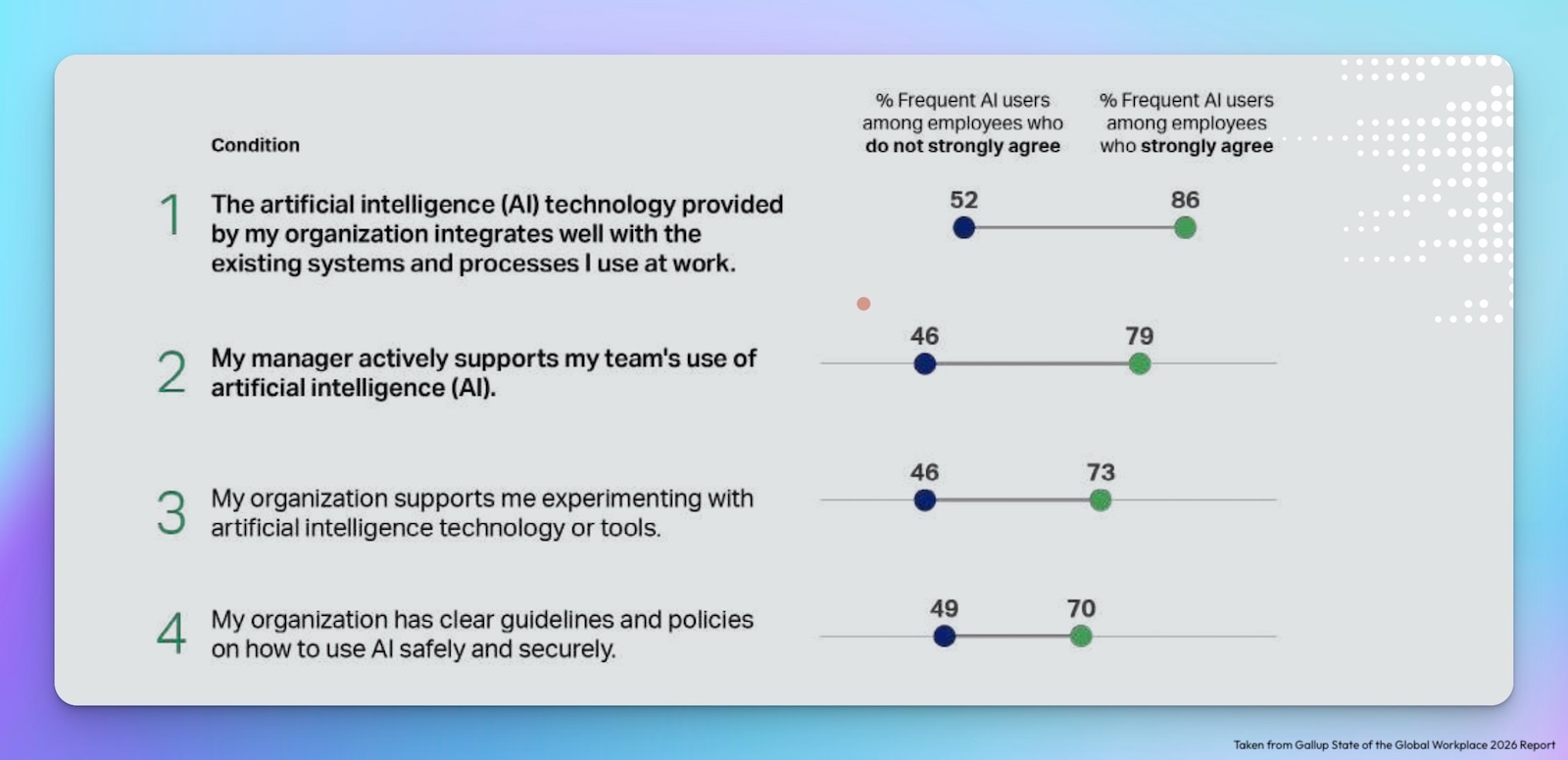
Here is the number that should change how you budget. In organisations investing in AI, employees who strongly agree that their manager actively supports their team’s use of AI are 98.7 times more likely to say AI has transformed how work gets done.

That is the difference between a tool that sits idle and a tool that reshapes the work.

Yet active support is thin on the ground. Less than one in three US employees strongly agree that their manager actively champions AI use, and a Gallup study in Germany put the figure at 21 percent.

Most managers are permitting AI. Far fewer are championing it.

The distinction is everything. Permitting means staying out of the way. Championing means showing your team how you used AI to solve a real problem, what you learned, and how they can do the same starting tomorrow.

The Manager is Also Burning Out

Asking managers to lead this shift would be reasonable if they were thriving. Many are not.

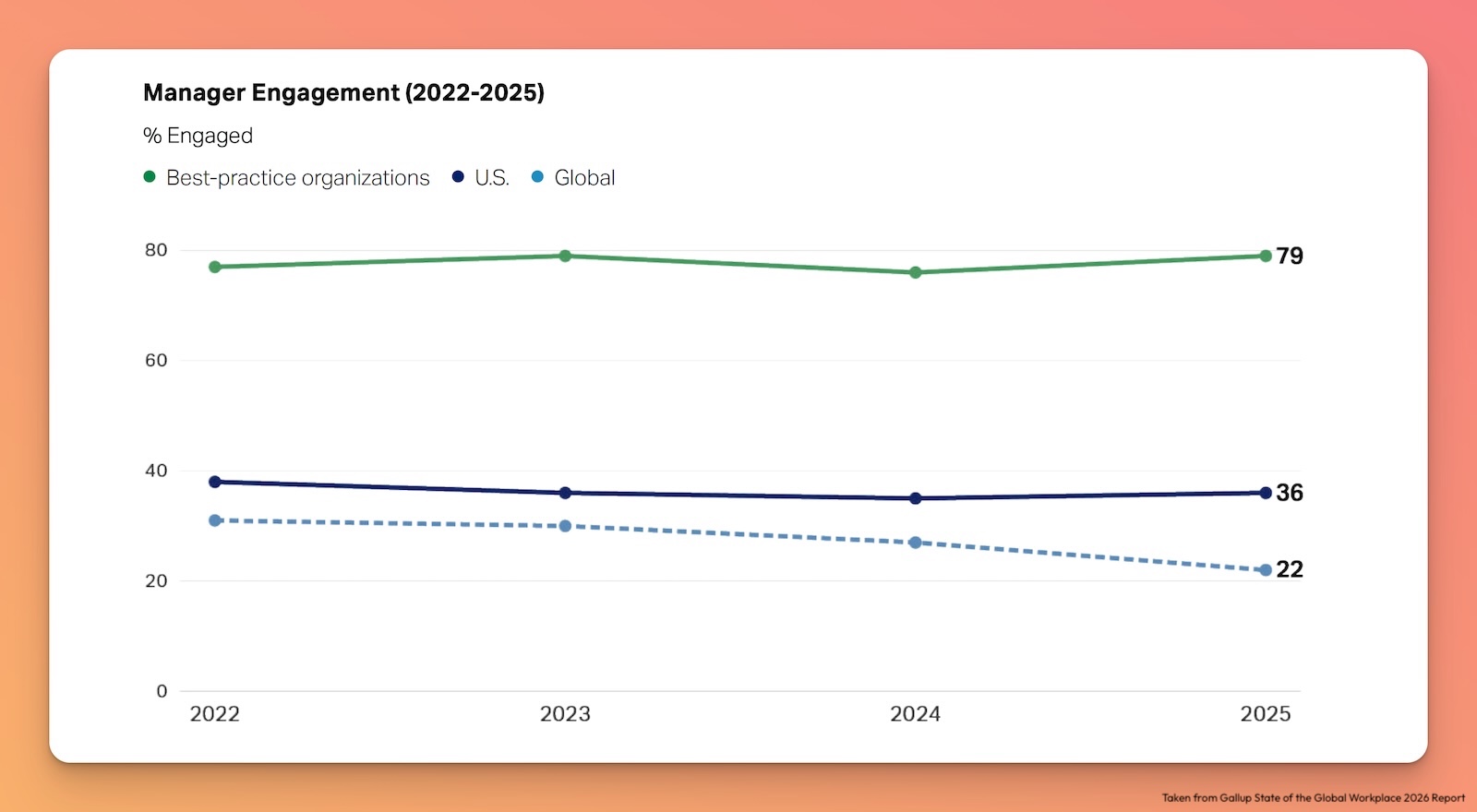
Manager engagement fell five points to 22 percent between 2024 and 2025, the largest single-year drop Gallup has recorded. The old engagement premium, where managers were more engaged than the people they led, is fading. Managers are now only as engaged as their teams.

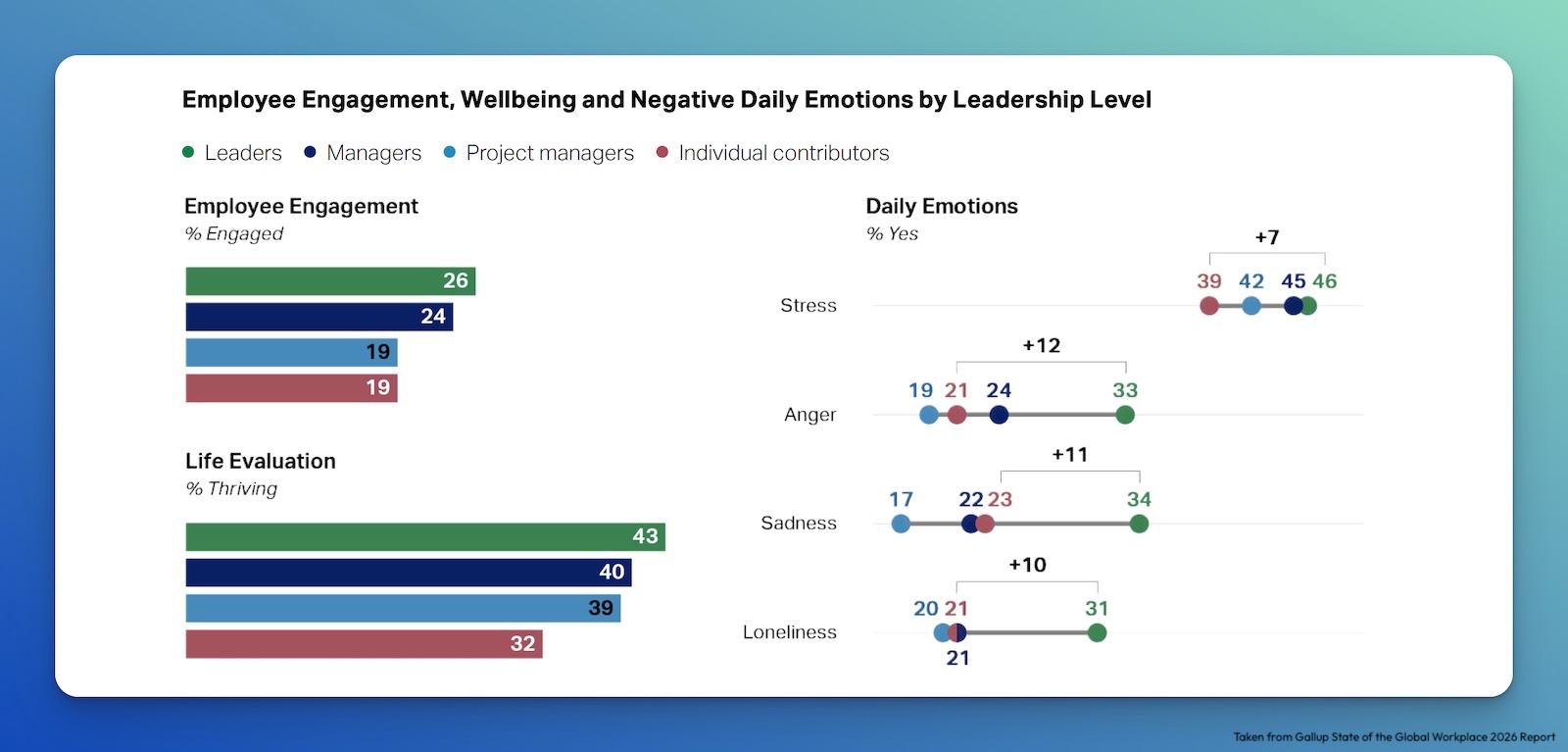
The emotional load is heavier too. Compared with individual contributors, leaders report more daily stress (7 points), anger (12 points), sadness (11 points) and loneliness (10 points). We are asking them to lead the most significant workplace shift in a generation while carrying a weight their teams cannot see, then wondering why adoption stalls.

There is an upside worth holding onto. Engaged managers are 14 points more likely to be thriving in their overall lives. Support the manager, and the manager wins too.

Engagement is Really AI Readiness

Gallup frames employee engagement as a measure of readiness for change. AI is a major disruption, and engaged teams navigate disruption more successfully. Disengagement is costly: low engagement cost the world economy roughly 10 trillion dollars in lost productivity last year, about 9 percent of global GDP.

For leaders in Malaysia and across APAC, there is a window here. Southeast Asia sits at around 25 percent engagement against a global average of 20 percent. That is a readiness advantage, and advantages like this tend to close.

Implications for Leaders and L&D

  • Audit your manager layer before your AI rollout. Most readiness checks measure tools and adoption rates. The sharper question is how engaged your managers are right now, because that answer changes where you invest first.
  • Treat championing as a teachable behaviour. The 98.7x effect comes from active, visible support rather than passive permission, so model it, coach it, and make it visible.
  • Treat manager wellbeing as a prerequisite. You cannot ask someone who is burning out to lead a transformation.

Try This This Week

  • Ask each manager to name three specific, visible actions they took this week to support their team’s AI use. If they cannot name three, you have found your gap.
  • Pick one real business process and have a manager solve it with AI in front of the team, narrating what they learned. Momentum tends to spread from a single visible example.
  • Run the Team AI Effectiveness Scorecard with one team for a clear read on where AI is actually landing. Pay close attention to the Scalability driver from 7 Drivers of AI Effectiveness, which shows whether good practice is spreading or staying stuck with a few individuals.

Ending Thought:

The story of AI in your organisation is written by the manager standing between your strategy and your team, far more than by the model you license. The data is consistent: engaged, well-supported managers who actively champion AI are the multiplier on every dollar you invest.

That makes middle management the highest-leverage place to focus right now. If your AI rollout is not yet delivering what you hoped, this is the layer to examine first.

If you would like help turning your managers into genuine AI champions, the team at Radiant Institute works with HR, L&D, and business leaders to build precisely that capability. We would be glad to talk through what it could look like for your teams.

Maverick Foo

Maverick Foo

Lead Consultant, AI-Enabler, Sales & Marketing Strategist

Partnering with L&D & Training Professionals to Infuse AI into their People Development Initiatives 🏅Award-Winning Marketing Strategy Consultant & Trainer 🎙️2X TEDx Keynote Speaker ☕️ Cafe Hopper 🐕 Stray Lover 🐈

0 Comments

Submit a Comment

Your email address will not be published. Required fields are marked *

Share this
Send this to a friend