The Satisfaction Mirage: Why AI Skill Development Needs More Than Happy Users

Maverick Foo
Tuesday, 13th October 2026
After three months with an AI drafting assistant, junior lawyers rated their drafting experience 1.48 standard deviations (SD) higher than juniors without it. That shows that AI is working, right?

However, when the AI was taken away, their skill had not improved at all (-0.03 SD).

That gap sits at the center of a new NBER field experiment.

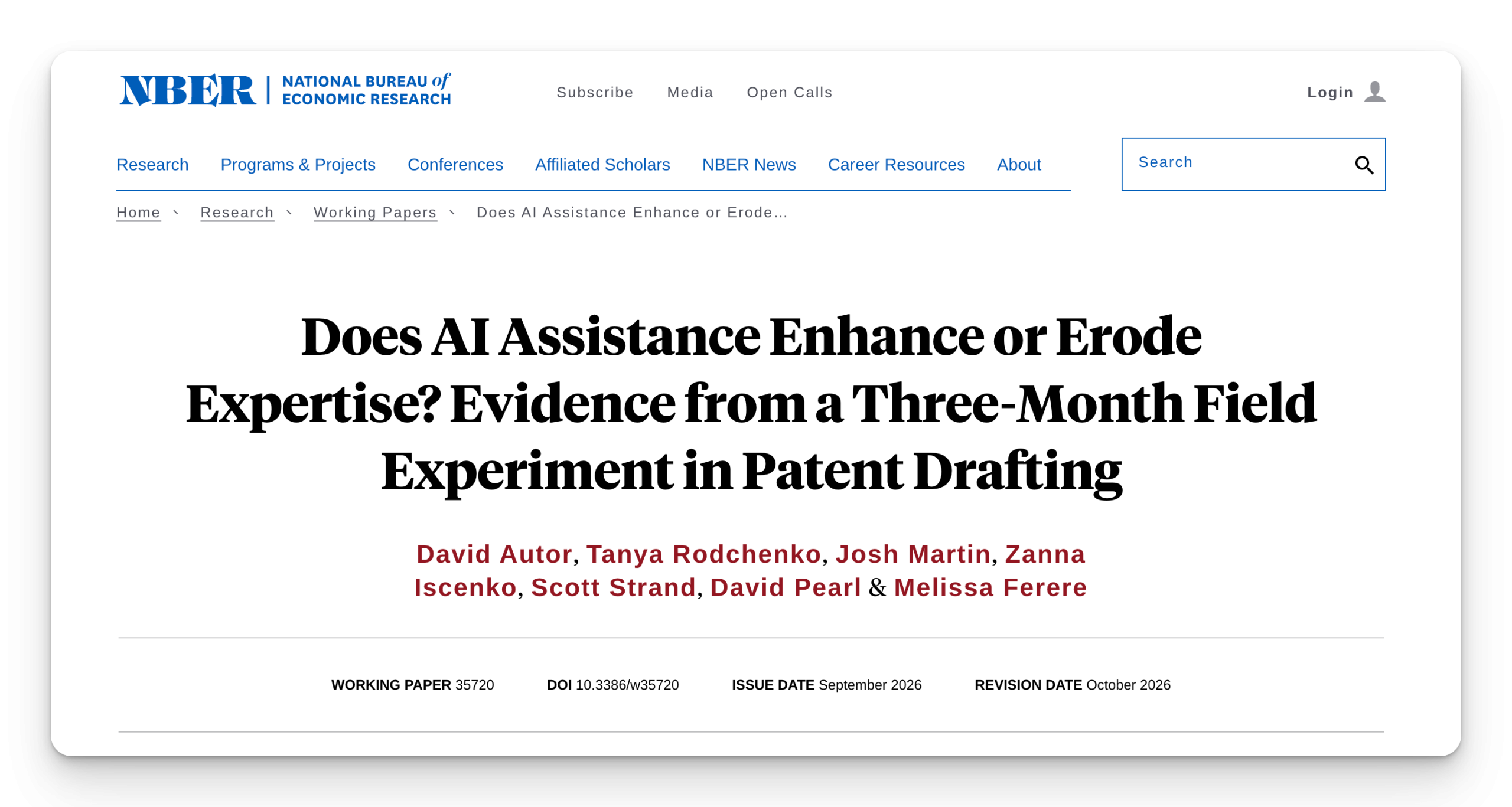
NBER working paper: Does AI Assistance Enhance or Erode Expertise?

The study, led by David Autor and published in September 2026, followed 133 practicing patent lawyers across 11 US firms. Participants were randomly assigned to use the AI assistant or not, and expert attorneys scored all work blind.

The sample may be just one profession, but the pattern applies to any expertise-heavy knowledge work.

Satisfaction tells you how the work felt. Only unassisted work shows what a person learned.

What the Study Found

The researchers measured performance while using AI, and judgment afterward without it. For the second, every lawyer did a "redlining" task: marking up a flawed patent draft with corrections and comments, much like Track Changes in Word. A standard deviation (SD) compares results on one scale, so a bigger number means a bigger gap.

While using AI, junior lawyers showed:

  • Drafting quality up by 0.58 SD at 10 days and 0.60 SD at 90 days
  • Drafting time down by 18 minutes per task at 10 days
  • Satisfaction with their drafting experience up by 1.48 SD at 90 days, the largest effect on any self-reported measure

With AI taken away:

  • Junior lawyers showed no average gain (-0.03 SD)
  • Senior lawyers outperformed their controls by 0.45 SD
  • Junior scores spread out, with fewer middling results and more poor ones alongside some good ones

The authors put it plainly:

"The largest gains from AI thus accrued to the lawyers who retained the least."

Why Satisfaction Is a Poor Measure of Growth

Most organizations judge AI success by adoption, usage and survey scores. Those readings all capture the moment when the person is working with AI. Durable skill, meaning what a person can still do when the tool is gone, is a separate thing. In the paper's words, juniors' accounts of their own development "are not reflected in their performance absent AI."

The Mirage in the Classroom

Physicist Richard Feynman met the same pattern while teaching in Brazil. His students could recite that light reflected from water is polarized, and in which direction. When he asked them to look at the bay through a polaroid and turn it, they had nothing to say. They "had memorized everything, but they didn't know what anything meant."

In his 1974 Caltech address he warned:

"The first principle is that you must not fool yourself, and you are the easiest person to fool."

Fluent output and a good feeling are the easiest things to be fooled by.

Why Experience Changes the Outcome

Seniors gained 0.45 SD, so something different happened for them. In the study's interviews, two seniors said they never accepted the AI's first draft as given. One used it as a "logic auditor" to pressure-test strategic reasoning, and both said a flawed but complete draft pushed them to question gaps they might have passed over. Only four people were interviewed, so treat this as a clue, not proof.

The authors also point to earlier research showing that workflows requiring people to interpret, evaluate or verify AI output build skill, while uncritical acceptance skips the friction skill needs. Seniors had the judgment to question the draft. Juniors, still building it, need a routine that makes them do the questioning.

Building AI Skill Development Into Junior Work With S.H.A.R.P.

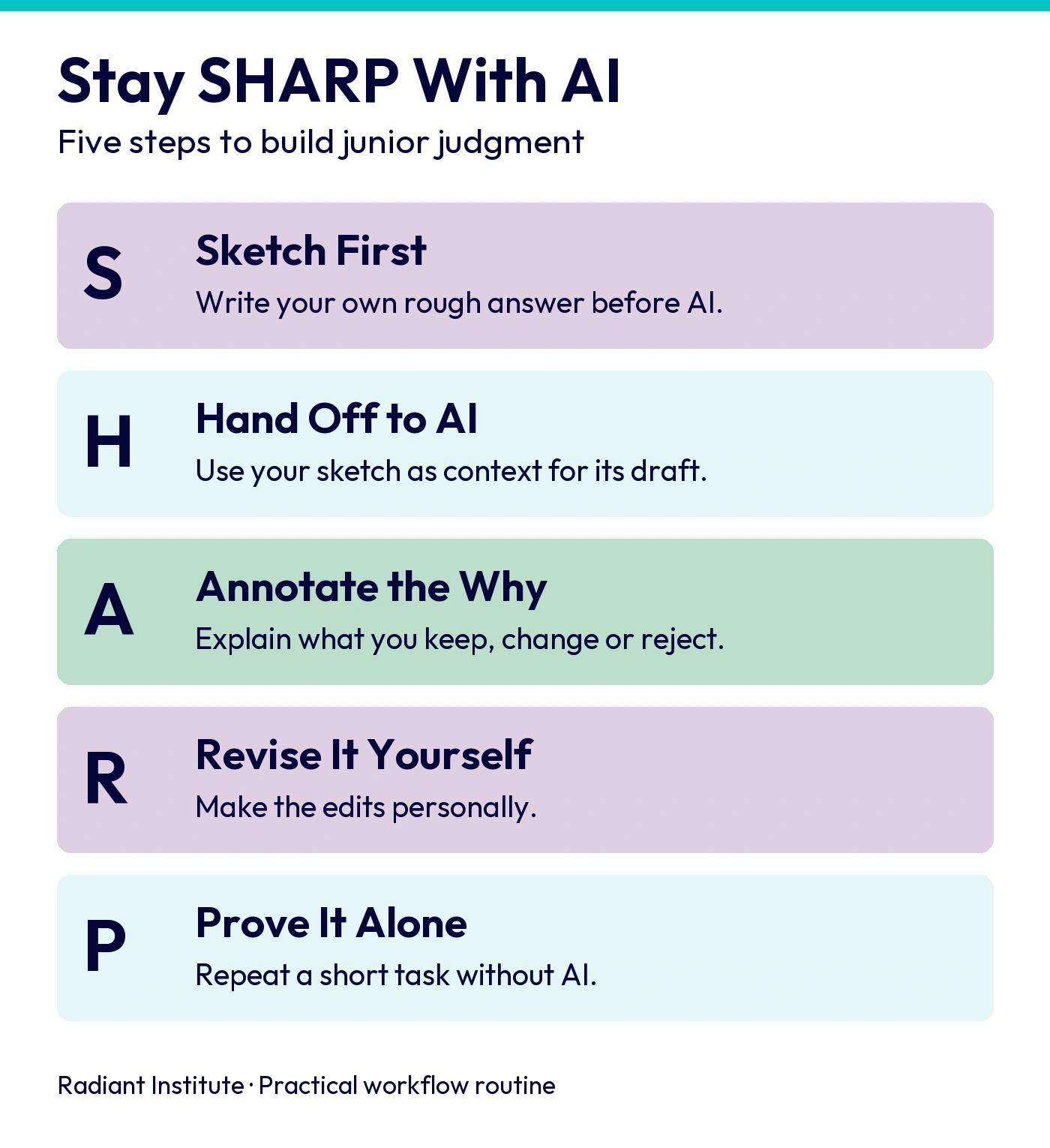
The study did not test a fix, so this routine is Radiant Institute's practical translation of the pattern. SHARP is a five-step routine that puts friction back into AI-assisted work, so juniors build judgment before they hand thinking over.

  1. Sketch First: The junior writes their own outline or rough answer before opening AI, however imperfect. Example: before opening AI, jot down 3 bullets for your weekly project update: what happened, what is at risk, and what you recommend.
  2. Hand Off to AI: AI produces its version, using the sketch as context. Example: paste your 3 bullets and raw notes into AI and ask for a draft update.
  3. Annotate the Why: The junior marks what to keep, change or reject, and writes the reason beside each call. Example: AI calls a delay "minor." You flag it and note why: the client deadline is fixed.
  4. Revise It Yourself: The junior makes the edits personally, rather than asking AI to fix its own draft. Example: rewrite that paragraph yourself, in the tone your manager actually prefers.
  5. Prove It Alone: On a regular cycle, a short task is done without AI to see what has stuck. Example: once a month, write the update with no AI and compare it with your own sketch from step 1.
SHARP: Sketch First, Hand Off to AI, Annotate the Why, Revise It Yourself, Prove It Alone

Implications for Leaders and L&D

  • Measure unassisted capability alongside output. Speed and survey scores only describe the AI-assisted state.
  • Design enablement separately for juniors and seniors. Seniors turned AI into learning, while juniors need structure that builds the judgment first.
  • Decide where the saved time goes. Juniors finished 18 minutes faster, and whether those minutes became reflection or the next task is a management choice.

Try This This Week

Closing Thoughts

AI can make junior staff faster and happier within weeks. That deserves credit, and it is still not evidence of growth. The study shows growth only becomes visible when the tool is removed. Pair your satisfaction and usage numbers with a regular unassisted check, and use routines like SHARP so juniors build the judgment AI needs them to have.

If you are in charge of talent development and want to see how your teams are really building skill with AI, reach out to Radiant Institute to explore how our AI enablement training solutions can help.

Maverick Foo

Maverick Foo

Lead Consultant, AI-Enabler, Sales & Marketing Strategist

Partnering with L&D & Training Professionals to Infuse AI into their People Development Initiatives 🏅Award-Winning Marketing Strategy Consultant & Trainer 🎙️2X TEDx Keynote Speaker ☕️ Cafe Hopper 🐕 Stray Lover 🐈

0 Comments

Share this
Send this to a friend