
Workplace Bot Habits
Six workplace AI habits every leader should recognie, and the one worth building towards.
-
 Work Faster
-
 Think Sharper
-
 Learn Smarter
Workplace AI habits are the everyday ways your people actually use AI. This framework helps leaders see those habits clearly and guide teams towards healthier, higher value adoption.
Most organisations measure whether their people use AI. Very few measure how. That blind spot is where value quietly leaks away, through quiet resistance, anxious over supervision, and misplaced trust.
Workplace Bot Habits gives leaders a shared language to name what is happening and a clear direction to move towards.
Why Workplace AI Habits Matter
The real risk is not whether your teams adopt AI, it is the habits they build around it.
This framework builds on original research by the Work AI Institute and Glean, The Work AI Index: Global, which coined the underlying BotSitting and BotShitting concepts.
Adoption is nearly universal, yet organisational gains stay stubbornly small. Broad usage does not translate into performance on its own. The reason sits in behaviour, not tooling.
Three unhealthy habits explain most of the leak:
- Resistance (BotStalling). People delay, wait and see, and keep working manually. Pilots never reach scale, so the investment sits idle.
- Over supervision (BotSitting). People check, recheck, and endlessly tweak prompts. The time AI saves is quietly spent again on watching it, so little real capacity is freed.
- Blind trust (BotShitting). People submit AI output they have not verified and cannot fully explain. Errors reach customers, and confidence replaces judgement.
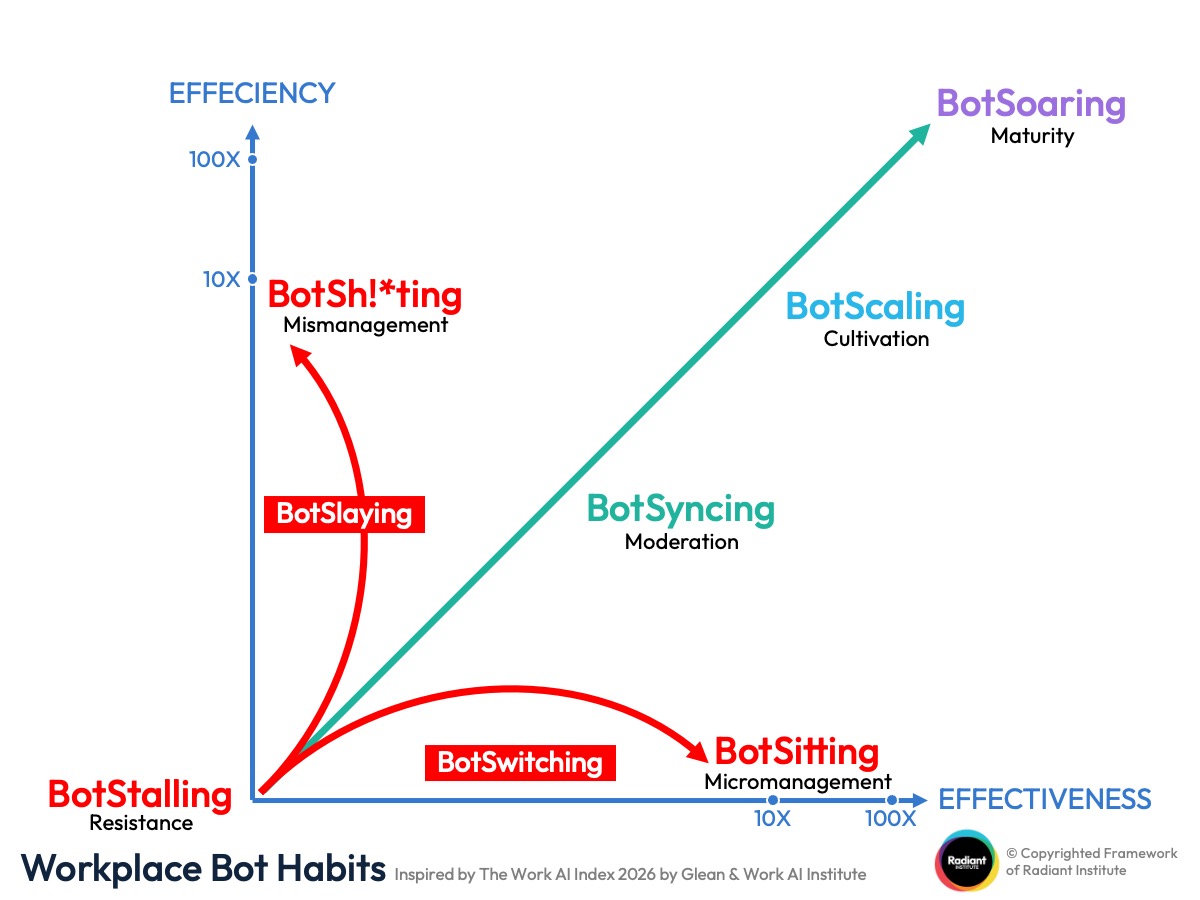
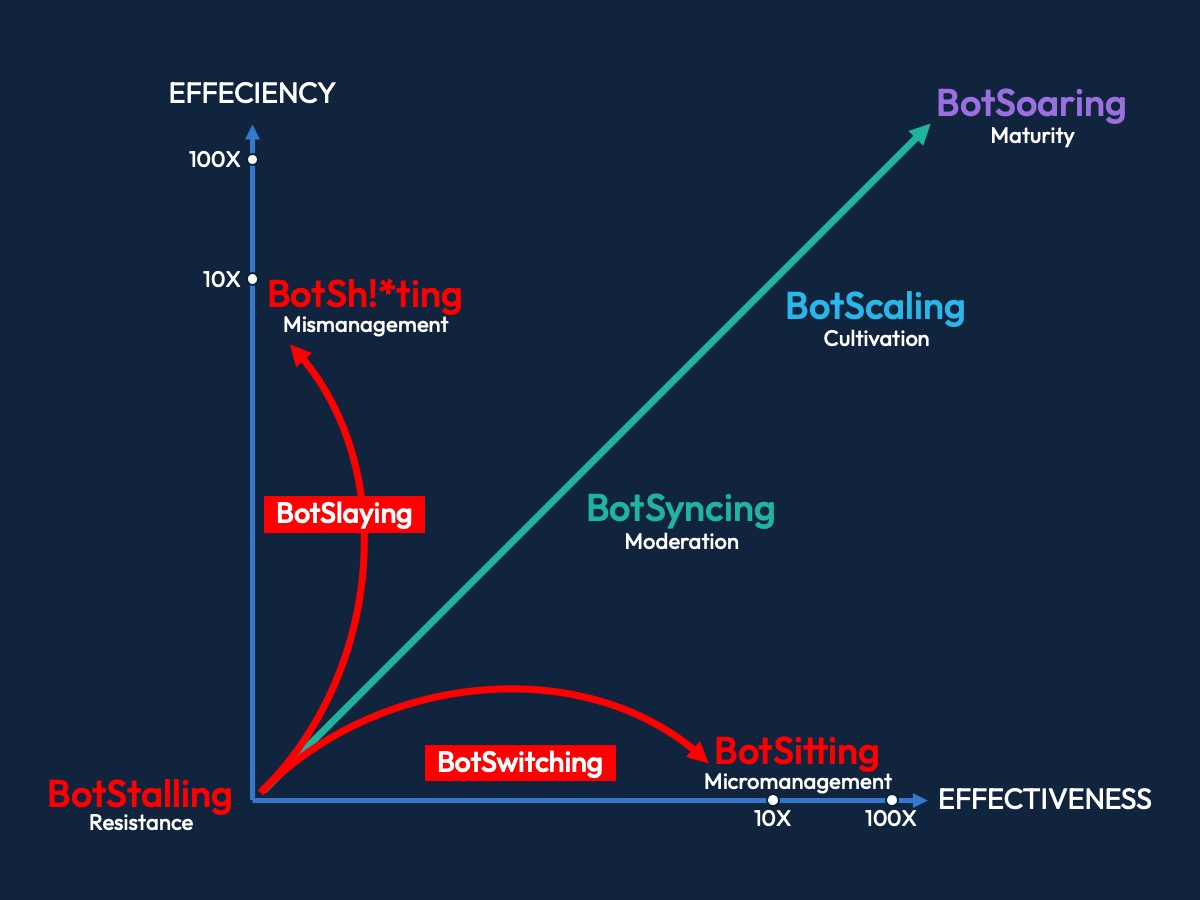
Each habit feels reasonable in the moment. Together they explain why so much AI activity produces so little organisational impact. The map below turns these habits into something leaders can name, locate, and act on.
The Framework at a Glance
What you are looking at when you read the Workplace Bot Habits map.
Read the map along two axes: effectiveness runs left to right, and efficiency runs bottom to top.
BotStalling sits at the origin, low on both. BotSitting sits to the lower right, effective but not efficient, because constant supervision preserves quality while eating the time AI was meant to save. BotShitting sits to the upper left, efficient but not effective, because speed comes at the cost of quality.
The healthy path runs diagonally up and to the right, from BotSyncing through BotScaling to BotSoaring, where effectiveness and efficiency rise together.
BotStalling
Theme: Resistance
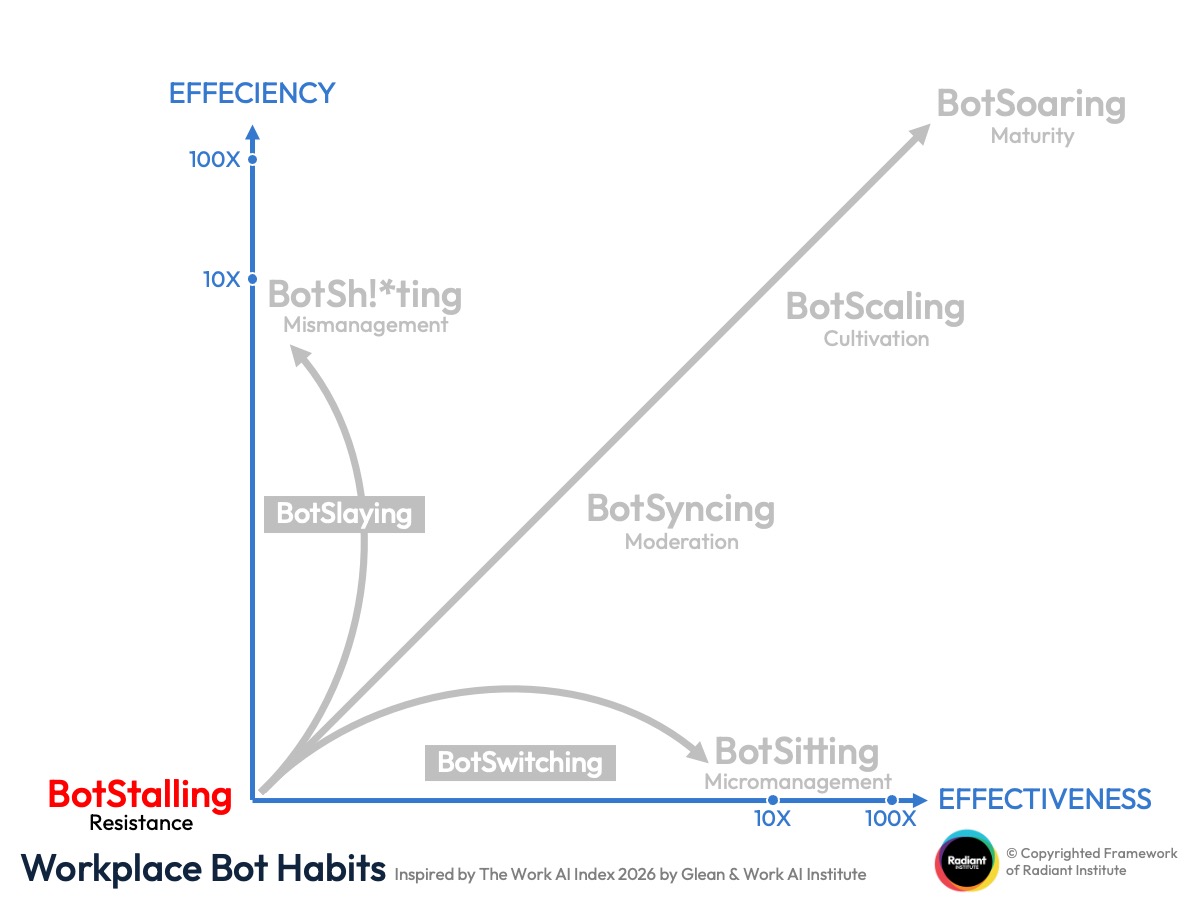
BotStalling is the habit of holding back. People avoid AI, or keep putting off real adoption, even when it could clearly help. Work carries on the way it always has, and the tools sit largely unused.
BotStalling sits at the origin, low on both effectiveness and efficiency. It is the starting point, not a destination.
What this behaviour looks like in the workplace?
- “Let us wait and see” becomes the default answer to any new tool.
- Manual processes continue unchanged, even where AI could remove obvious drudgery.
- Pilots and trials launch with enthusiasm, then quietly never reach production.
Why this happens?
Resistance is rarely about capability. It is usually fear, uncertainty, or low trust: worry about getting it wrong, about looking foolish, or about what AI might mean for the role. When fear outweighs the appetite to experiment, people stay put.
What’s the cost of this behaviour?
The organisation captures none of the value it is paying for. The tools sit idle, the manual workload stays exactly where it was, and teams that keep stalling fall further behind those quietly building real habits.
How can organisations progress from this state?
Progress starts with confidence and permission, not pressure. A few principles help a stalling team move off the starting line:
- Make it safe to experiment. Give explicit permission to try AI on low-risk, real work, and treat early stumbles as learning rather than failure.
- Start with the work, not the tool. Pick one genuine friction point people already feel, and let AI earn trust by solving it.
- Let peers lead. Adoption spreads faster when a trusted colleague shows the way than when it is pushed from the top.
- Make leadership use visible. When leaders use AI openly, hesitation drops and permission starts to feel real.
BotSitting
Theme: Micromanagement
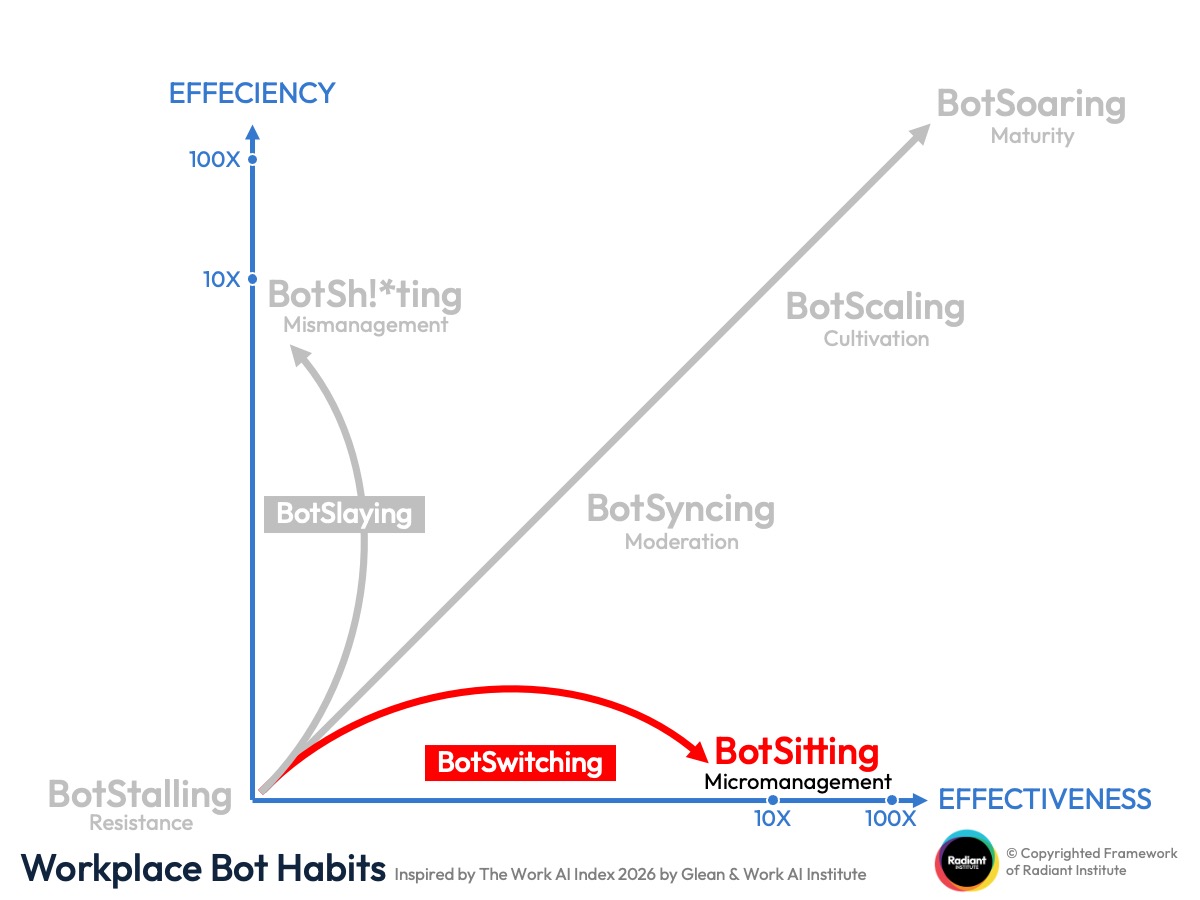
BotSitting is the habit of over-supervising AI. People do use the tools, but they hover: checking, re-checking, and re-prompting until the time AI was meant to save is spent watching it instead.
BotSitting sits to the lower right of the map, effective but not efficient. Quality holds up, yet the promised time savings quietly disappear into supervision.
What this behaviour looks like in the workplace?
- Rewriting the same prompt again and again in search of a perfect answer.
- Rechecking every line of output, even on low-stakes work.
- Finishing a task barely faster than doing it the manual way.
Why this happens?
Over-supervision usually comes from low trust in the output paired with high personal accountability. It is also diligence with no off-switch: when there is no agreed standard for what “good enough” looks like, people check everything just to be safe.
What’s the cost of this behaviour?
The time AI saves is reabsorbed into watching it, so real capacity is barely freed. People tire of babysitting the tool, and the time savings the business paid for never actually materialise.
The wrong counter-move: BotSwitching.
The tempting fix is to blame the tool and switch to another, then another, hoping one will finally need less supervision. That is BotSwitching. Hopping between tools adds switching cost without building the trust or standards that actually reduce checking, so it keeps a team busy inside BotSitting rather than moving it towards BotSyncing.
How can organisations progress from this state?
The shift is from checking everything to checking what matters:
- Set clear quality bars. Agree what “good enough” looks like so review effort matches the stakes.
- Match verification to risk. Reserve deep checking for high-stakes work and lighten it elsewhere.
- Build trust through evidence. Track where AI is reliable and where it is not, so confidence is earned rather than assumed.
- Protect the core, delegate the rest. Keep human judgement on the decisions that matter and let AI carry the routine load.
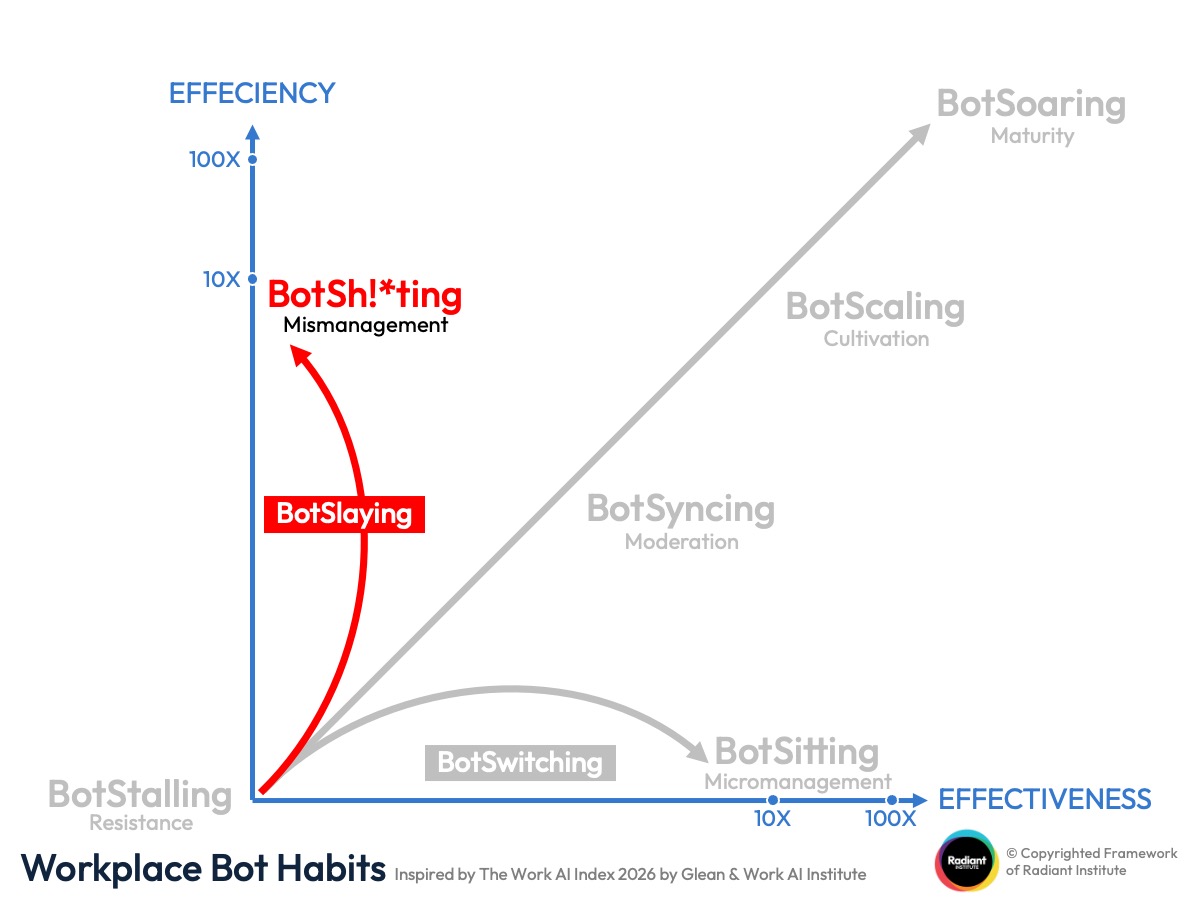
BotShitting
Theme: Mismanagement
BotShitting is the habit of trusting AI too much. People submits what the tool produces without really reading it, understanding it, or being able to defend it. Speed goes up, and so does risk.
BotShitting sits to the upper left of the map, efficient but not effective. Work moves fast, but polished output hides errors that surface downstream.
What this behaviour looks like in the workplace?
- Pasting AI output straight into work without reading them
- A hallucinated figure or fact reaching a customer.
- “The AI said so” standing in for human judgement.
- Confidence in a slick-looking answer that nobody has actually checked.
Why this happens?
When output looks finished, the usual warning signs disappear, so people stop looking closely. Deadline pressure, fatigue from over-checking elsewhere, and the quiet assumption that someone else will catch it all push work out unverified. Counterintuitively, the more capable the tool, the easier it is to fall into this.
What’s the cost of this behaviour?
Small errors compound into poor decisions, and mistakes reach customers under the organisation’s name. Accountability blurs, trust erodes, and the clean-up costs far more than the check would have.
The wrong counter-move: BotSlaying.
The tempting fix is to overreact and shut AI down. After unverified output causes damage, leaders ban the tools or clamp down so hard that people stop using AI altogether. That is BotSlaying: “killing” the bots instead of fixing the trust and verification gap. It throws the value out with the risk and pushes the team back towards resistance, never towards BotSyncing.
How can organisations progress from this state?
The shift is from blind trust to accountable use:
- Keep a human in the loop. Make a named person responsible for what goes out, especially on higher-stakes work.
- Verify what matters. Build light checks into the workflow so speed does not skip the substance.
- Reintroduce friction on purpose. Slow down at the decision points where a confident-sounding error would be expensive.
- Reward honesty over polish. Make it safe to say “I have not checked this yet” rather than pass work off as done.
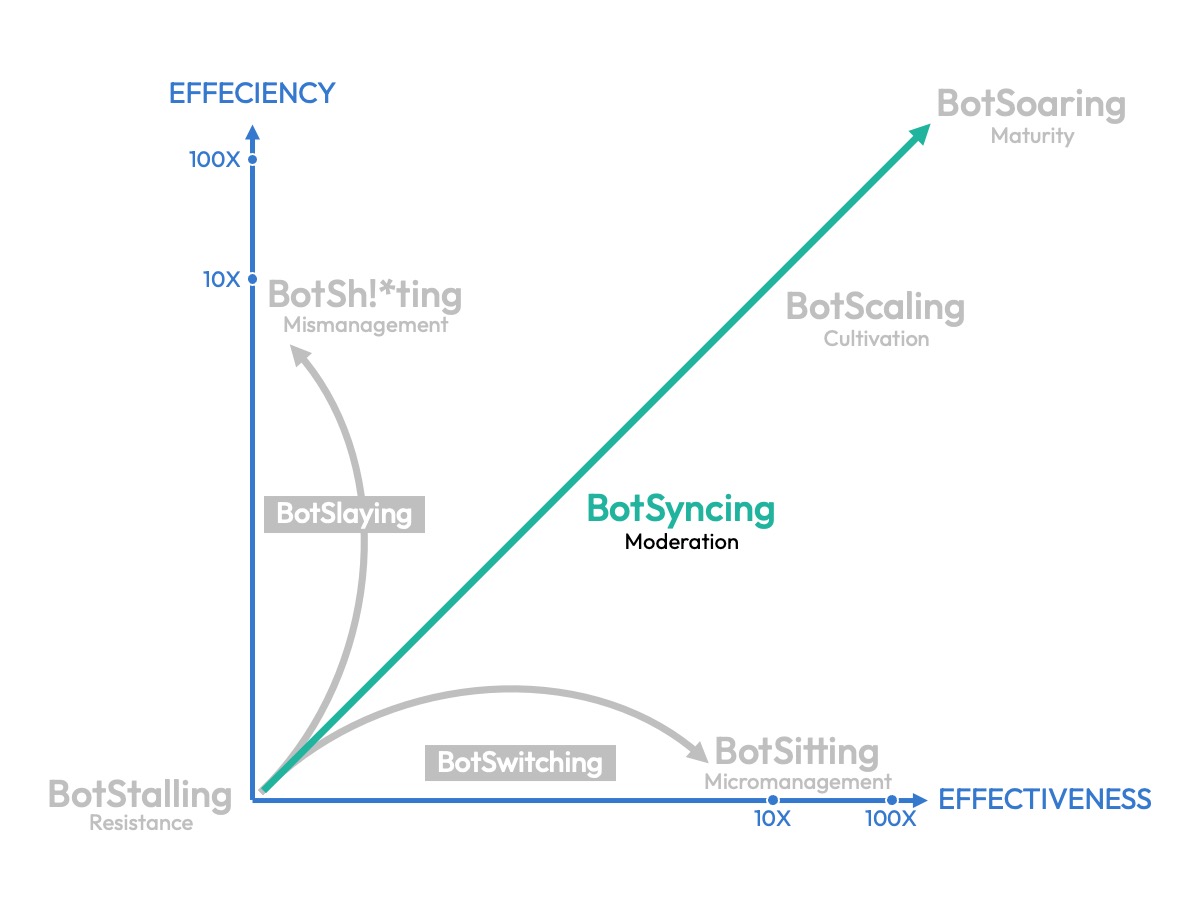
BotSyncing
Theme: Moderation
BotSyncing is the healthy centre. Humans and AI each do what they are best at, in rhythm: AI drafts, summarises, and spots patterns at speed, while people supply judgement, context, and accountability.
BotSyncing sits on the healthy diagonal, where effectiveness and efficiency rise together. It is the habit every other one is trying, and often failing, to reach.
What this behaviour looks like in the workplace?
- AI produces the first draft or the analysis, and a person decides what actually matters.
- Checking is matched to the stakes, not applied to everything.
- A named human stays accountable for whatever goes out.
- People know when to reach for AI and when to leave it out.
Why this works?
Neither over-checking nor blind trust wins. BotSyncing keeps a human in the loop for the judgement machines lack, while letting AI carry the volume that slows people down. The friction that remains is productive, because it is where quality control and real learning happen.
What’s the payoff?
Time saved is genuinely freed rather than reabsorbed, and quality holds because judgement stays human. Teams in this habit report both higher productivity and higher quality, the combination the research calls high AI achievers.
How can organisations sustain and build on this?
The move from here is to spread it, not to relax it:
- Keep judgement human. Protect the decisions and craft that make the work yours.
- Hold the standard. Keep quality bars and clear accountability in place as volume grows.
- Capture what works. Write down the prompts, checks, and workflows that are paying off, ready to share.
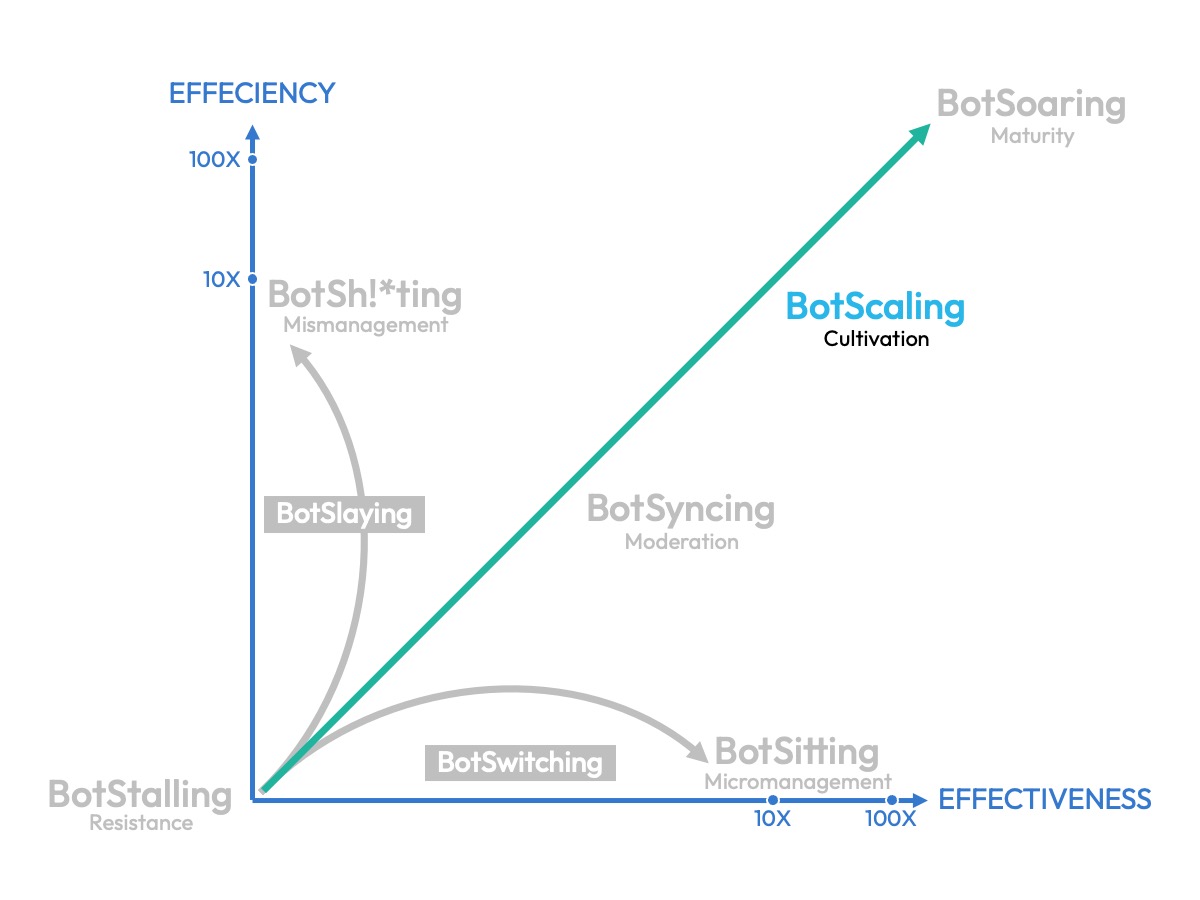
BotScaling
Theme: Cultivation
BotScaling is the habit of spreading what works. Once a team has found a healthy way of working with AI, that pattern is documented and adopted by others, so the gains compound beyond a single team.
BotScaling sits further up the healthy diagonal. Effectiveness and efficiency are now rising across teams, not just individuals.
What this behaviour looks like in the workplace?
- A workflow proven in one team is written up and handed to others.
- Shared prompts, checks, and guardrails replace everyone starting from scratch.
- Cross-functional peers, not only leaders, champion what works.
Why this works?
Value stops being trapped in a few individuals. Adoption spreads fastest peer to peer, so proven patterns travel further and faster than any mandate could push them.
What’s the payoff?
Individual wins become organisational gains, closing the gap between people who feel more productive and a business that actually performs better.
How can organisations sustain and build on this?
- Scale only what is genuinely working. Do not spread a habit that has not reached BotSyncing first.
- Give patterns an owner. Someone should keep shared workflows current as tools change.
- Make success visible. Recognise the teams and peers whose ways of working others choose to copy.
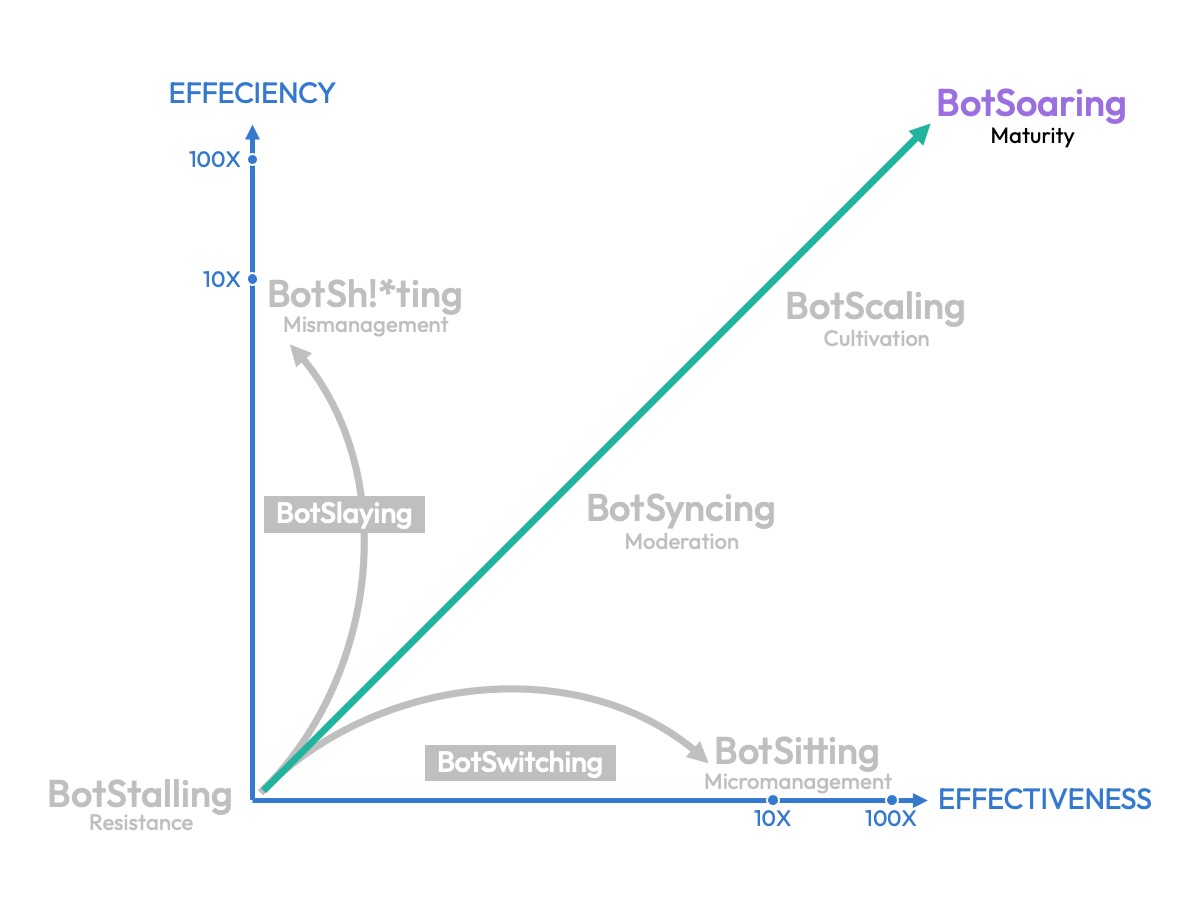
BotSoaring
Theme: Maturity
BotSoaring is the habit becoming the culture. Healthy AI use is no longer something to prompt or police, it is simply how the organisation works.
BotSoaring sits at the top right of the map, high on both effectiveness and efficiency, and sustained over time rather than in bursts.
What this behaviour looks like in the workplace?
- Teams instinctively know when to use AI and when to leave it out.
- Good habits persist without reminders or crackdowns.
- New tools are absorbed without the organisation sliding back into old failure modes.
Why this works?
Excellence holds because it rests on habits and judgement, not on any single tool. When the norm is healthy, new people inherit it and new technology is folded in without drama.
What’s the payoff?
AI compounds into a durable advantage rather than a passing spike. The organisation keeps its gains as tools, teams, and tasks change.
How can organisations sustain and build on this?
- Keep learning live. Treat AI fluency as ongoing, not a one-off rollout.
- Watch for drift. Even mature teams can slip towards over-checking or blind trust under pressure.
- Reinvest the dividend. Put the time AI frees into higher-value work and new capability, not just more output.
Common Misconceptions this Framework Clears Up
“If people are using AI, we are getting value.”
Usage and impact are different things. Value depends on how AI is used, not how much.
“More checking is always safer.”
Constant rechecking is its own cost. It reabsorbs the time AI was meant to free, without lifting quality.
“Smarter tools mean fewer mistakes.”
More capable tools can invite more complacency. When output looks polished, people stop looking closely.
“The best users automate everything.”
The strongest users protect the core of their craft and know when not to use AI at all.
“Resistance is just a training gap.”
Stalling is often about fear and trust, not skill, so it needs a different response from over supervision or blind trust.
AI Adoption vs. AI Enablement
Why buying tools is not the same as building healthy habits.
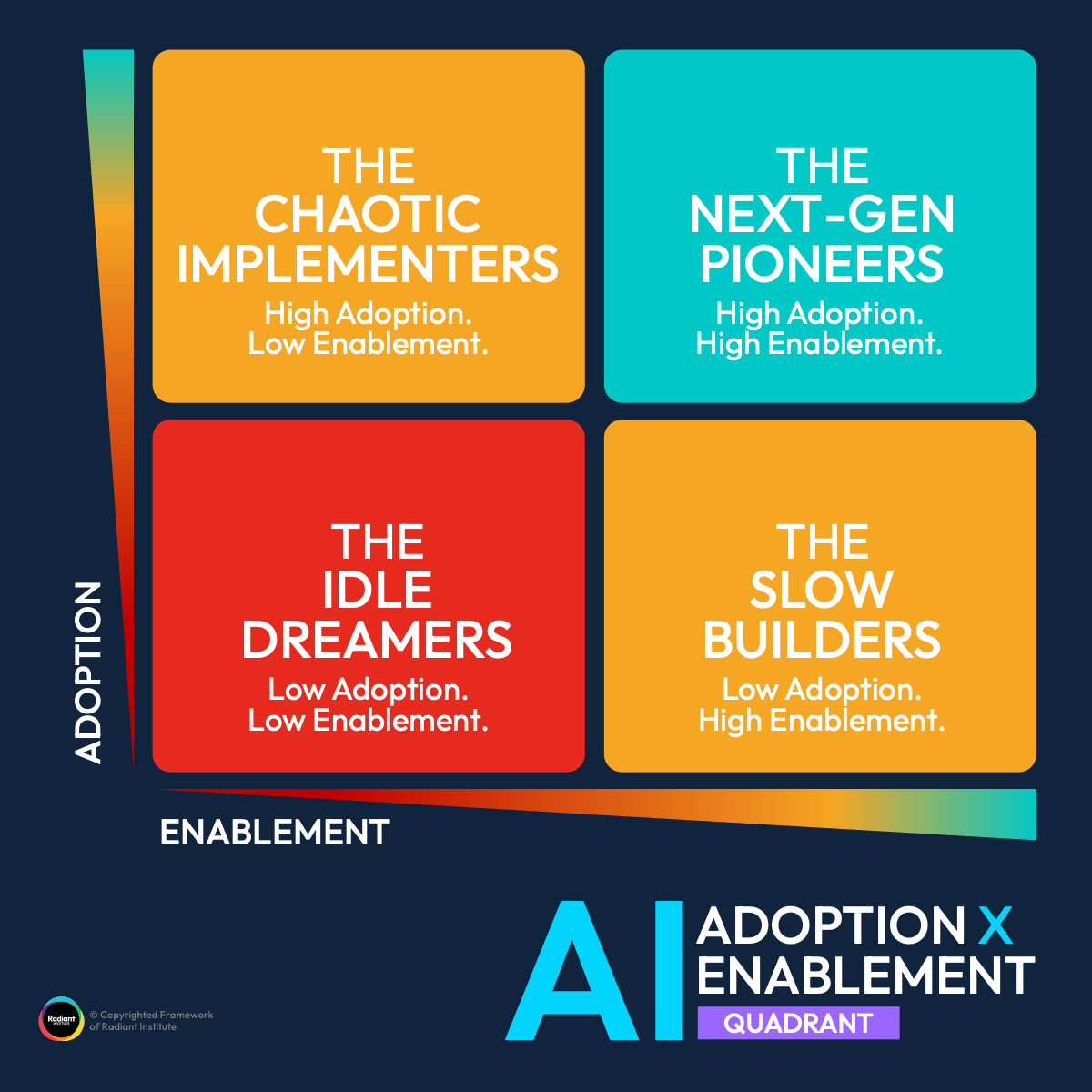
Buying licences creates access. It does not create capability.
The organisations that pull ahead invest in what sits around the tool: clear context, sensible guardrails, and the judgement to know when AI helps and when it does not.
This is the difference between adoption, which is easy to purchase, and enablement, which has to be built.
Workplace Bot Habits focuses on the enablement layer, because that is where healthy habits and real returns are made.
4 Ways to Use This Framework In Your Organization
This is application guidance for leaders, not a facilitation script or a set of instructions.
RECOMENDATION 1
Diagnose where each team sits
Ask: Where does each team currently land on the map, and why?
Use the map as a shared language in leadership conversations. Naming a habit out loud, whether BotStalling, BotSitting, or BotSyncing, turns a vague sense of unease into something specific.
Once a team knows where it sits, the next move becomes clearer. A BotStalling team needs confidence and permission. An over supervising team needs trust and better guardrails.

RECOMMENDATION 2
Find the hidden cost of over supervision
Ask: Where are we saving time with AI, only to spend it again on rechecking?
Over supervision hides in plain sight because it looks diligent. The research behind this framework shows workers can spend a large share of their AI time simply watching and correcting the tool.
Locating that cost helps leaders decide where lighter checking is safe and where careful review genuinely matters.
RECOMMENDATION 3
Build guardrails against blind trust
Ask: How do we keep a human in the loop when AI output looks polished and convincing?
Blind trust grows when output feels finished. Healthy teams keep a human in the loop for judgement, verification, and accountability, especially on higher stakes work.
The aim is not fear of AI. It is clear ownership, so people can explain and defend what they produce.
RECOMMENDATION 4
Plan the path from BotSyncing to BotScaling
Ask: What working practices are ready to spread across the organisation?
Once a team reaches balanced collaboration, the opportunity is to replicate what works. BotScaling before BotSyncing simply spreads poor habits faster.
Use the map to sequence the journey, from healthy habits in one team to shared practice across many.
Want to see this framework in action?
Radiant Institute uses this framework to give leaders and teams a common vocabulary for AI at work, then to build the habits and workflows that turn adoption into results. The focus stays practical: healthier habits, clearer judgement, and measurable capability.
Frequently Asked Questions
Common questions on workplace AI habits, AI literacy, and building a practical AI adoption framework.
What is the Workplace Bot Habits framework?
It is a leadership framework that names the everyday habits people form when using AI at work, from resistance to blind trust to balanced collaboration. It helps leaders diagnose where teams sit and guide them towards healthier, more productive use.
What is the difference between BotSitting and BotShitting?
Botsitting is the hidden work of making AI usable: feeding it context, supervising output, and cleaning up after it. Botshitting is shipping AI work that has not been verified or fully understood. One over invests attention, the other withholds it.
What is AI literacy, and how does it relate to these habits?
AI literacy is the practical judgement to know when AI helps, when to check it, and when to leave it out. Stronger AI literacy is what moves teams away from over supervision and blind trust, and towards balanced collaboration.
What is the AI productivity paradox?
It is the gap between individual time savings and organisational results. People feel more productive, yet the organisation often sees little measurable gain, because the savings are reabsorbed by hidden habits.
How is this different from a generic AI adoption framework?
Most adoption frameworks focus on rollout and usage. Workplace Bot Habits focuses on behaviour: how people actually work with AI, and how those habits shape whether adoption creates value.
Where does human in the loop fit?
Human in the loop is the guardrail against blind trust. It keeps people accountable for judgement and verification, so AI accelerates the work without owning the decisions.
How do we know which habit our team has?
Look at where the time goes and how output is treated. Endless rechecking points to over supervision. Unverified, confident output points to blind trust. Little change at all points to resistance.