
The AI Momentum Framework
A practical framework for redesigning knowledge work with AI, built on the six modes that every knowledge-worker role shares.
-
 Work Faster
-
 Think Sharper
-
 Learn Smarter
Most teams adopt AI one tool at a time, then wonder why the xgains stay scattered.
The AI Momentum Framework gives leaders and teams a shared language for how AI changes knowledge work, so every role can find where AI creates momentum without weakening human judgment, trust, or accountability.
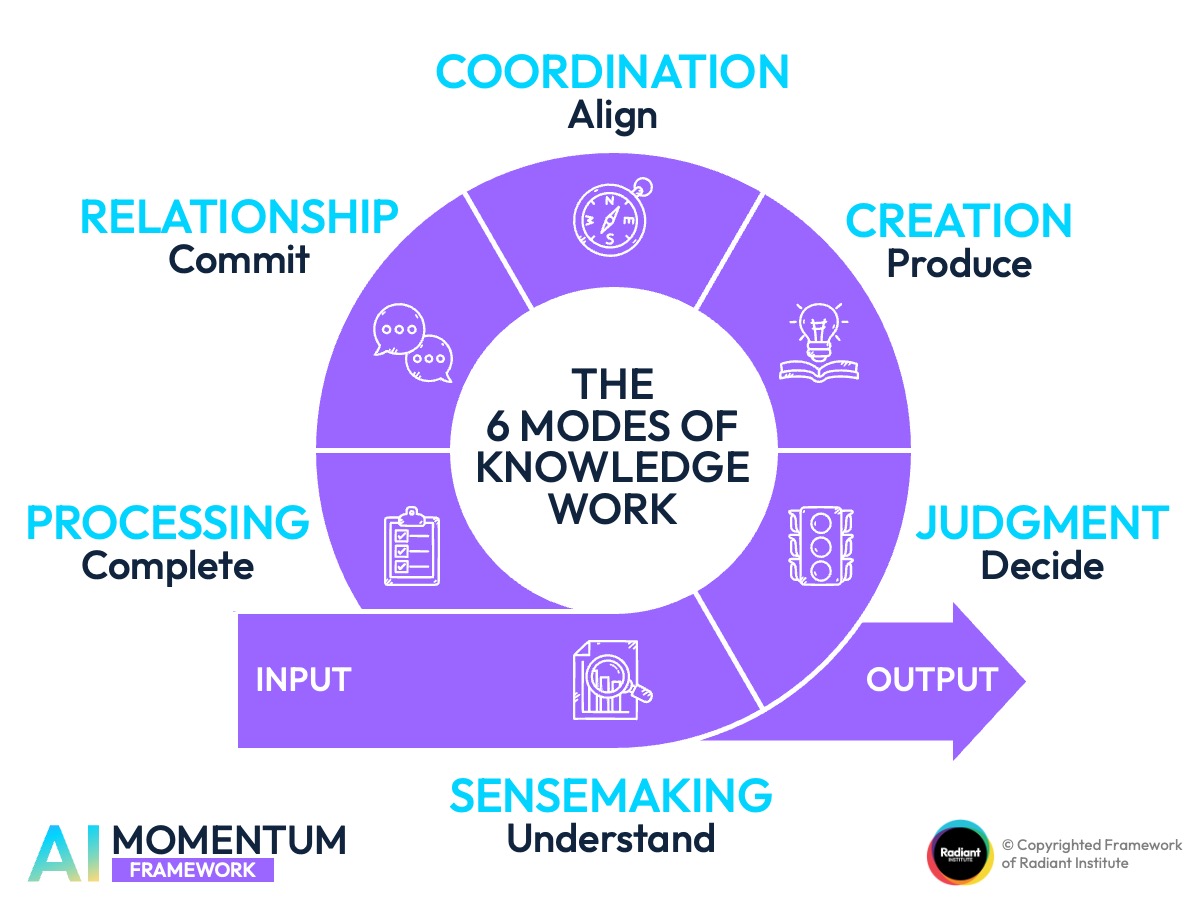
At its center sits a simple model called The 6 Modes of Knowledge Work: the recurring types of work that show up across almost every knowledge-worker role, whatever the job title.
Why the AI Momentum Framework exists
Most people can’t see the shape of their own work, so they can’t see where AI belongs.
Most of us reach for a job title. But a title is a label on a box, not a description of the work. Two people can carry the same title and do almost nothing alike: one HR manager spends the week coaching managers through difficult conversations and defusing team conflict, while another spends it processing leave requests, updating records, and chasing policy compliance. Same title, different work.
That gap, between the label and the lived work, becomes the real problem the moment AI arrives. When work feels like one undifferentiated block, it invites two opposite mistakes: handing AI the judgment calls it should never own, or missing the routine tasks it could quietly take off your plate. What’s missing is a clear view of the work itself, the thing the tool is meant to improve.
The AI Momentum Framework gives that work a structure. Every role, whatever the title, runs on six recurring modes. The moment you see your work as modes instead of a blur, you can also see where AI creates momentum and where your judgment, trust, and relationships have to stay in charge.
So the framework changes the first question. Instead of asking which tool to use, it asks which mode of work you are trying to improve.
The Framework at a Glance
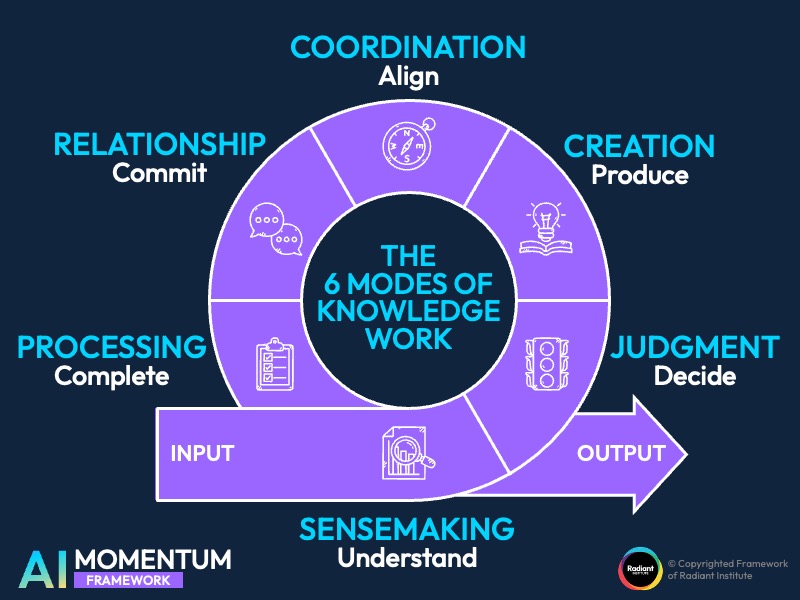
Six modes of knowledge work, shown as a loop that moves from understanding to completion and back into learning.
Read the diagram as a value flow, not a fixed assembly line.
Knowledge work tends to move from understanding, to decision, to output, to alignment, to buy-in, to completion, and then back into learning.
In plain language: Understand, Decide, Produce, Align, Commit, Complete, Learn.
At each step the mode either builds momentum or creates friction, and the aim is to keep momentum moving around the loop. Real work is messier, so you can enter at any mode, repeat modes, or blend several at once.

Mode #1. Sensemaking (Understanding)
Turning information, signals, and noise into usable understanding. AI accelerates retrieval and first-pass analysis, so the human premium moves to framing the question, verifying sources, and interpreting meaning.
The question: What is happening, and what does it mean?
Momentum or friction: Done well, sensemaking produces clarity; done poorly, it leaves confusion.
Example: A B2B sales exec sifts through market reports, competitor moves, and customer signals to work out what is really shifting in a key account.

Mode #2. Judgment (Decide)
Making decisions, setting priorities, weighing trade-offs, and owning accountability. AI can generate options and surface risks, but consequential decisions stay human-owned.
The question: What matters, and what should we do?
Momentum or friction: Strong judgment creates direction; weak judgment leaves drift.
Example: A product manager weighs three roadmap options against limited engineering time and decides what ships next quarter.
Mode #3. Creation (Produce)
Producing content, plans, designs, code, and recommendations. AI drafts and reshapes quickly, so the human premium shifts to direction, taste, originality, and quality control.
The question: What needs to be made?
Momentum or friction: Good creation produces useful, original output; weak creation produces generic filler.
Example: A content marketer turns a rough brief into a launch blog, shaping the angle, voice, and proof points until it lands with the audience.
Mode #4. Coordination (Align)
Aligning people, tasks, timelines, and dependencies, and increasingly orchestrating AI agents. AI handles scheduling and status admin, so people focus on ownership, escalation, and workflow design.
The question: Who does what, by when?
Momentum or friction: Good coordination creates movement; poor coordination creates delay.
Example: An operations lead lines up owners, timelines, and dependencies across teams so a launch actually hits its date.

Mode #5. Relationship (Commit)
Building trust, influence, learning, and buy-in between people. AI can prepare and personalize, but trust-heavy moments stay deeply human.
The question: Who needs to understand, believe, or commit?
Momentum or friction: Strong relationship work earns buy-in; weak relationship work breeds resistance.
Example: A customer success manager rebuilds trust with a frustrated client and earns their commitment to renew.
Mode #6. Processing (Complete)
Completing structured, repeatable, system-based work accurately. AI automates much of the routine, so the human role shifts to exceptions, audit, and process improvement.
The question: What must be completed and recorded correctly?
Momentum or friction: Reliable processing keeps work flowing; sloppy processing causes breakage.
Example: An accounts payable clerk matches invoices to purchase orders and clears payments accurately and on schedule.
Common Misconceptions this Framework Clears Up
“AI affects all work equally.”
It does not. AI changes each mode differently, which is why the mode is the right unit of analysis.
“The modes are a fixed sequence.”
They are a value flow with a natural direction, not a rigid order. You can start anywhere.
“Coordination disappears as AI takes over.”
It grows. Coordination expands into orchestration of people and AI agents.
“Human plus AI is always better.”
Only with calibration: knowing when to rely on AI, when to challenge it, and when to ignore it.
“Processing work just goes away.”
It shrinks as a share of time, then shifts toward exception handling, data quality, and oversight.
AI Momentum vs. AI Friction
Why more AI does not automatically mean more momentum.
On their own, the six signals above are a per-mode scorecard: clarity or confusion in Sensemaking, direction or drift in Judgment, on down to reliability or breakage in Processing.
Read together, they become a diagnostic. Step back from any single mode and look at the whole role, team, or workflow at once: which modes are running on momentum, and which are stuck in friction?
That pattern, not any one mode, is what the framework is named for, and it shows where AI should take load off and where human judgment has to hold the line.
The practical question this leaves you with:
Where are we gaining momentum, and where are we losing it?
Momentum in the Making: From Friction to Flywheel
How connected modes turn early friction into compounding momentum.
At first, connecting the modes takes real effort, and it can feel like friction: fixing the handoffs between them rarely pays off on the very first turn.
But momentum compounds once the modes start feeding one another.
Better Sensemaking sharpens Judgment. Clearer Judgment gives stronger direction for Creation. Cleaner Creation is easier to Coordinate. Better Coordination supports Relationship and buy-in. Stronger Relationship improves follow-through into Processing.
And better Processing produces cleaner data and feedback for the next round of Sensemaking.
This is the flywheel: the first turns are the hardest, but once it catches, each turn gets easier and the gains compound.
The loop does not assume every task begins at Sensemaking. It shows how value keeps building when each mode hands off well to the next. The catch is that most teams stop pushing before the wheel turns freely.
4 Ways to Use This Framework In Your Organization
Application guidance, not step-by-step instructions.
RECOMENDATION 1
Find one AI Momentum Win
Ask: What recurring task could I improve right now?
Start with a real, repeated task rather than an abstract list of AI ideas. Decide what you want to improve (understand faster, decide clearer, produce better, align people, build trust, or complete reliably), then connect that outcome to a mode. The goal is one practical win you can reuse, not a full transformation program.
Example: A sales rep who rewrites the same kind of post-call follow-up every day hands the first draft to AI, then edits for tone and accuracy. One Creation win, reused daily.
RECOMMENDATION 2
Design the Right Intervention for Each Level
Ask: Where does my week actually go?
Estimate how your time splits across the six modes. The mix reveals where AI can help most, which work is admin-heavy, and where human judgment needs protecting. Two people with the same job title often have very different mode mixes, and therefore different AI opportunities.
Example: A finance manager maps their week and finds it dominated by Processing, reconciling reports and chasing numbers, with little time left for the Judgment work of advising the business. The map shows where AI can take load off and what to protect.
RECOMMENDATION 3
Measure Progress Beyond Tool Adoption
Ask: Which work should AI take on, and which must stay human-led?
Use the modes to sort work into automate, augment, accelerate, or protect. Structured, repeatable, low-stakes work is a strong automation candidate. Ambiguous, high-stakes, trust-heavy, or ethically loaded work stays human-led, with AI in a supporting role.
Two cautions sharpen the call. AI capability is uneven, so it can be excellent at one task in a role and unreliable at the very next, which makes verification part of the work rather than an afterthought. And automating the learning-rich parts of a job too early can leave people output-efficient but context-poor, so protect the work that builds judgment, especially early in a career.
Example: A marketing manager automates the weekly performance report (Processing) but keeps campaign strategy and brand calls firmly human-led (Judgment and Creation).
RECOMMENDATION 4
Future-Proof your AI Capability Strategy
Ask: What skill does each mode now demand?
Instead of training people only on tools, build capability around the work: questioning and verification for Sensemaking, decision and risk literacy for Judgment, direction and editing for Creation, orchestration for Coordination, coaching and influence for Relationship, and oversight for Processing.
Example: A recruiter builds more than tool skills: sharper questioning to verify candidate signals (Sensemaking) and stronger influence in offer conversations (Relationship).
Want to see this framework in action?
We use the AI Momentum Framework to help teams build shared language and workflow-level AI capability that lasts.
AI momentum starts with seeing the work clearly, then placing AI where it genuinely helps your people understand, decide, produce, align, commit, and complete better, with human judgment in charge.
Frequently Asked Questions
Common questions about the AI Momentum Framework, the 6 modes of knowledge work, and what changes for people.
What is the AI Momentum Framework?
A practical framework from Radiant Institute for redesigning knowledge work with AI. It helps teams create momentum across six modes of work without weakening human judgment, trust, or accountability.
What are the 6 modes of knowledge work?
Sensemaking, Judgment, Creation, Coordination, Relationship, and Processing. Every knowledge-worker role is a weighted mix of these six modes. What differs is the ratio, complexity, and stakes.
Why does this matter for human judgment in the AI era?
As AI generates more options and outputs, someone still has to decide what is responsible, relevant, and sound. Judgment becomes more visible and more valuable, which is why the framework keeps it human-owned.
Is the framework a fixed sequence?
No. The six modes form a value flow with a natural direction, but you can enter at any mode, repeat modes, or blend several at once.
Does AI replace these modes?
No. AI changes how each mode is performed. It shrinks routine effort in some modes and raises the value of human judgment, trust, and interpretation in others.
How is this different from full workflow redesign?
The framework is built for finding and improving practical AI opportunities, not for full workflow mapping, metrics, and governance. It helps you find the opportunity. Dedicated transformation methods help you systemize it.
Who is the framework for?
Leaders, managers, individual contributors, and L&D or HR teams. The value is framed differently for each: work redesign for leaders, team friction for managers, and one practical win for individual contributors.