
The AI Advantage Framework
A practical AI enablement framework that helps organisations move beyond isolated AI tools and build a connected, compounding AI advantage across six dimensions.
-
 Work Faster
-
 Think Sharper
-
 Learn Smarter
Most organisations know AI is important.
Fewer know where to start, what to prioritise, or how to make AI initiatives compound over time.
The AI Advantage Framework gives leaders and teams a shared language for classifying how AI creates value. This ensure every initiative has a clear purpose, every role has a defined place, and the path to workforce modernisation, margin maximisation, and market leadership becomes a system, not a guessing game.
Why this AI Enablement Framework exists
AI adoption fails when it is treated as a tools or training problem.
It succeeds when it becomes a workflow and habit system.
Most AI initiatives stall not because the technology fails, but because organisations lack a shared way to talk about what AI should actually do.
The conversation around AI in business is stuck in three traps:
The Knowledge Trap
Teams attend AI workshops, learn prompting techniques, and walk away inspired. But without a framework that connects AI capabilities to business outcomes, knowledge stays theoretical. People know about AI but don’t know what to do with it.
The Tool Trap
Organisations adopt ChatGPT, Copilot, or Gemini and assume the job is done. But tools without workflow integration create scattered experiments, not systemic improvement. The question is never “which tool?” — it is “what is the tool doing for us?”
The Hype Trap
AI vendor promises and media narratives create unrealistic expectations. When early pilots don’t deliver transformational results overnight, momentum dies. Organisations need a grounded way to define success that goes beyond hype cycles.
The AI Advantage Framework cuts through all three traps by answering one question clearly: What is AI doing to what the human already has?
That single question unlocks six distinct ways AI creates value, and gives every team a practical starting point.
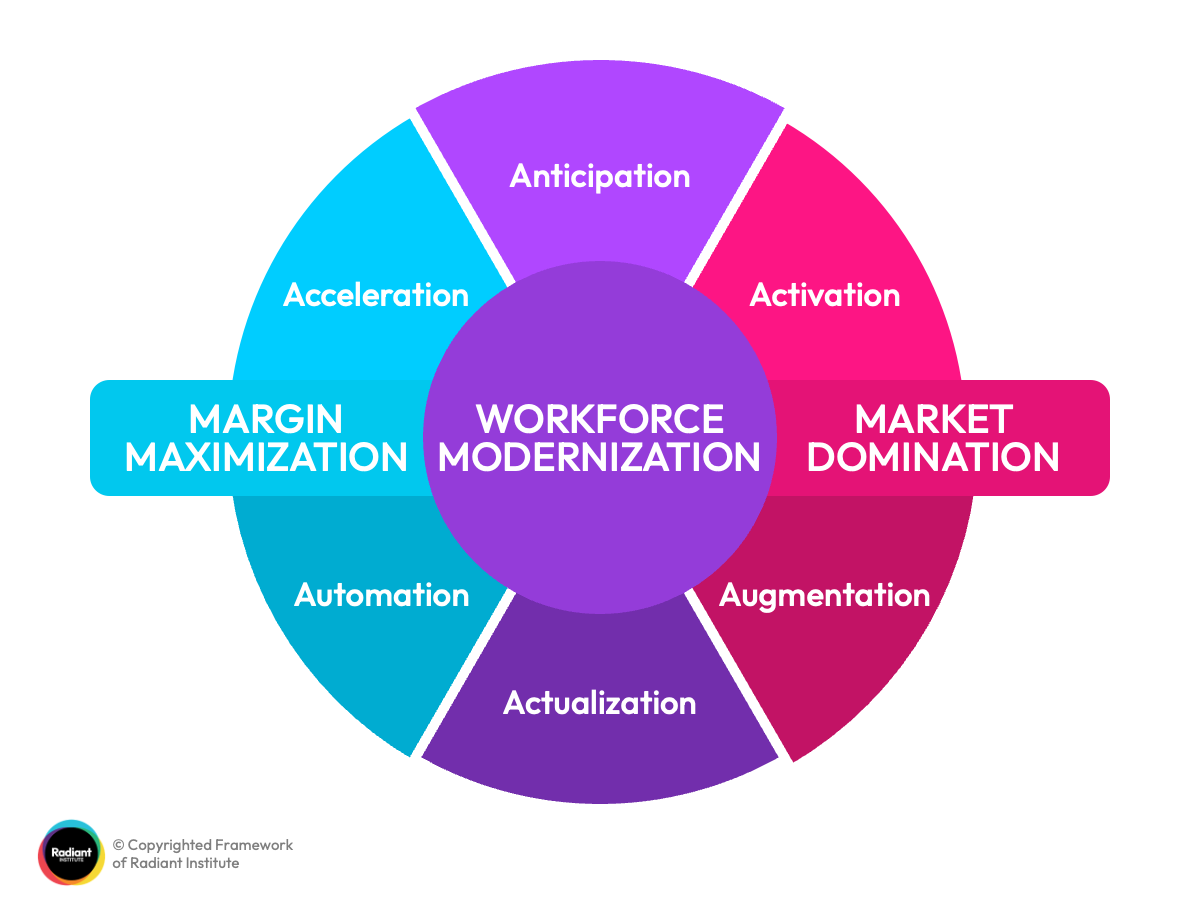
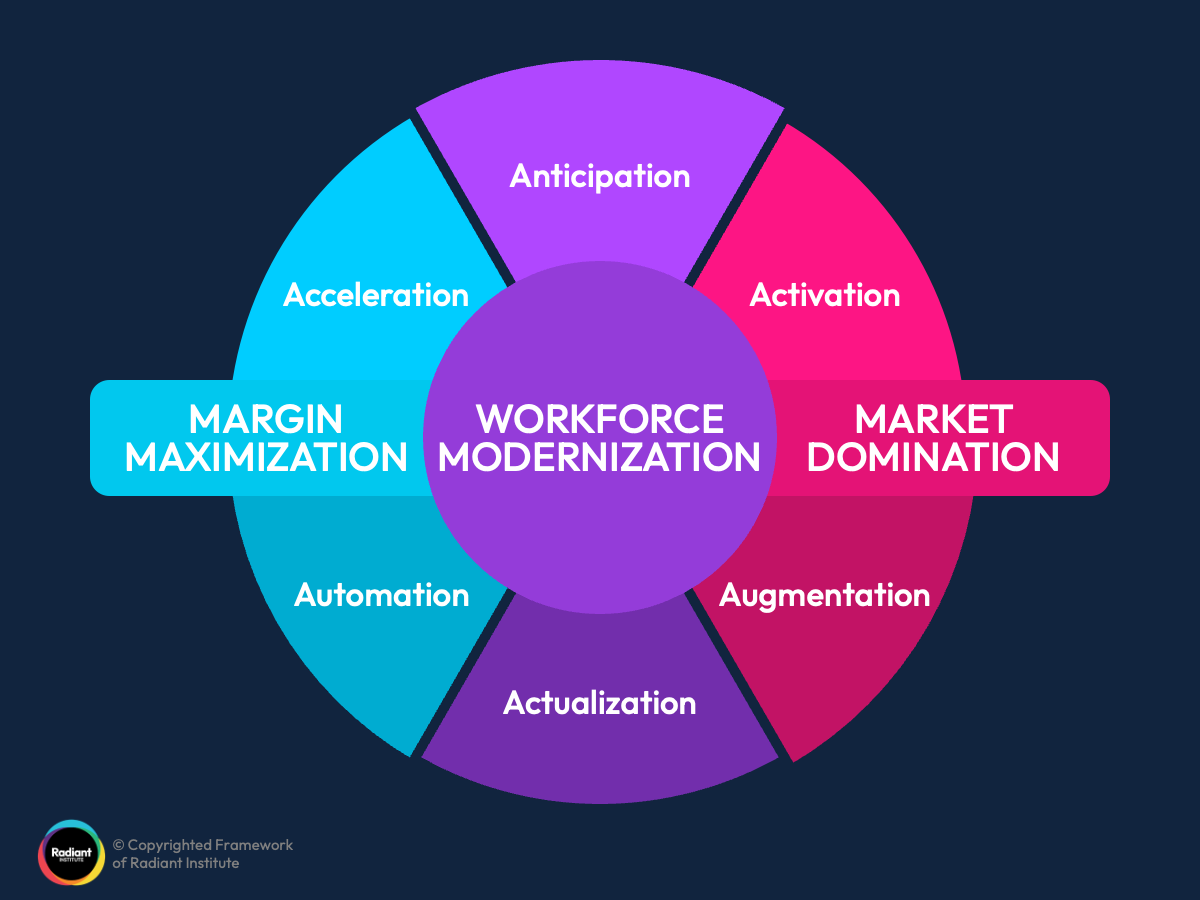
The Framework at a Glance
Six interconnected AI Advantages that classify how AI contributes to business outcomes.
The diagram maps six AI Advantages arranged as a connected system.
Each Advantage answers a different version of the question: What can AI do for me, my department and my organization.
Read it not as a sequence, but as a set of entry points.
Start where your biggest constraint is, and let momentum build from there.
AI ADVANTAGE #1
AUTOMATION
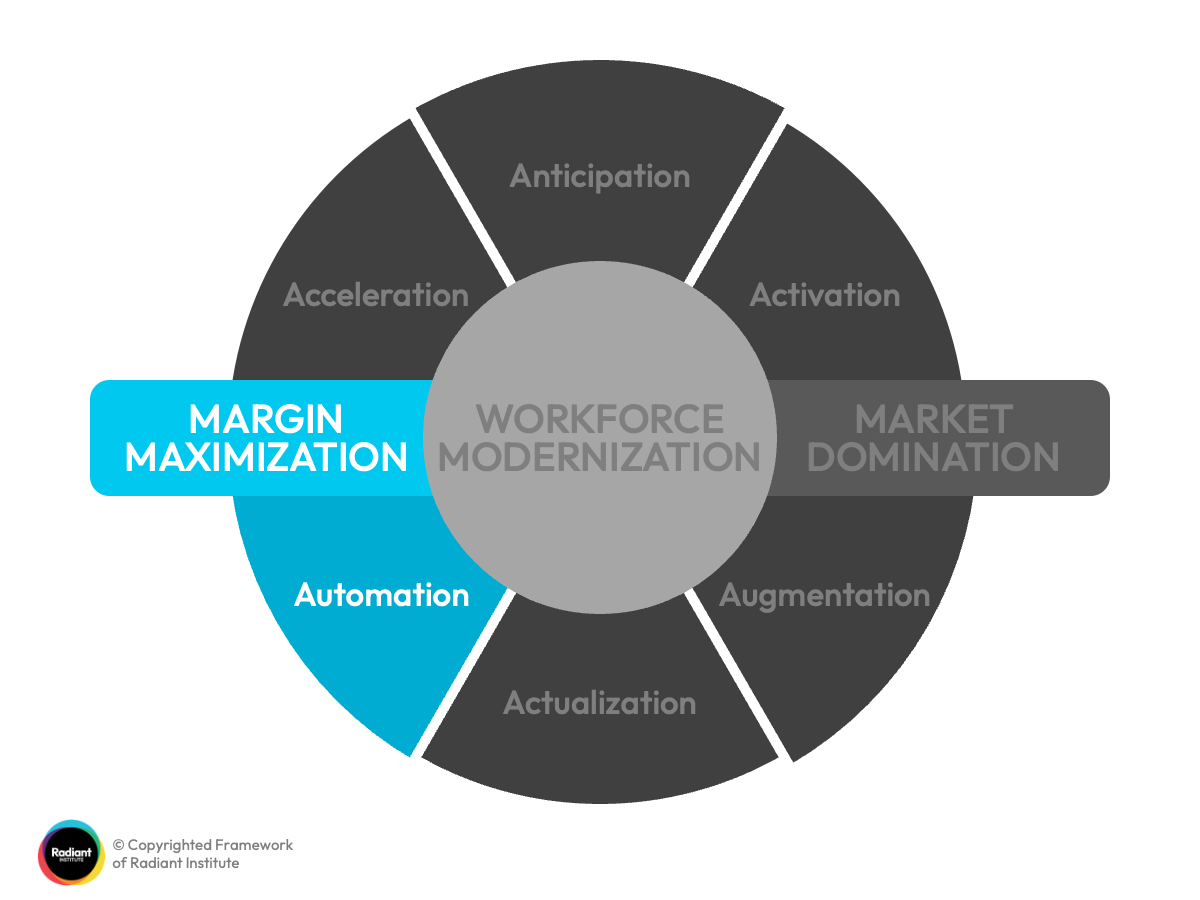
KEYWORD: Optimisation
AI handles repetitive, rule-based tasks. The human shifts from doing the work to overseeing it — setting rules, verifying outputs, and managing exceptions. The result is leaner operations with greater consistency and scalability.
What this looks like in the workplace:
- An HR team uses AI to screen and shortlist job applications based on pre-set criteria. The recruiter reviews the shortlist and makes the final call — but no longer spends hours reading every CV manually.
- A finance department automates invoice matching and expense categorisation. The controller monitors exceptions and approves flagged items, but the bulk of data entry is handled by AI.
- A customer support team deploys an AI chatbot to resolve routine enquiries (password resets, order tracking, FAQs). Human agents focus on complex or sensitive cases that require judgment.
Human Role: Overseer
The human is no longer the one doing the repetitive work — they are the one making sure it is done right. The Overseer sets the rules AI follows, reviews outputs for quality and accuracy, and steps in when exceptions arise. The value of this role is in governance and judgment, not execution.
In a nutshell: AI runs it. You govern it.
AI ADVANTAGE #2
ACCELERATION
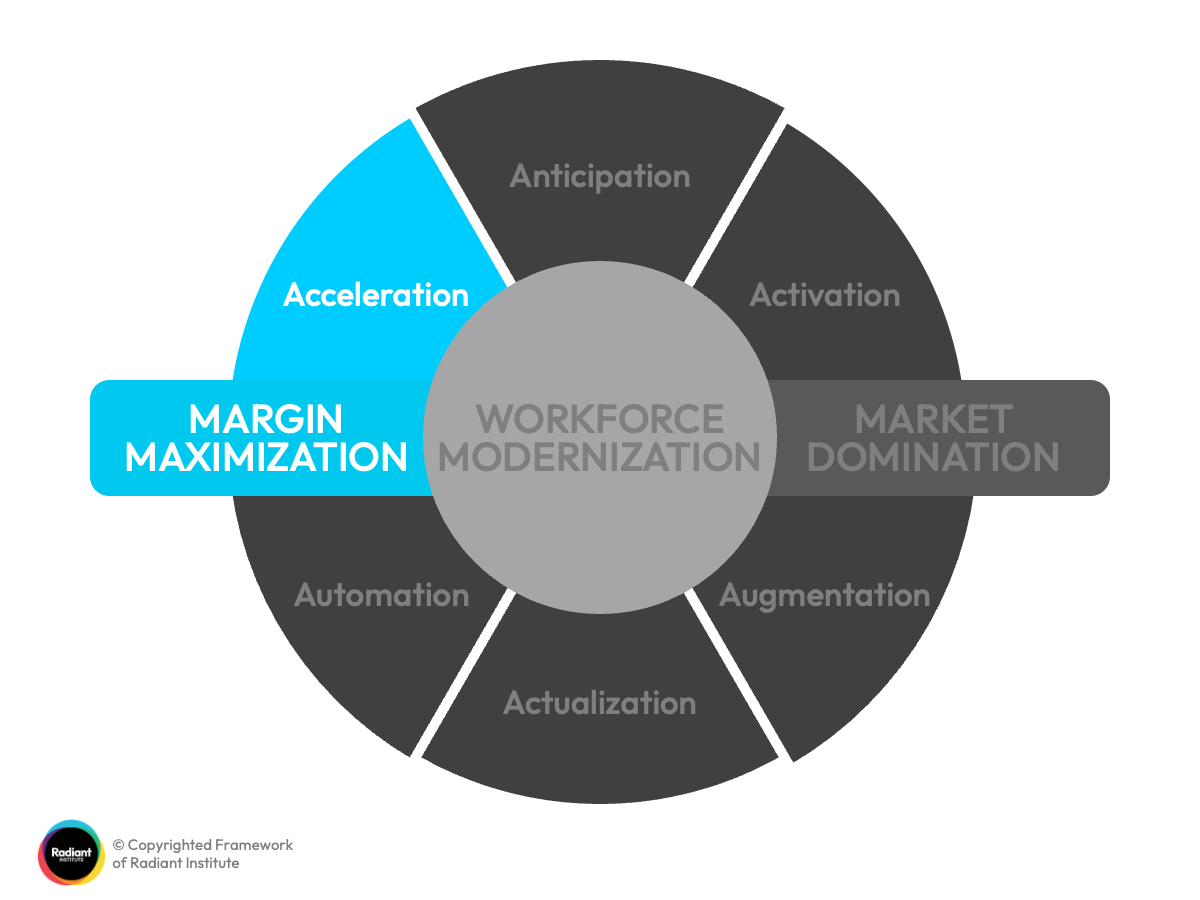
KEYWORD: Velocity
AI compresses the time it takes to complete tasks while maintaining or improving quality. The human stays in the loop — thinking, deciding, steering — but bottlenecks disappear and delivery cycles shrink.
What this looks like in the workplace:
- A marketing team uses AI to generate first drafts of campaign copy, social posts, and email sequences in minutes. The copywriter reviews, refines, and approves — but the blank-page problem is gone.
- A consultant uses AI to scan and summarise 50 pages of industry research in seconds, extracting key data points for a client presentation that would have taken a full day to prepare manually.
- A project manager uses AI to auto-generate meeting summaries and action items immediately after every call. Follow-ups that used to take 30 minutes now take 2.
Human Role: Director
The human stays firmly in the driver’s seat — thinking, deciding, and prioritising. AI compresses the time between intent and output, but the human directs what gets done, in what order, and to what standard. The value of this role is in judgment and decision-making, not waiting.
In a nutshell: AI removes the wait. You make the calls.
AI ADVANTAGE #3
AUGMENTATION
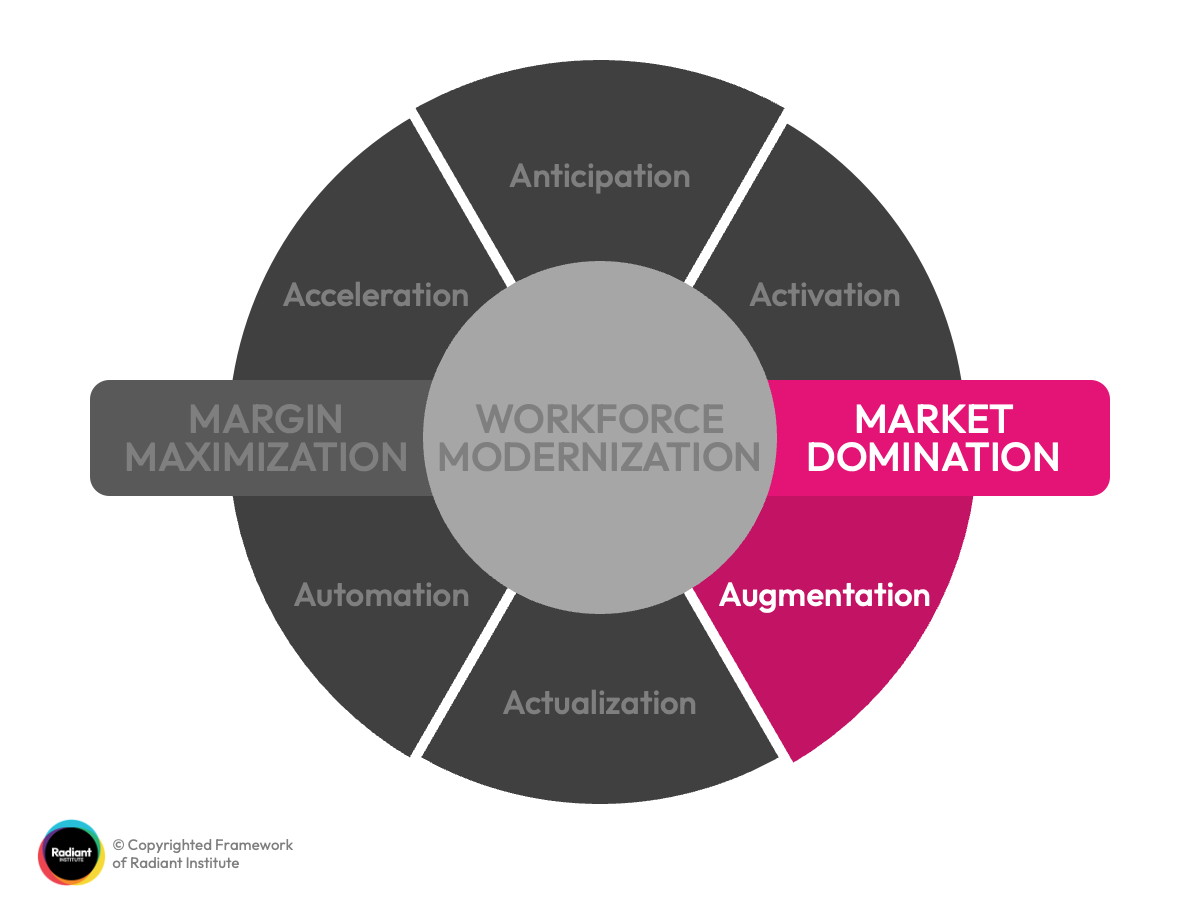
KEYWORD: Elevation
AI raises the quality of existing work. Rather than creating from scratch or saving time, AI acts as a quality multiplier – refining, improving, and elevating what the human has already produced.
What this looks like in the workplace:
- A sales manager writes a client proposal, then uses AI to sharpen the messaging, adjust the tone for the target audience, and flag inconsistencies — producing a polished final version that would normally require a second pair of eyes.
- A data analyst builds a quarterly report, then uses AI to identify patterns they missed, suggest better visualisations, and cross-reference findings against benchmarks — elevating the insight, not just the formatting.
- A trainer designs a workshop outline, then uses AI to stress-test the flow, suggest stronger examples, and improve clarity of learning objectives — the substance is theirs, but the delivery is tighter.
Human Role: Creator
The human brings the substance — the ideas, the expertise, the first draft. AI acts as a quality multiplier that refines and elevates what the human has already produced. The value of this role is in originality and intent. AI raises the ceiling, but the human sets the floor.
In a nutshell: AI raises the ceiling. You set the floor.
AI ADVANTAGE #4
ACTIVATION
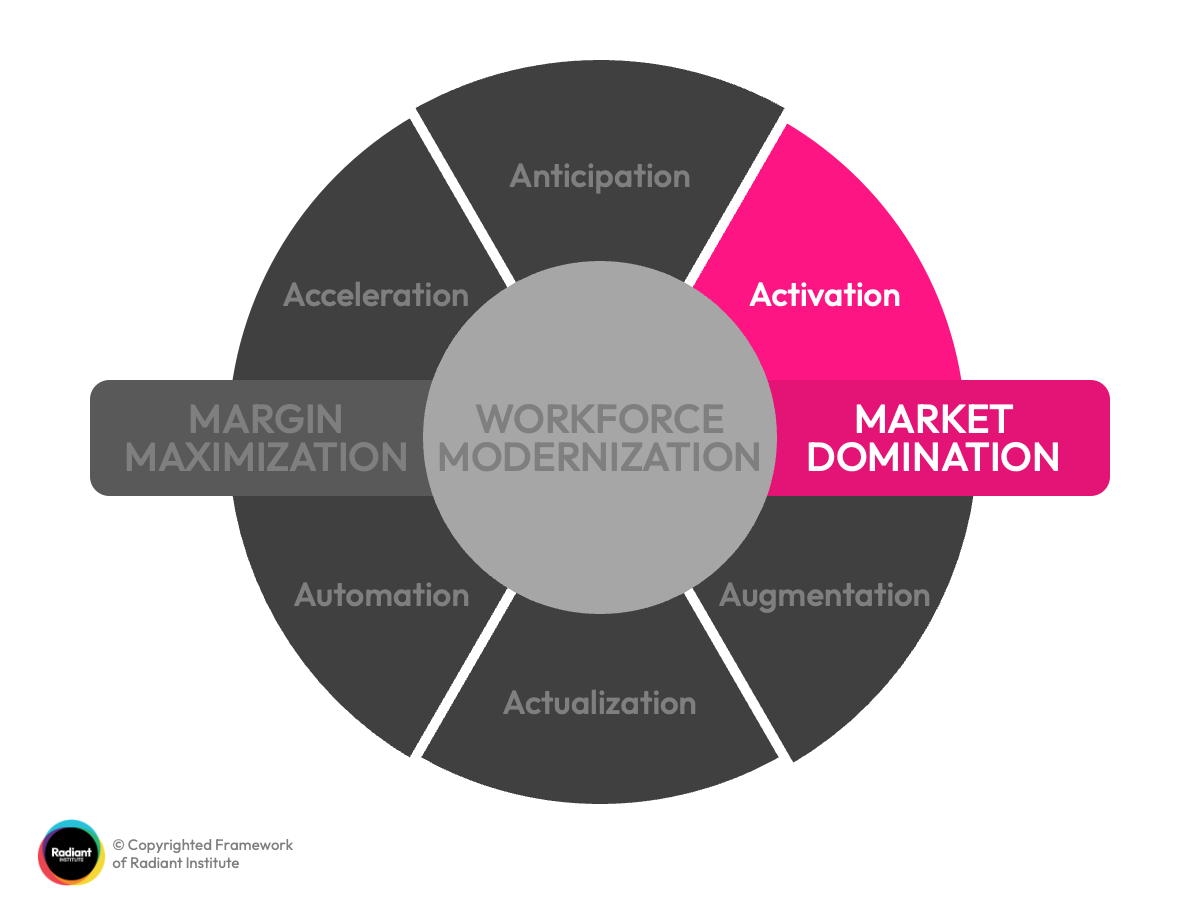
KEYWORD: Opportunity
AI surfaces untapped markets, unserved segments, and new revenue streams that traditional analysis would miss. The human evaluates opportunities and decides which bets to place.
What this looks like in the workplace:
- A product team uses AI to analyse customer support tickets, reviews, and usage data — and discovers a feature gap that no one on the roadmap had identified. A new product line is born from existing data.
- A regional business uses AI-powered market intelligence to identify demand patterns in neighbouring markets they had never considered entering. The data gives them the confidence to expand.
- An L&D team analyses internal survey data with AI and uncovers three distinct employee personas with very different AI readiness levels — leading to segmented training instead of a one-size-fits-all programme.
Human Role: Strategist
The human evaluates what AI surfaces and decides which opportunities are worth pursuing. AI expands the field of vision by scanning data at scale and detecting patterns invisible to traditional analysis. The value of this role is in strategic judgment and risk appetite — AI shows what is possible, but the human decides what is worth doing.
In a nutshell: AI expands the field. You choose the direction.
AI ADVANTAGE #5
ANTICIPATION
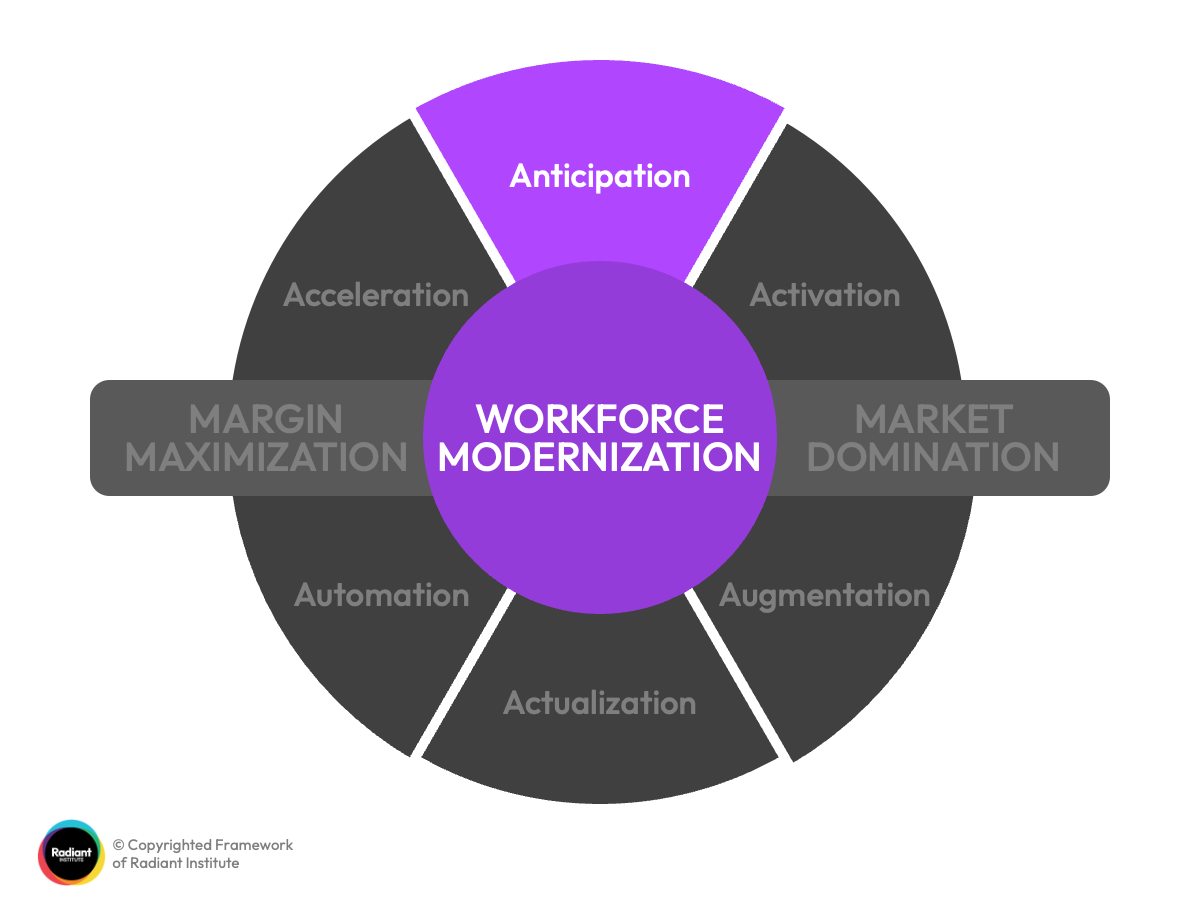
KEYWORD: Foresight
AI detects weak signals, models scenarios, and forecasts risks before they materialise. The human interprets, weighs trade-offs, and decides how to respond.
What this looks like in the workplace:
- A supply chain team uses AI to forecast demand spikes based on seasonal patterns, weather data, and social media trends — adjusting procurement weeks before a shortage would have hit.
- A compliance department uses AI to monitor regulatory changes across multiple jurisdictions in real time, flagging upcoming requirements before they become enforcement risks.
- An operations manager uses AI-driven predictive maintenance to identify equipment likely to fail in the next 30 days — scheduling repairs during planned downtime instead of reacting to breakdowns.
Human Role: Navigator
The human interprets the signals AI surfaces and charts the course forward. AI forecasts scenarios, detects risks, and models outcomes — but the human decides how to respond and what to prioritise. The value of this role is in contextual judgment and adaptive leadership — AI provides the radar, but the human steers the ship.
In a nutshell: AI provides the radar. You steer the ship.
AI ADVANTAGE #6
ACTUALIZATION
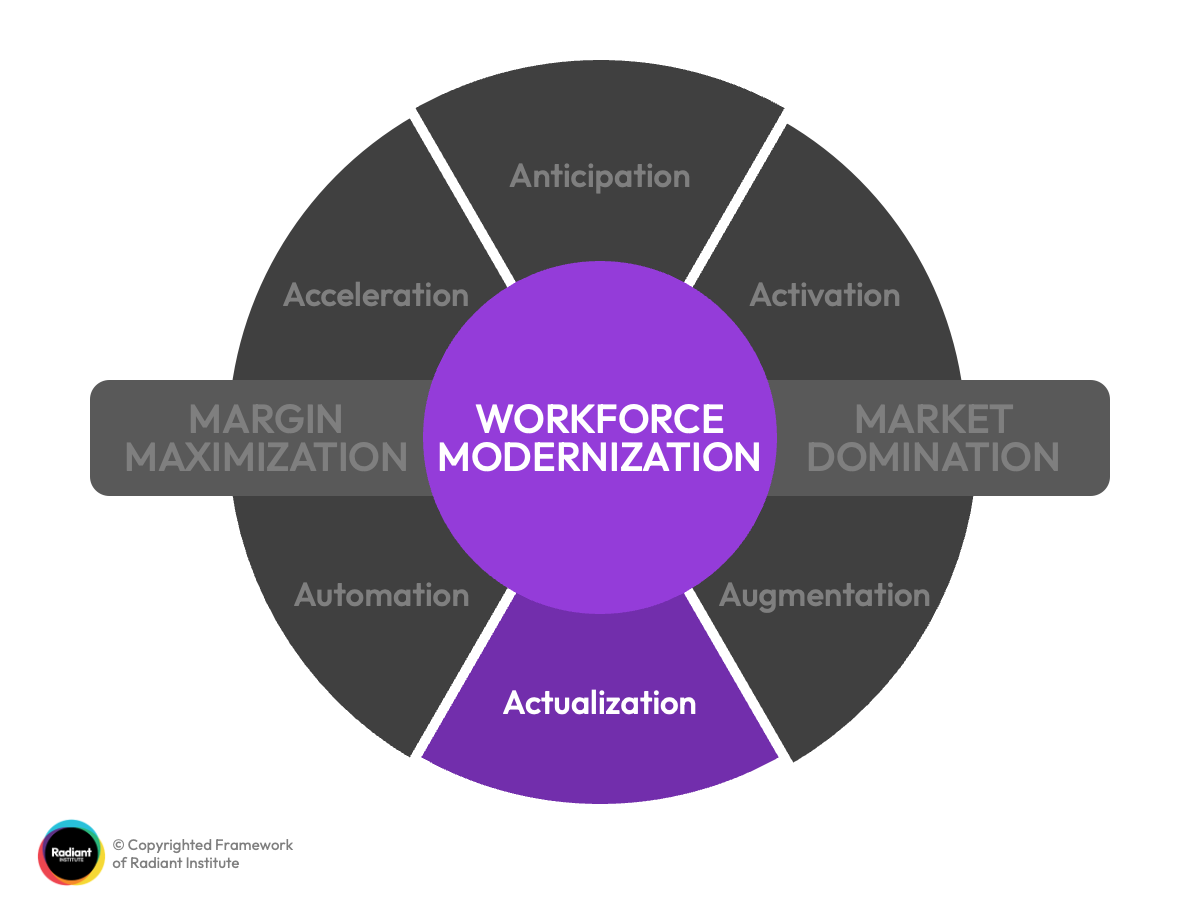
KEYWORD: Renaissance
AI reshapes how people think about and engage with their work. Roles evolve, mindsets shift, and the organisation’s relationship with technology fundamentally changes.
What this looks like in the workplace:
- A company introduces “AI innovation time” where employees experiment with AI tools to solve problems in their own workflows. Within three months, teams are sharing solutions across departments — and the culture shifts from fear of AI to ownership of AI.
- A customer service team evolves from scripted phone agents to AI-augmented advisors. Their role changes from reading scripts to interpreting AI-surfaced insights and having more meaningful client conversations.
- A leadership team embeds AI literacy into their management development programme, so every new manager understands how to evaluate AI opportunities, define Human Roles, and champion adoption within their teams.
Human Role: Champion
The human leads the cultural shift — modelling new behaviours, inspiring adoption, and connecting AI capabilities to purpose. AI enables new ways of working, but the human drives the mindset change and ensures transformation is meaningful, not mechanical. The value of this role is in leadership, empathy, and vision — AI is the catalyst, but the human is the movement.
In a nutshell: AI is the catalyst. You lead the movement.
Common Misconceptions this Framework Clears Up
“AI replaces people.”
Every Advantage includes a defined Human Role. AI shifts the nature of work, not its existence.
“We need to implement all six at once.”
They are entry points, not a checklist. Start with one. Momentum builds the rest.
“AI strategy means picking the right tool.”
The framework classifies *how AI contributes*, not which vendor you use.
“Fast output means good output.”
Acceleration compresses time. Augmentation raises quality. They are not the same.
“AI adoption is a one-off project.”
The Flywheel Effect means AI value compounds. This is a system, not a project.
AI Adoption vs. AI Enablement
Enablement is what makes adoption safe, consistent, and scalable.
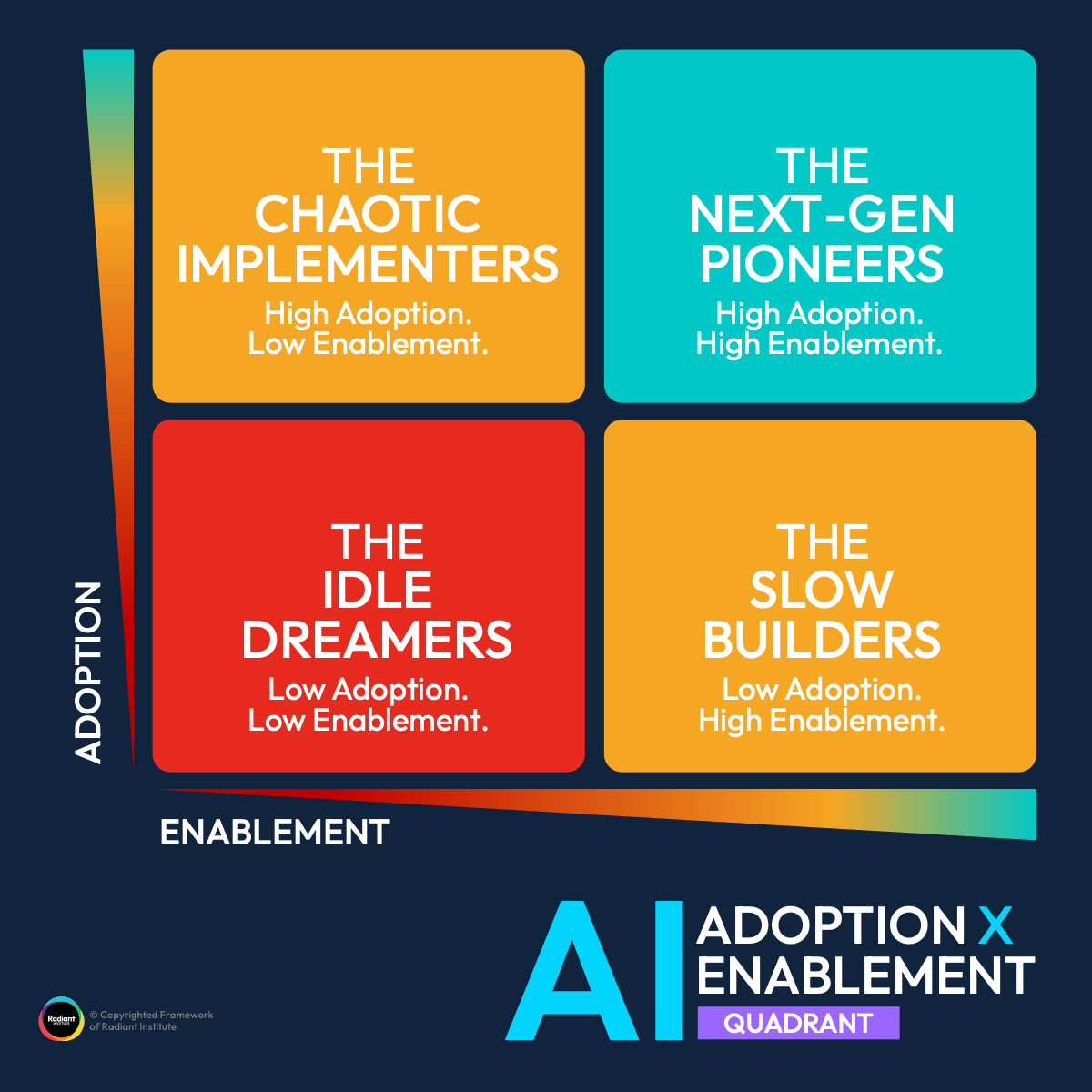
One of the most common confusions in the AI conversation — and one of the most consequential.
AI Adoption means using AI tools without deep workflow integration.
AI Enablement means embedding AI across the organisation to drive systemic, compounding improvement.
The AI Advantage Framework is an enablement tool. It does not ask “Are you using AI?” but “How is AI contributing, and is that contribution compounding?”
Organisations that stop at adoption get scattered experiments. Organisations that pursue enablement build a connected AI strategy framework that grows stronger over time.
The AI Flywheel Effect
How progress in one Advantage creates momentum for the next.
As AI strengthens different facets of a business, the momentum feeds back into the system:
- Automation frees capacity
Leaner processes create bandwidth to redeploy. - Acceleration compresses execution
Freed capacity turns into faster delivery. - Augmentation raises the bar
Speed does not come at the cost of quality. - Activation expands the field
High-quality outputs at speed reveal new opportunities. - Anticipation reduces risk
New opportunities are pursued with informed confidence. - Actualization transforms the culture
AI becomes embedded, roles evolve, and the cycle renews.
The flywheel has no fixed starting point. Enter where your biggest constraint is. What matters is not where you start. It is that you start deliberately.
Three Strategic Outcomes of the AI Flywheel
When the six AI Advantages compound through the flywheel, they produce three macro-level business results.
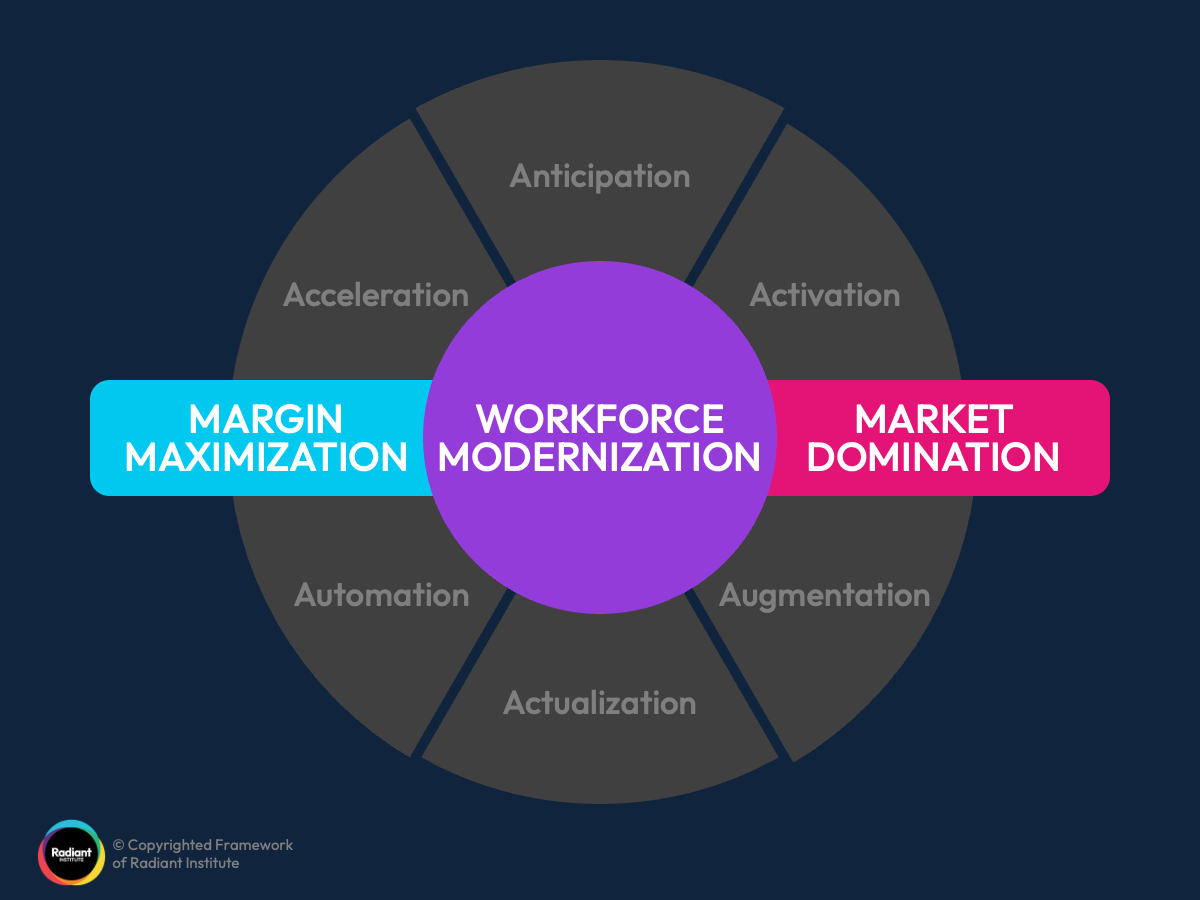
The flywheel does not just make the organisation more efficient.
When AI enablement is working, six Advantages compounding together produce three strategic outcomes that reshape the business at a structural level.
These are not additional framework components. They are the results that emerge when AI contributions connect and reinforce one another.
How the Three Outcomes Connect
The three strategic outcomes reinforce one another through the flywheel:
- Workforce Modernisation reates the human capability needed to pursue margin gains and market growth. Teams that understand their evolving Human Roles adopt AI more deeply across all Advantages.
- Margin Maximisation funds and sustains the investment in workforce development and market expansion. Efficiency gains create the bandwidth and resources for growth.
- Market Domination validates the investment in both workforce and margins. New revenue streams and stronger positioning justify continued AI enablement.
When all three outcomes are active, the organisation operates in a self-reinforcing cycle: a modernised workforce drives better margins, better margins fund market expansion, and market success attracts the talent and investment that further modernises the workforce.
Margin Maximisation
Primary drivers: Automation (Optimisation), supported by Acceleration (Velocity) and Anticipation (Foresight).
Margin Maximisation is the cumulative financial impact of AI-driven efficiency, speed, and risk reduction. Automation delivers leaner operations and lower costs. Acceleration compounds this by enabling higher throughput per person and increased revenue velocity. Anticipation protects margins by reducing operational uncertainty and catching risks before they become costly.
The flywheel effect means these gains are not isolated. Capacity freed by Automation feeds into faster delivery via Acceleration, which generates more revenue per cycle. Anticipation ensures that growth does not introduce unmanaged risk. The result is structurally improved margins, not a one-time cost cut, but a compounding efficiency engine.
Workforce Modernisation
Primary drivers: Actualization (Renaissance), supported by Augmentation (Elevation) and Acceleration (Velocity).
Workforce Modernisation is the shift from a traditional workforce to one that operates differently because of AI. Roles evolve as AI absorbs routine elements. Employees gain access to capabilities previously reserved for specialists. Mindsets shift from fear of AI to ownership of AI. The organisation future-proofs its workforce skills and builds a culture where human-AI collaboration is the norm, not the exception.
This is not about replacing people. Every AI Advantage includes a Human Role (Overseer, Director, Creator, Strategist, Navigator, Champion) precisely because the human remains central. The modernisation is in the nature of the work, not the existence of the worker.
Market Domination
Primary drivers: Activation (Opportunity), supported by Anticipation (Foresight) and Augmentation (Elevation).
Market Domination is the strategic outcome of AI-powered opportunity discovery, risk-informed expansion, and consistently higher-quality market-facing outputs. Activation identifies new customer segments, fuels product innovation, and enables data-driven market entry. Anticipation gives the organisation foresight to pursue new opportunities with informed confidence. Augmentation ensures that every customer-facing deliverable meets a higher standard, strengthening brand perception and competitive positioning.
Organisations that execute faster, at higher quality, with broader market visibility, and with informed confidence create a compounding competitive advantage. They do not just enter markets. They shape them.
4 Ways to Use This Framework In Your Organization
Strategic starting points for leaders, enablers, and teams.

RECOMENDATION 1
Classify Your Current AI Initiatives
Where are we already using AI, and how is it actually contributing?
Map your current AI projects against the six Advantages. You will likely find clusters (heavy on Automation, light on Activation) that reveal blind spots.
This exercise creates shared language across departments and prevents the trap of assuming “we’re doing AI” when the organisation is only doing one type.
RECOMMENDATION 2
Identify Your Entry Point
How do we decide where to start or what to prioritise next?
Ask: What is our biggest constraint right now?
Drowning in manual work → Automation.
Running lean but cannot see where to grow → Activation.
Producing too slowly → Acceleration.
Fast but mediocre → Augmentation.
Pick the Advantage that removes the biggest bottleneck. Momentum builds from there.

RECOMMENDATION 3
Define the Human Role in Every AI Initiative
How do we ensure AI enhances our people rather than sidelining them?
When launching any AI initiative, name the Human Role explicitly. It gives employees a clear identity in the new workflow (reducing fear), and gives leaders a governance lens to keep human judgment in the loop.
The question is never “Will AI replace this person?” — it is “What is this person’s new role alongside AI?”
RECOMMENDATION 4
Measure Compounding ROI Across Advantages
How do we prove AI value beyond isolated efficiency metrics?
Track not just improvements within a single Advantage, but how gains in one area unlock progress in others.
For example: Automation frees 20% of a team’s time → faster project delivery (Acceleration) → higher-quality proposals (Augmentation) → a new market segment opens (Activation).
That compounding story is far more compelling than isolated metrics.
Want to see this framework in action?
We use the AI Advantage Framework to help organisations build shared language and workflow-level AI capability that sticks.
AI enablement is not about tools or hype. It is about embedding AI into how your people think, decide, and deliver.
Frequently Asked Questions
Common questions about the AI Advantage Framework, AI enablement, and how organisations build a practical AI strategy framework.
What is the AI Advantage Framework?
An AI enablement framework by Radiant Institute that classifies six ways AI creates business value. It gives organisations shared language for AI strategy and a practical structure for prioritisation.
What is the difference between AI adoption and AI enablement?
Adoption means using AI tools without deep workflow integration. Enablement means embedding AI across the organisation for systemic, compounding improvement.
Do we need to implement all six AI Advantages at once?
No. They are entry points, not a checklist. Start with one. The flywheel effect creates momentum for the others.
What is human AI collaboration in this framework?
Every Advantage includes a defined Human Role (Overseer, Director, Creator, Strategist, Navigator, Champion). AI enhances what humans do. The human’s role shifts depending on how AI is contributing.
How do we decide where to start with AI?
Identify your biggest constraint. Buried in manual work → Automation. Quality inconsistent → Augmentation. Executing well but cannot grow → Activation.
Can a single project involve multiple AI Advantages?
Yes. A single outcome often engages several Advantages. The differentiator is always: what does the human already have, and what is AI doing to it?
What is the AI Flywheel Effect?
Progress in one Advantage creates momentum for the next. Each reinforces the others, creating compounding AI value over time.
How do we measure AI ROI using this framework?
Track improvements within each Advantage and across Advantages. Compounding ROI — where gains in one area unlock progress in others — is the strongest indicator of success.