

Thirty-six percent of companies say AI has already improved their competitive differentiation.
Not efficiency.
Not experimentation.
Differentiation.
That data point comes from McKinsey & Company’s State of AI 2025 report, and it is worth sitting with for a moment.
Most AI conversations still orbit productivity. Faster emails. Quicker research. Fewer manual steps. Useful gains, yes, but largely internal and incremental.
This stat points to something else entirely.
AI is quietly shifting from an internal productivity tool into a market-facing strategy.
Adoption Is Common. Advantage Is Not.
According to the same report, 88 percent of organizations now use AI in at least one business function. AI adoption is no longer rare. It is becoming baseline.
What separates companies is not whether they use AI. It is how they intend to use it.
Organizations reporting the strongest returns from AI are not just reducing costs. They are deliberately using AI to drive growth and innovation. These organizations are also more likely to report stronger customer satisfaction, clearer positioning, and visible competitive differentiation.
The difference is not technology. It is expectation.
When leaders frame AI purely as a way to save time or improve efficiency, the upside is capped. The organisation gets faster, but not meaningfully different.
When AI is framed as a way to rethink how value is created, delivered, and experienced, it begins to shape how the market perceives the organisation.
That is where differentiation starts.
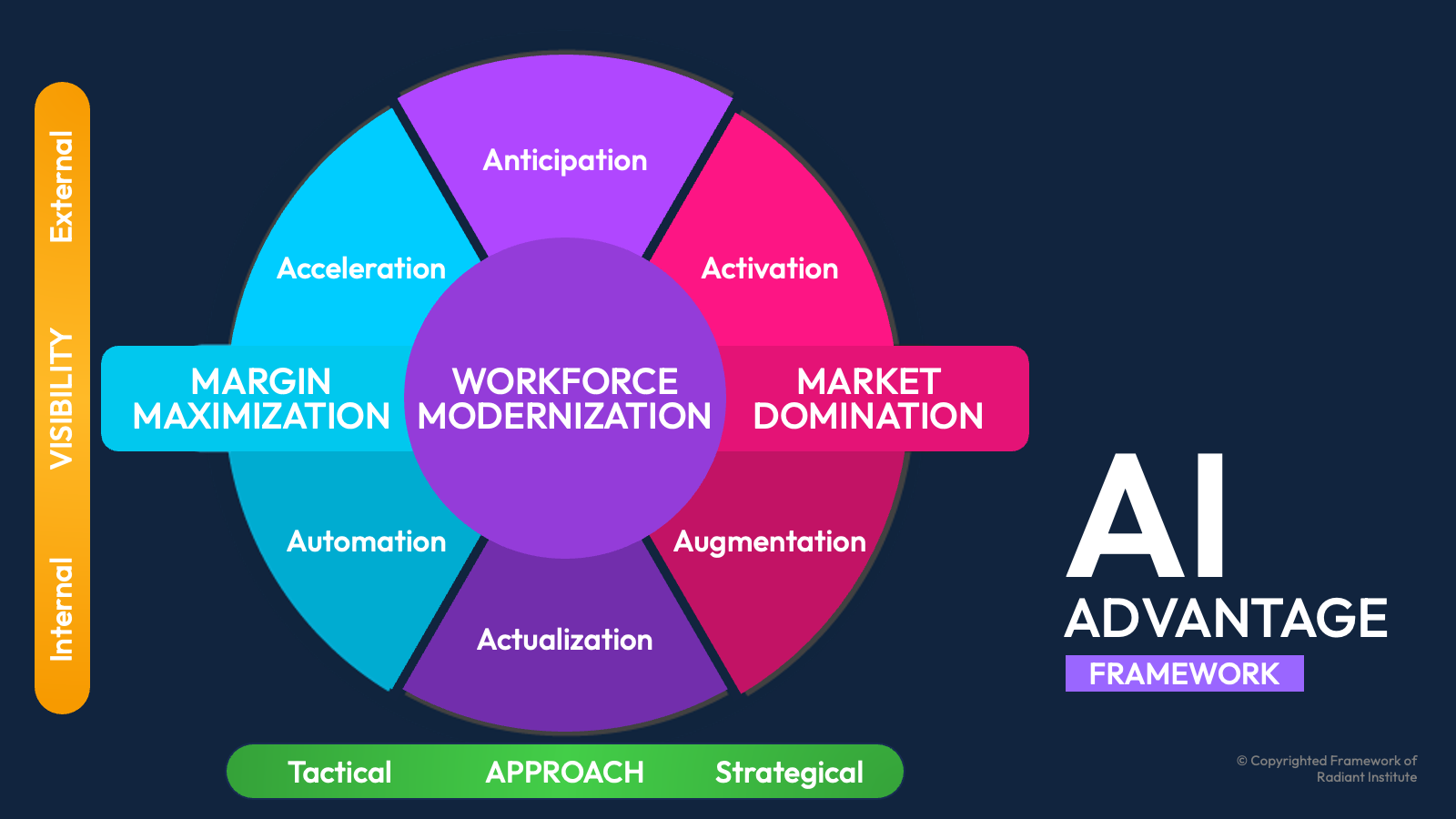
The AI Advantage Framework Lens
This distinction shows up clearly inside Radiant Institute’s AI Advantage Framework.
On one side sit Automation and Acceleration. This is where most AI initiatives begin. Automating repetitive work. Speeding up existing processes. Improving throughput. These are tactical wins, often necessary, and usually quick to demonstrate.
But their impact is typically incremental. They optimise what already exists.
On the other side sit Augmentation and Activation.
Augmentation is where AI enhances human judgment, decision-making, and sense-making. Activation is where those enhanced capabilities shape offerings, customer experience, and how value shows up externally.
This is where AI stops being an internal efficiency lever and starts influencing positioning, trust, and relevance in the market.
Not coincidentally, this is exactly the shift McKinsey’s data appears to be pointing toward.
Why Differentiation Takes Time
Augmentation and activation advantages do not appear overnight. They require changes in how leaders think about work, capability, and value creation.
That is why we treat them as strategic, not tactical.
Automation projects can be scoped, deployed, and measured quickly. Differentiation emerges from sustained intent, reinforced over time through decisions, talent development, and operating models.
When you look at companies pulling ahead, a pattern emerges.
Speed still matters. But direction matters more.
Intent Is the Real Multiplier
The good news is that most organisations are still early in this journey.
Differentiation today is not about being first, nor about having the most advanced tools. Many competitors are using the same platforms, models, and vendors.
The advantage comes from being intentional.
Leaders who are clear about what they want AI to change in how customers experience their business will compound value over time. Leaders who focus only on efficiency gains will plateau quickly, even if they deploy AI everywhere.
The real question is no longer, “Are we using AI?”
It is, “What do we want to be known for because of it?”
Implications for Leaders and L&D
- AI strategy should be tied to positioning, not just productivity metrics
- Capability building must include judgment, decision quality, and human-AI collaboration
- L&D plays a central role in moving AI from tools to organisational muscle
Try This This Week
- Review one AI initiative and ask what customer-facing outcome it ultimately supports
- Map current AI use cases across Automation, Acceleration, Augmentation, and Activation
- Redefine success for one AI project beyond time saved or cost reduced
AI does not differentiate organisations on its own. Leadership intent does.
At Radiant Institute, this is why our programs focus on helping leaders and teams clarify what AI is meant to change in how value is created and experienced, not just how fast work gets done. A short diagnostic or capability scorecard is often enough to reveal where intent is clear and where it is still fuzzy.

Maverick Foo
Lead Consultant, AI-Enabler, Sales & Marketing Strategist
![[Template] Multi Section Blog Post](https://radiant.institute/wp-content/uploads/2026/01/ai-workflow-continuity-400x250.jpg)
[Template] Multi Section Blog Post
Build an AI workflow that stays reliable as tools change. Learn why continuity matters for multi-step work and what leaders can do.
AI Workflow Continuity: The Skill Teams Need for Multi-Step Work
Build an AI workflow that stays reliable as tools change. Learn why continuity matters for multi-step work and what leaders can do.

AI Leadership Strategy Determines Whether AI Helps or Harms
Understand why AI leadership now determines whether AI helps or harms at work, and what leaders and L&D can do to guide responsible AI use.
REACH OUT TO US
Fill up your details below, and we will get back to you A.S.A.P.!
0 Comments